
Commonly used reducing agent - Burgess reagent
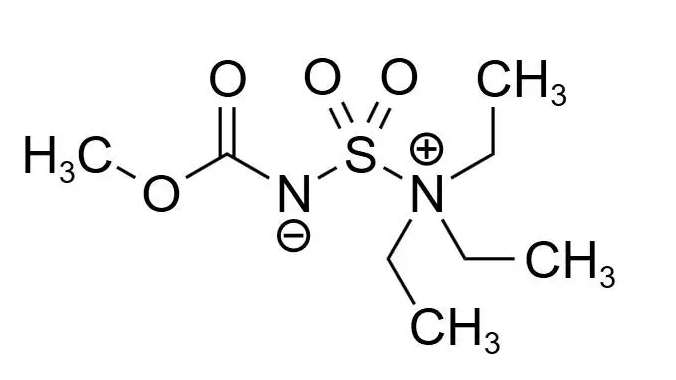
[English name] Methyl N- (triethylammoniumsulfonyl) -carbamate
【分子式】 C₈H₁₈N₂O₄S
[Molecular weight] 238.31
[CAS number] 29684-56-8
[Abbreviation and alias] Burgess reagent
[Physical properties] Yellow-white crystal, mp 76~ 79 ℃.
[Preparation and commodity] Major reagent companies have sales. It is best to prepare isocyanate sulfonyl chloride and triethylamine in methanol in situ before use.
[Precautions] Burgess reagent is easily oxidized and is also very sensitive to moisture. It should be used immediately after in situ preparation.
Burgess reagent is a highly effective dehydrogenation reagent, which can be used to prepare isocyanide, nitrile and nitrile oxide compounds from formamide and nitroalkane compounds. In recent years, the biggest use of this reagent is to realize the cyclic dehydrogenation of hydroxyamides and sulfamides to obtain corresponding heterocyclic compounds.
In thiazoline, the chiral centers attached to C2 are prone to differential isomerization, so that most cyclization dehydrogenation reactions of hydroxysulfamides produce diastereomeric mixtures. However, under the induction of this reagent, hydroxysulfamides can obtain chiral monomers with 96% yield and more than 94% enantioselectivity.

The reagent was obtained by linking the reagent with polyethylene glycol 2Reagent 2 It can induce the preparation of 1,3-azoline and thiazoline compounds in higher yields.

In reagents 2 Under the induction, hydroxysulfamide can be converted to thiazide with high yield, and this method can obtain a higher yield than the Mitusnobu reaction.