

Pimodivir (VX-787) is an orally bioavailable inhibitor of influenza A virus polymerases through interaction with the viral PB2 subunit. In Vitro Pimodivir rescues macrophages from virus-mediated death at non-cytotoxic concentrations 24 hpi. The EC 50 value for Pimodivir are 8 and 12 nM for A(H1N1) and A(H3N2) strains, respectively, whereas the CC 50 values are >1 μM, giving selectivity indexes (SI) > 125 and > 83 for A(H1N1) and A(H3N2) strains, respectively. Pimodivir significantly attenuates the transcription of viral M1 RNA in macrophages, which are infected with A(H1N1) or A(H3N2) strains for 8 h. Pimodivir inhibits the transcription of viral but not cellular genes. Pimodivir allows some activation of IAV-mediated expression of several cellular genes, which are involved in tryptophan and nucleotide metabolism. Pimodivir possesses excellent anti-IAV but not immuno/metabolo-modulating effect. Pimodivir (VX-787) is very potent against influenza A strains, including pandemic 2009 H1N1 and avian H5N1. Pimodivir (VX-787) shows potent activity against all influenza A virus strains tested, with an EC 50 range of 0.13 to 3.2 nM. Pimodivir-selected PB2 variant viruses maintain susceptibility to neuraminidase inhibitors in vitro . MCE has not independently confirmed the accuracy of these methods. They are for reference only. In Vivo Pimodivir (2, 6, and 20 mg/kg/day, p.o.) and GS 4071 (20 mg/kg/day) completely prevent death in the H1N1pdm virus infection in mice. Pimodivir (20 mg/kg/day) is more effective than GS 4071 (20 mg/kg/day) in improving body weight and reducing the severity of lung infection . Moreover, Pimodivir (VX-787) shows 100% survival in a +48 h delay to treatment mouse influenza model at 10, 3 and 1 mpk (BID × 10 days) whereas the SOC, GS 4071, provide no survival benefit in this model at 10 mpk. Pimodivir (VX-787; 1, 3, or 10 mg/kg, bid) provided complete survival, with a dose-dependent reduction in BW loss of the mice. MCE has not independently confirmed the accuracy of these methods. They are for reference only. Cell Assay The compound cytotoxicity and efficacy testing is performed in 96-well plates with macrophages at 95% confluence. The compounds are added to the medium, and 30 min later, the cells are infected with virus or non-infected. The cell viability is analyzed with the Cell Titer Glo assay at 24 hpi. The luminescence is read with a PHERAstar FS plate reader. MCE has not independently confirmed the accuracy of these methods. They are for reference only. Form:Solid
All
Chemical Reagents
Biomedicine
Organic raw materials
Inorganic chemical industry
intermediate
Agricultural chemicals
Auxiliaries and catalysts
Fragrances and Flavors
Dyes and Pigments
Daily chemical industry
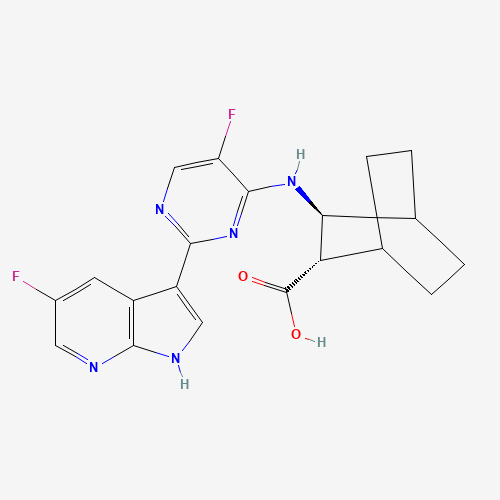
Pimodivir
CAS number:1629869-44-8 molecular formula:C20H19F2N5O2
overview
compound introduction
Specs
| Chinese alias | 匹莫迪韦 | ||
| English alias | D11287 | N,N-DIMETHYL-PERYLENE-TETRACARBONICACID-DIAMIDE | SCHEMBL20150447 | AT13207 | 4p1u | DFC121MXC3 | EN300-365064 | JNJ-63623872-ZCD | MS-26767 | Pimodivir(VX-787 | Disodium 7-anilino-3-((4-((2,4-dimethyl-6-sulphonatophenyl)azo)-6-methoxy-m-tolyl)az | ||
| CAS number | 1629869-44-8 | molecular formula | C20H19F2N5O2 |
| molecular weight | 399.39 g/mol | Exact mass | ≥99% |
| PSA | 104.000 Ų | logp | 3.8 |
numbering system
No numbering system information yet
physicochemical properties
No physical and chemical property information yet
Safety information
No safety information yet
Production methods and uses
No production method and use information yet
Related
upstream information
No upstream information yet
downstream information
No downstream information yet
MSDS
Found 0 shareMSDS




