
Asciminib (ABL001) hydrochloride is a potent and selective allosteric BCR-ABL1 inhibitor, which inhibits Ba/F3 cells grown with an IC 50 of 0.25 nM. In Vitro Asciminib (ABL001) hydrochloride binds to the myristoyl pocket of ABL1 and induces the formation of an inactive kinase conformation. Asciminib hydrochloride binds potently (dissociation constant=0.5-0.8 nM) and selectively to the myristoyl pocket of ABL1 and induces the inactive C-terminal helix conformation. Asciminib hydrochloride exhibits the same non-ATP-competitive biochemical kinetics as the BCR–ABL inhibitor GNF-2 but with approximately 100-fold greater potency. Asciminib hydrochloride lacks activity against more than 60 kinases, including SRC, and is similarly inactive against G-protein-coupled receptors, ion channels, nuclear receptors and transporters. In BCR–ABL1-transformed Ba/F3 cells grown without IL-3, Asciminib hydrochloride has an anti-proliferative with IC 50 value of 0.25 nM. In the CML blast-phase cell line KCL-22, Asciminib hydrochloride inhibits phosphorylation of both STAT5 (Tyr694; pSTAT5) and BCR–ABL1 (Tyr245; pBCR–ABL1) after 1 h using concentrations that correlate with those required for inhibition of cell proliferation. Asciminib hydrochloride is selectively active against all BCR–ABL1 lines (IC 50 value of 1–20 nM), irrespective of the presence of either the p210 or the p190 BCR–ABL1 isoform. MCE has not independently confirmed the accuracy of these methods. They are for reference only. In Vivo Single doses of 7.5, 15 and 30 mg/kg Asciminib, administered to mice bearing KCL- 22 xenografts, inhibits pSTAT5 (Tyr694), which return to baseline at 10, 12 and 16-20 h after administration of the dose, respectively. In mice implanted with KCL-22 tumors, the minimum dose of Asciminib required for complete regression is 7.5 mg/kg twice a day (BID) or 30 mg/kg once a day (QD), and is tolerated at doses up to 250 mg/kg BID . MCE has not independently confirmed the accuracy of these methods. They are for reference only. Form:Solid
All
Chemical Reagents
Biomedicine
Organic raw materials
Inorganic chemical industry
intermediate
Agricultural chemicals
Auxiliaries and catalysts
Fragrances and Flavors
Dyes and Pigments
Daily chemical industry
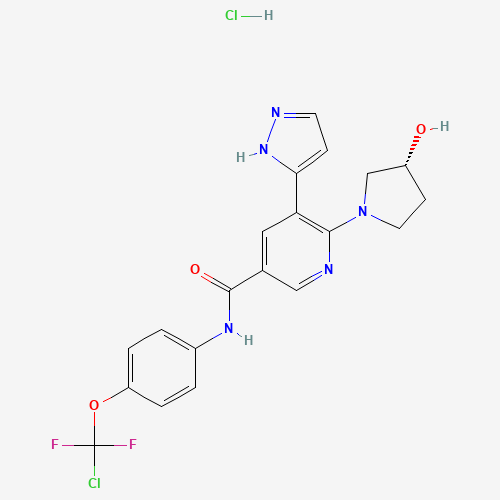
Asciminib hydrochloride
CAS number:2119669-71-3 molecular formula:C20H19Cl2F2N5O3
overview
compound introduction
Specs
| Chinese alias | 盐酸阿昔米尼 | ||
| English alias | Asciminib hydrochloride | ASCIMINIB HYDROCHLORIDE [JAN] | 2119669-71-3 | UNII-C5U34S9XFV | ASCIMINIB HYDROCHLORIDE [ORANGE BOOK] | SCHEMBL22656445 | ABL001-AAA | ASCIMINIB HYDROCHLORIDE [WHO-DD] | 3-Pyridinecarboxamide, N-(4-(chlorodifluoromethoxy)phenyl) | ||
| CAS number | 2119669-71-3 | molecular formula | C20H19Cl2F2N5O3 |
| molecular weight | 486.30 g/mol | Exact mass | ≥99% |
| PSA | - | logp | - |
numbering system
No numbering system information yet
physicochemical properties
No physical and chemical property information yet
Safety information
No safety information yet
Production methods and uses
No production method and use information yet
Related
upstream information
No upstream information yet
downstream information
No downstream information yet
MSDS
Found 0 shareMSDS