

PLX647 is an orally active, highly specific dual FMS and KIT kinase inhibitor, with IC 50 s of 28 and 16 nM, respectively. PLX647 shows selectivity for FMS and KIT over a panel of 400 kinases at a concentration of 1 μM except FLT3 and KDR (IC 50 s=91 and 130 nM, respectively). In Vitro In vitro, PLX647 potently inhibits proliferation of BCR-FMS cells, with an IC 50 of 92 nM. A corresponding Ba/F3 cell line expressing BCR-KIT is also quite sensitive to PLX647, with an IC 50 of 180 nM. PLX647 also inhibits endogenous FMS and KIT, as demonstrated by inhibition of the ligand-dependent cell lines M-NFS-60 (IC 50 =380 nM) and M-07e (IC 50 =230 nM), which express FMS and KIT, respectively. PLX647 potently inhibits the growth of FLT3–ITD-expressing MV4-11 cells (IC 50 =110 nM). PLX647 displayed minimal inhibition of the proliferation of Ba/F3 cells expressing BCR–KDR (IC 50 =5 μM). PLX647 inhibits osteoclast differentiation with an IC 50 of 0.17 μM. MCE has not independently confirmed the accuracy of these methods. They are for reference only. In Vivo PLX647 (40 mg/kg; p.o.; twice daily for 7 days) reduces macrophage accumulation in UUO kidney and blood monocytes . PLX647 (40 mg/kg; p.o.; male Swiss Webster mice) reduces LPS-induced TNF-α and IL-6 release . PLX647 (20-80 mg/kg; p.o.; daily or twice daily from 27-41 days) shows effects on collagen-induced arthritis . PLX647 (30 mg/kg) results in significant inhibition of TRAP5b immunostaining and bone osteolysis. PLX647 (30 mg/kg BID) is able to prevent bone damage by the tumor cells . MCE has not independently confirmed the accuracy of these methods. They are for reference only. Animal Model: Male C57BL/6 mice (mouse unilateral ureter obstruction model) Dosage: 40 mg/kg Administration: P.o.; twice daily for 7 days Result: Resulted in reduction in the levels of F4/80+ macrophages by 77%. Animal Model: 7-9 wk old Male DBA/1J mice (Mouse collagen-induced arthritis model) Dosage: 20 mg/kg, 80 mg/kg Administration: P.o.; daily (20 mg/kg) from 27-41 days, twice daily (80 mg/kg) from 27-41 days Result: 20 mg/kg PLX647 had no initial effect on the development of severe arthritis. However, starting on day 33, no further development of disease severity was recorded, and a 30% inhibition of the macroscopic signs of arthritis was evident in clinical score on day 41. Mice treated with 80 mg/kg BID PLX647 initially shows delayed development of severe arthritic signs. Starting on day 33, the signs of arthritis began to decrease in this treatment group, reaching a maximum reversal of 76% on day 41. Form:Solid
All
Chemical Reagents
Biomedicine
Organic raw materials
Inorganic chemical industry
intermediate
Agricultural chemicals
Auxiliaries and catalysts
Fragrances and Flavors
Dyes and Pigments
Daily chemical industry
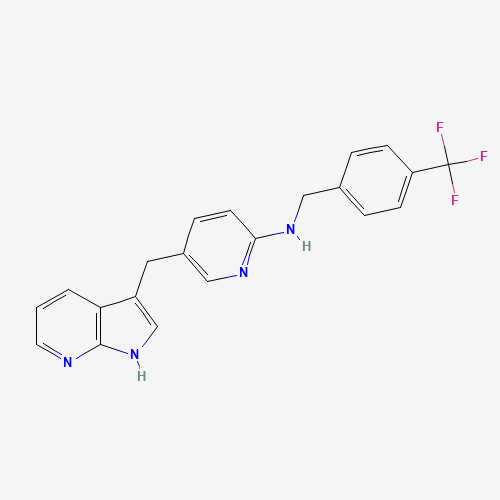
PLX647
CAS number:873786-09-5 molecular formula:C21H17F3N4
overview
compound introduction
Specs
| Chinese alias | - | ||
| English alias | PLX647 | PLX-647 | 4hvs | AC-35285 | 5-((1H-Pyrrolo[2,3-b]pyridin-3-yl)methyl)-N-(4-(trifluoromethyl)benzyl)pyridin-2-amine | 5-(1H-pyrrolo[2,3-b]pyridin-3-ylmethyl)-N-[[4-(trifluoromethyl)phenyl]methyl]pyridin-2-amine | Q27456207 | AKOS026750267 | A85702 | ||
| CAS number | 873786-09-5 | molecular formula | C21H17F3N4 |
| molecular weight | 382.38 g/mol | Exact mass | ≥99% |
| PSA | 53.600 Ų | logp | 4.9 |
numbering system
No numbering system information yet
physicochemical properties
No physical and chemical property information yet
Safety information
No safety information yet
Production methods and uses
No production method and use information yet
Related
upstream information
No upstream information yet
downstream information
No downstream information yet
MSDS
Found 0 shareMSDS




