

Tenovin-6 Hydrochloride, an analog of Tenovin-1 , is an activator of p53 transcriptional activity. Tenovin-6 Hydrochloride inhibits the protein deacetylase activities of purified human SIRT1 , SIRT2 , and SIRT3 with IC 50 s of 21 μM, 10 μM, and 67 μM, respectively. Tenovin-6 Hydrochloride also inhibits dihydroorotate dehydrogenase (DHODH) In Vitro Tenovin-6 Hydrochloride inhibits the growth of S. cerevisiae cultures with an IC50 of 30 μM and is more toxic to yeast than the less water-soluble tenovin-1. Tenovin-6 Hydrochloride rapidly increases the levels of endogenous K382-Ac p53 in MCF-7 cells. Tenovin-6 Hydrochloride (0 to 15 μM) dose dependently increases the level of LC3-II in diverse cell types, and the increase is ATG5/7 dependent. Tenovin-6 Hydrochloride treatment also increases the number and intensity of autophagic vesicles with or without the presence of Torin 1, and prevents Torin 1-induced SQSTM1/p62 degradation. Tenovin-6 Hydrochloride affects the acidification of autolysosomes and impairs the hydrolytic activity of lysosomes but does not affect the fusion between autophagosomes and lysosomes. That Tenovin-6 Hydrochloride inhibits autophagy does not correlate with p53 activation and SIRT1/2 inhibition by knockdown or knockout cannot mimic the effect of Tenovin-6 Hydrochloride on LC3B accumulation. Tenovin-6 Hydrochloride (0, 1, 2.5, 5 or 10 μM) potently inhibits cell proliferation in a dose- and time-dependent manner in all OCI-Ly1, DHL-10, U2932, RIVA, HBL1 and OCI-Ly10 cell lines. Tenovin-6 Hydrochloride consistently increases LC3B-II level in DLBCL cell lines by inhibiting the classical autophagy pathway, without activating p53, and the increase is independent of SIRT1/2/3 and p53. Tenovin-6 Hydrochloride induces apoptosis through the extrinsic cell-death pathway [4 . Tenovin-6 Hydrochloride suppresses the growth of UM cells with IC50 of 12.8 μM, 11.0 μM, 14.58 μM and 9.62 μM for 92.1, Mel 270, Omm 1 and Omm 2.3 cells, respectively . MCE has not independently confirmed the accuracy of these methods. They are for reference only. In Vivo Tenovin-6 Hydrochloride (50 mg/kg, i.p.) inhibits the growth of tumor in mice . MCE has not independently confirmed the accuracy of these methods. They are for reference only. Form:Solid IC50& Target:SIRT2 10 μM (IC 50 ) SIRT1 21 μM (IC 50 ) SIRT3 67 μM (IC 50 ) HDAC8 MDM-2/p53
All
Chemical Reagents
Biomedicine
Organic raw materials
Inorganic chemical industry
intermediate
Agricultural chemicals
Auxiliaries and catalysts
Fragrances and Flavors
Dyes and Pigments
Daily chemical industry
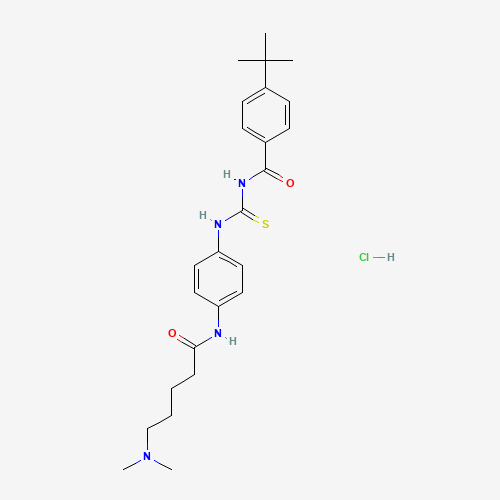
Tenovin-6 Hydrochloride
CAS number:1011301-29-3 molecular formula:C25H35ClN4O2S
overview
compound introduction
Specs
| Chinese alias | Tenovin-6 盐酸盐 | ||
| English alias | SCHEMBL907346 | Tenovin 2 | 4-(Tert-butyl)-N-((4-(5-(dimethylamino)pentanamido)phenyl)carbamothioyl)benzamide hydrochloride | AKOS030526197 | CCG-269623 | BCP18122 | 1011301-29-3 | AC-36468 | Tenovin-6 (Hydrochloride) | A921712 | F85008 | MS-29130 | HY-15 | ||
| CAS number | 1011301-29-3 | molecular formula | C25H35ClN4O2S |
| molecular weight | 491.09 g/mol | Exact mass | ≥98% |
| PSA | 106.000 Ų | logp | - |
numbering system
No numbering system information yet
physicochemical properties
No physical and chemical property information yet
Safety information
No safety information yet
Production methods and uses
No production method and use information yet
Related
upstream information
No upstream information yet
downstream information
No downstream information yet
MSDS
Found 0 shareMSDS




