

Palmatine hydroxide is an orally active and irreversible indoleamine 2,3-dioxygenase 1 (IDO-1) inhibitor with IC 50 s of 3 μM and 157μM against HEK 293-hIDO-1 and rhIDO-1, respectively. Palmatine hydroxide can also inhibit West Nile virus (WNV) NS2B-NS3 protease in an uncompetitive manner with an IC 50 of 96 μM. Palmatine hydroxide shows anti-cancer, anti-oxidation, anti-inflammatory, neuroprotection, antibacterial, anti-viral activities In Vitro Palmatine (0-100 μM; 42 h) suppresses WNV with an EC 50 value of 3.6 μM, and reduce the viral titers of DENV-2 and YFV with EC 50 values of 26.4 μM and 7.3 μM, respectively. Palmatine (0-1128 μM; 24-72 h) inhibits colon cancer cell proliferation . Palmatine (0-704 μM; 24 h) reduces AURKA protein levels, induces G2/M phase arrest, and induces apoptosis in colon cancer cells via the mitochondrial associated pathway . MCE has not independently confirmed the accuracy of these methods. They are for reference only. Cell Proliferation Assay Cell Line: HCT-116, SW480, HT-29 Concentration: 0, 88, 176, 352, and 704 μM (HCT-116, SW480); 0, 141, 282, 564, and 1128 μM (HT-29) Incubation Time: 24, 48 and 72 h Result: Decreased cell viability in a dose-dependent manner. Western Blot Analysis Cell Line: HCT-116, SW480, HT-29 Concentration: 100 nM for HCT-116, 500 nM for SW480 and HT-29 Incubation Time: 24, 48 and 72 h Result: Promoted the expression of apoptosis markers such as P53 / P73, Caspase3, and Caspase9. Reduced AURKA protein levels. Increased cyt. c in the cytoplasm while reduced Bcl2 and Bcl-xl in a dose-dependent manner. Cell Cycle Analysis Cell Line: HCT-116, SW480 Concentration: 88, 176, 352 and 704 μM Incubation Time: 24, 48 and 72 h Result: Induced G2/M phase arrest in a dose-dependent manner. Apoptosis Analysis Cell Line: HCT-116, SW480 Concentration: 88, 176, 352 and 704 μM Incubation Time: 24, 48 and 72 h Result: Induced apoptosis in a dose-dependent manner. In Vivo Palmatine (50 or 100 mg/kg; p.o.; daily for 7 days) ameliorates DSS (dextran sulfate sodium)-induced colitis and prevents infiltration of inflammatory cells . Palmatine (0-200 mg/kg; i.p.; once) attenuates D-galactosamine/ Lipopolysaccharides -induced fulminant hepatic failure in mice. Palmatine (0-1 mg/kg; i.p.; 10 days) shows memory-enhancing activity in mice. Palmatine (33.75-135 mg/kg; p.o.; daily for 26 days) can effectively inhibit the growth of HCT-116 xenografts in mice. MCE has not independently confirmed the accuracy of these methods. They are for reference only. Animal Model: DSS- induced Colitis BALB/c mice model (8-week-old) Dosage: 50 or 100 mg/kg Administration: Orally, daily, for 7 days Result: Ameliorated DSS-induced colitis and prevented infiltration of inflammatory cells; remarkably extended the colon length; significantly suppressed the colonic MPO activity. Decreased the levels of colonic inflammatory cytokines (TNF-α, IFN-γ, IL-1β, IL-6, IL-4 and IL-10); Protected mucosal integrity by modulating TJs protein and apoptosis proteins; Restored DSS-induced decreases of TJ protein ZO-1, ZO-2 and claudin-1; Reduced Bax expression and enhanced Bcl-2 expression at the dose of 100 mg/kg, prevented epithelial apoptosis and improved intestinal integrity. Prevented DSS-induced changes of gut microbiota in colitis mice. Animal Model: Male ICR mice (20–22 g), D-galactosamine/lipopolysaccharide (GalN/LPS)-induced fulminant hepatic failure modelDosage: 25, 50, 100, or 200 mg/kg Administration: Intraperitoneal injection, 1 h before the GalN/LPS treatment Result: Attenuated the mortality and serum aminotransferase activities increased by GalN/LPS. Prevented the increase of serum TNF-α and augmented that of serum IL-10. Decreased the TNF-a mRNA expression and increased the IL-10 mRNA expression. Attenuated the apoptosis of hepatocytes. Animal Model: Swiss young male albino mice, with Scopolamine - and diazepam-induced amnesia modelDosage: 0.1, 0.5, 1 mg/kg Administration: Intraperitoneal injection, 10 days Result: Significantly improved learning and memory of mice at 0.5 and 1 mg/kg and did not show any significant effect on locomotor activity of the mice. Significantly reversed scopolamine- and diazepam-induced amnesia in mice. Significantly reduced brain acetylcholinesterase activity of mice. Animal Model: BALB/c-nude mice, HCT-116 xenograft modelDosage: 33.75, 67.5 and 135 mg/kg Administration: Oral administration, once a day for 26 days Result: The tumor volume and weight of the treatment group were significantly reduced. Form:Solid IC50& Target:IDO-1 3 μM (IC 50 , HEK 293-hIDO-1) IDO-1 157 μM (IC 50 , rhIDO-1) WNV NS2B-NS3 96 μM (IC 50 )
All
Chemical Reagents
Biomedicine
Organic raw materials
Inorganic chemical industry
intermediate
Agricultural chemicals
Auxiliaries and catalysts
Fragrances and Flavors
Dyes and Pigments
Daily chemical industry
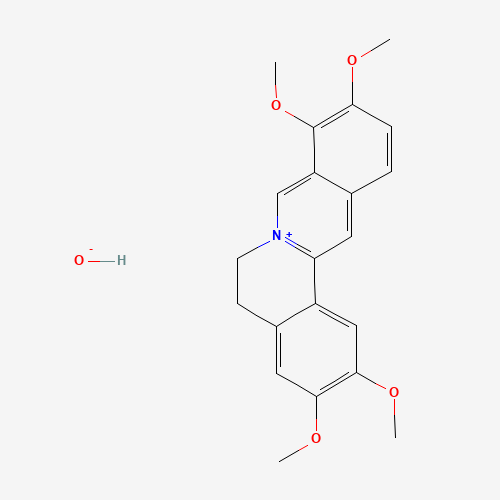
Palmatine hydroxide
CAS number:131-04-4 molecular formula:C21H23NO5
overview
compound introduction
Specs
| Chinese alias | 氢氧化巴马汀 | ||
| English alias | - | ||
| CAS number | 131-04-4 | molecular formula | C21H23NO5 |
| molecular weight | 369.41 g/mol | Exact mass | ≥99% |
| PSA | 41.800 Ų | logp | - |
numbering system
No numbering system information yet
physicochemical properties
No physical and chemical property information yet
Safety information
No safety information yet
Production methods and uses
No production method and use information yet
Related
upstream information
No upstream information yet
downstream information
No downstream information yet
MSDS
Found 0 shareMSDS




