
PIM447 dihydrochloride (LGH447 dihydrochloride) is a potent, orally available, and selective pan- PIM kinase inhibitor, with K i values of 6, 18, and 9 pM for PIM1 , PIM2 , and PIM3 , respectively. PIM447 dihydrochloride displays dual antimyeloma and bone-protective effects. PIM447 dihydrochloride induces apoptosis In Vitro PIM-447 (0.05-10 µM; 24, 48 and 72 hours) has inhibitory effects in MM cells, it against sensitive cell lines with IC 50 values ranging from 0.2 to 3.3 µM (MM1S, MM1R, RPMI-8226, MM144, U266 and NCI-H929) and less sensitive cell lines with IC 50 values at 48 h >7 µM (OPM-2, RPMI-LR5, U266-Dox4 and U266-LR7). PIM-447 (0.1-10 µM; 24, 48 and 72 hours) does not induce important levels of apoptosis, when PIM447 at 5 µM, it substantially increases annexin-V levels (about 30%) in sensitive cell lines(MM1S, NCI-H929 and RPMI-8226). When PIM447 at 10 µM, it induces apoptosis in all the cell lines but to a lesser extent in OPM-2 and RPMI-LR5. PIM447 promotes the cleavage of initiator caspases, such as caspases 8 and 9, and increases the cleavage of the effector caspases 3 and 7, together with PARP cleavage in MM1S,RPMI-8226 and NCI-H929 cells. PIM447 (0.1-1 µM) increases the percentage of cells in the G0/G1 phase and decreases the proliferative phases (S and G2/M) of the cell cycle. The effects at low concentrations (0.1-1 µM) were more pronounced in MM1S cells than in OPM-2. MCE has not independently confirmed the accuracy of these methods. They are for reference only. Cell Viability AssayCell Line: Sensitive MM cell lines: MM1S, MM1R, RPMI-8226, MM144, U266 and NCI-H929 cells Less sensitive MM cell lines: OPM-2,RPMI-LR5, U266-Dox4 and U266-LR7cells Concentration: 0.05-10 µM Incubation Time: 24, 48 and 72 hours Result: Was cytotoxic for MM cells (PIM kinases highly expressed). Apoptosis AnalysisCell Line: Sensitive MM cell lines: MM1S, NCI-H929 and RPMI-8226 cells Less sensitive MM cell lines: OPM-2 and RPMI-LR5 cells Concentration: 0.05-10 µM Incubation Time: 24, 48 and 72 hours Result: Induced cell apoptosis at higer doses, had no effects at 0.1-1 uM. Western Blot AnalysisCell Line: Sensitive MM cell lines: MM1S, NCI-H929 and RPMI-8226 cells Concentration: 0.05-10 µM Incubation Time: 24, 48 hours Result: Increased the cleavage of the effector caspases 3 and 7, and the PARP cleavage. Cell Cycle AnalysisCell Line: MM1S, OPM-2 cells Concentration: 0.1, 0.5 or 1 µM Incubation Time: 48 hours Result: Increased the cleavage of the effector caspases 3 and 7, and the PARP cleavage. In Vivo PIM447 (oral gavage; 100 mg/kg; 5 times/week) clearly controlls tumor progression and the serum levels of hIgλ secreted by RPMI-8226-luc cells in mouse model of bone marrow-disseminated human multiple myeloma . MCE has not independently confirmed the accuracy of these methods. They are for reference only. Animal Model: RPMI-8226-luc cells are injected intravenously into 6-week-old female NODSCID-IL-2Rγ -/- (NSG) mice Dosage: 100 mg/kg Administration: oral gavage; 100 mg/kg; 5 times/week Result: Was well tolerated, as the body weight of mice did not decrease by more than 10%. Increased bone volume density and trabecular number and reduced trabecular separation relative to vehicle group. Form:Solid IC50& Target:Ki: 6 pM (PIM1),18 pM (PIM1),9 pM (PIM3)
All
Chemical Reagents
Biomedicine
Organic raw materials
Inorganic chemical industry
intermediate
Agricultural chemicals
Auxiliaries and catalysts
Fragrances and Flavors
Dyes and Pigments
Daily chemical industry
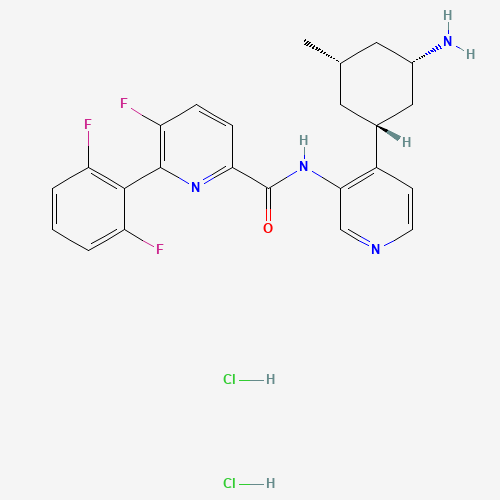
PIM-447 dihydrochloride
CAS number:1820565-69-2 molecular formula:C24H25Cl2F3N4O
overview
compound introduction
Specs
| Chinese alias | PIM-447 二盐酸盐 | ||
| English alias | - | ||
| CAS number | 1820565-69-2 | molecular formula | C24H25Cl2F3N4O |
| molecular weight | 513.38 g/mol | Exact mass | ≥99% |
| PSA | 80.900 Ų | logp | - |
numbering system
No numbering system information yet
physicochemical properties
No physical and chemical property information yet
Safety information
No safety information yet
Production methods and uses
No production method and use information yet
Related
upstream information
No upstream information yet
downstream information
No downstream information yet
MSDS
Found 0 shareMSDS