
Prinomastat hydrochloride (AG3340 hydrochloride) is a broad spectrum, potent, orally active metalloproteinase (MMP) inhibitor with IC 50 s of 79, 6.3 and 5.0 nM for MMP-1 , MMP-3 and MMP-9 , respectively. Prinomastat hydrochloride inhibits MMP-2 , MMP-3 and MMP-9 with K i s of 0.05 nM, 0.3 nM and 0.26 nM, respectively. Prinomastat hydrochloride can cross blood-brain barrier. Antitumor avtivity. In Vitro Prinomastat (AG3340; 0.1-1 µg/mL; 4 days; C57MG/Wnt1 cells) inhibits Wnt1-induced MMP-3 production. Reversal of Wnt1-induced EMT and β-catenin transcriptional activity by Prinomastat. Co-culture of L/Wnt3a cells and CT7 cells increases the Topflash activity in CT7 cells, and co-culturing both L/Wnt3a cells and MMP-3 overexpressing C57MG cells with CT7 cells increases the Topflash luciferase activity in CT7 cells beyond the level observed with L/Wnt3a cells, and these effects are all suppressed by Prinomastat (AG3340). Inhibition of entry of C57MG/Wnt1 cells into S phase by Prinomastat corresponds to a decrease in expression of cyclin D1 and Erk1/2 phosphorylation. The effect of Prinomastat on Wnt1-induced migration is then examined using an in vitro wound assay. As anticipated, the migration of C57MG/Wnt1 cells is increased by 1.8-fold when compared with C57MG cells.The effect of Wnt1 on the cellular distribution of vimentin is reversed by Prinomastat in C57MG/Wnt1 cells. MCE has not independently confirmed the accuracy of these methods. They are for reference only. Western Blot AnalysisCell Line: C57MG/Wnt1 cells Concentration: 0.1 µg/mL, 1 µg/mL Incubation Time: 4 days Result: A significant decrease in MMP-3 promoter activity in C57MG/Wnt1 cells. In Vivo In a human fibrosarcoma mouse model (HT1080), the mice are treated therapeutically for 14-16 days with 50 mg/kg/day ip daily starting day 3 to 6 after tumour inoculation. Prinomastat is well tolerated by the animals, and there are no signs of weight loss or other adverse effects. Prinomastat has good tumour growth inhibition, with a short T 1/2 of 1.6 hours . MCE has not independently confirmed the accuracy of these methods. They are for reference only. Form:Solid
All
Chemical Reagents
Biomedicine
Organic raw materials
Inorganic chemical industry
intermediate
Agricultural chemicals
Auxiliaries and catalysts
Fragrances and Flavors
Dyes and Pigments
Daily chemical industry
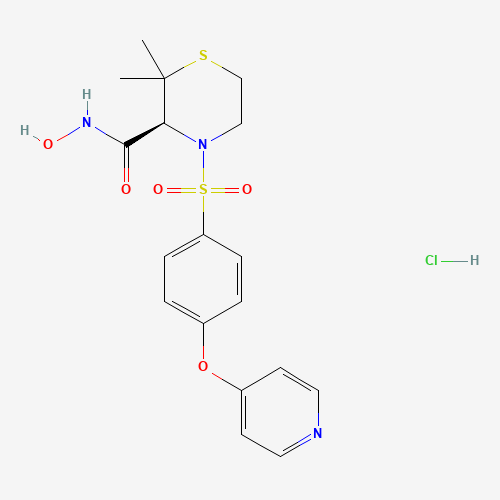
Prinomastat hydrochloride
CAS number:1435779-45-5 molecular formula:C18H22ClN3O5S2
overview
compound introduction
Specs
| Chinese alias | 盐酸普啉司他 | ||
| English alias | Q27273753 | N-hydroxy-2,2-dimethyl-4-[[4-(4-pyridinyloxy)phenyl]sulfonyl]-3-thiomorpholinecarboxamide, monohydrochloride | prinomastat HCl | (3S)-N-hydroxy-2,2-dimethyl-4-(4-pyridin-4-yloxyphenyl)sulfonylthiomorpholine-3-carboxamide;hydrochloride | F70895 | ||
| CAS number | 1435779-45-5 | molecular formula | C18H22ClN3O5S2 |
| molecular weight | 459.97 g/mol | Exact mass | - |
| PSA | 143.000 Ų | logp | - |
numbering system
No numbering system information yet
physicochemical properties
No physical and chemical property information yet
Safety information
No safety information yet
Production methods and uses
No production method and use information yet
Related
upstream information
No upstream information yet
downstream information
No downstream information yet
MSDS
Found 0 shareMSDS