

BRD-6929 is a potent, selective brain-penetrant inhibitor of class I histone deacetylase HDAC1 and HDAC2 inhibitor with IC 50 of 1 nM and 8 nM, respectively. BRD-6929 shows high-affinity to HDAC1 and HDAC2 with K i of 0.2 and 1.5 nM, respectively. BRD-6929 can be used for mood-related behavioral model research. In Vitro In vitro IC 50 for HDAC1-9 by BRD-6929 using recombinant human HDAC enzymes and HDAC class-specific substrates. BRD-6929 and substrate are incubated for 180 min (HDAC1-3) to control for HDAC1-3 inhibition, BRD-6929 is against HDAC1, HDAC2, HDAC3 and HDAC4-9 with IC 50 s of 0.001 µM, 0.008 µM, 0.458 µM and >30 µM, respectively. In vitro binding affinity (K i ) and kinetics (half-life ‘T 1/2 ′ in minutes) for HDAC 1, 2 and 3 incubated with BRD-6929 (10 µM), the K i values are 2400 mins, >4800 mins, and 1200 mins for HDAC 1, 2 and 3, respectively. BRD-6929 (1 and 10 uM) does not cause an increase or decrease in overall cell number in brain region specific primary cultures. Additionally, BRD-6929 (10 uM) causes an increase in H4K12 acetylation in brain region specific primary cultures (striatum). BRD-6929 (1-10 uM; 6 hours) causes a significant increase in H2B acetylation in primary neuronal cell cultures. BRD-6929 (1-20 uM; 24 hours) induces a dose-dependent acetylation of H4K12ac with an EC 50 of 7.2 µM in cultured neurons. BRD-6929 potentiates the efficacy of gnidimacrin (a PKC Agonist) against latent HIV-1. MCE has not independently confirmed the accuracy of these methods. They are for reference only. In Vivo BRD-6929 (intraperitoneal injection; 45 mg/kg; single dose) exhibits a C max , T 1/2 and AUC values of 17.7 μM, 7.2 hours, and 25.6 μM/L*hr, respectively in plasma. It shows a C max , T 1/2 and AUC values of 0.83 μM, 6.4 hours, and 3.9 μM/L*hr, respectively in brain . BRD-6929 (intraperitoneal injection; 45 mg/kg; 10 days) acts as a deacetylase inhibitor in mouse brain. It significantly increases acetylation in each brain region by 1.5- to 2.0-fold compared to vehicle. The western blotting reveals that BRD-6929 significantly increases acetylation of histone H2B (tetra-acetylated), H3K9 and H4K12 in cortex, ventral striatum and hippocampus after the 10th daily treatment in adult male C57BL/6J mice . MCE has not independently confirmed the accuracy of these methods. They are for reference only. Form:Solid
All
Chemical Reagents
Biomedicine
Organic raw materials
Inorganic chemical industry
intermediate
Agricultural chemicals
Auxiliaries and catalysts
Fragrances and Flavors
Dyes and Pigments
Daily chemical industry
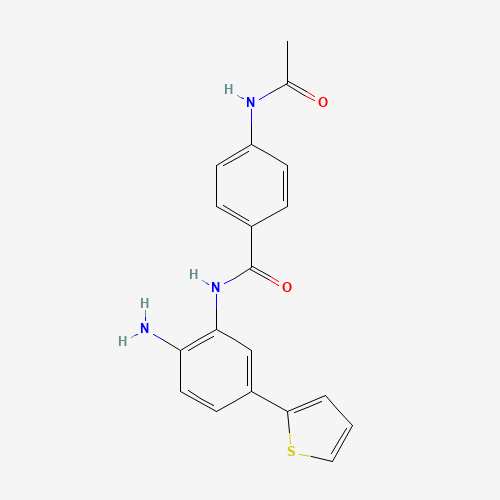
BRD-6929
CAS number:849234-64-6 molecular formula:C19H17N3O2S
overview
compound introduction
Specs
| Chinese alias | - | ||
| English alias | - | ||
| CAS number | 849234-64-6 | molecular formula | C19H17N3O2S |
| molecular weight | 351.42 g/mol | Exact mass | ≥99% |
| PSA | 112.000 Ų | logp | 2.600 |
numbering system
No numbering system information yet
physicochemical properties
No physical and chemical property information yet
Safety information
No safety information yet
Production methods and uses
No production method and use information yet
Related
upstream information
No upstream information yet
downstream information
No downstream information yet
MSDS
Found 0 shareMSDS




