

SAR-260301 is an orally available and selective PI3Kβ inhibitor with an IC 50 of 23 nM In Vitro In the UACC-62 tumor cell line assay, SAR-260301 inhibits pAktS473 with a measured IC 50 at 0.06 μM and an estimated IC 90 at 2 μM. In MEF-3T3-myr-p110β mechanistic model, SAR260301 inhibits PI3Kβ-dependent proliferation/viability in low serum conditions with an IC 50 of 196 nM. In PTEN-deficient human prostate tumor cells, SAR260301 inhibits LNCaP cell proliferation in low and high serum conditions with IC 50 values of 2.9 and 5.0 μM, respectively, after 4-day treatment, whereas it is inactive in these conditions in PC3 cells at concentrations up to 10 μM, despite target engagement. After prolonged treatment, SAR260301 at 3 or 10 μM inhibits PC3 cell proliferation in low serum conditions, with a cytostatic effect achieved for 14 days, despite some cell death induction observed at 10 μM. SAR260301 also leads to antitumor activities in PTEN-deficient/ BRAF -mutant human melanoma cells, inhibiting cell proliferation with IC 40 values of 6.5 and 3.3 μM for UACC-62 and WM-266.4, respectively, after 4-day treatment. MCE has not independently confirmed the accuracy of these methods. They are for reference only. In Vivo SAR-260301 displays antitumor efficacy in human PTEN-deficient melanoma models in mice as a single agent. SAR-260301 treatment leads to a statistically significant tumor growth inhibition as measured by a ΔT/ΔC of 39% (p = 0.054 versus control mice) on day 15 post-tumor implantation. SAR-260301 is well tolerated at the active dose, with no sign of toxicity and no body weight loss. Oral administration of SAR-260301 reveals sustained target inhibition (≥50%) of pAkt-S473 for at least 7 h. SAR-260301 has moderate terminal elimination half-life (t 1/2 =0.87 h, 1.4 h, 2.5 h, 0.87h, 6.9 h and 4.5 h for female SCID mice (3 mg/kg, iv), mice (10 mg/kg, po), mice (100 mg/kg, po), female nude rats (3 mg/kg, iv), rat (10 mg/kg, po), male beagle dogs (10 mg/kg, po)) . MCE has not independently confirmed the accuracy of these methods. They are for reference only. Cell Assay Cell proliferation is measured by quantifying intracellular ATP using CellTiter-Glo kit. Cells seeded into 96-well black microplates in complete medium, are treated with single or combined agents (e.g., SAR260301) 0.3 nM-30 μM (0.1% DMSO final concentration) for 96 hours. MCE has not independently confirmed the accuracy of these methods. They are for reference only. Form:Solid IC50& Target:PI3Kβ 23 nM (IC 50 ) PI3Kδ 468 nM (IC 50 ) PI3Kα 1539 nM (IC 50 ) PI3Kγ 10000 nM (IC 50 ) Vps34 183 nM (IC 50 ) PI3KC2γ 3812 nM (IC 50 ) pAkt 49 nM (IC 50 ) DNA-PK 2000 nM (IC 50 )
All
Chemical Reagents
Biomedicine
Organic raw materials
Inorganic chemical industry
intermediate
Agricultural chemicals
Auxiliaries and catalysts
Fragrances and Flavors
Dyes and Pigments
Daily chemical industry
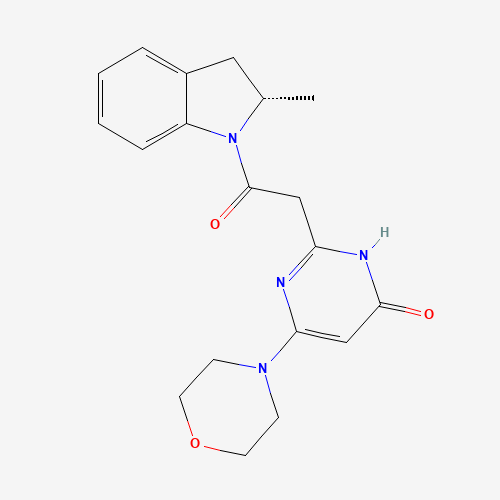
SAR-260301
CAS number:1260612-13-2 molecular formula:C19H22N4O3
overview
compound introduction
Specs
| Chinese alias | - | ||
| English alias | UNII-33639WNC7Q | AS-35206 | J82 | SCHEMBL1027765 | UAXHPOBBKRWJGA-ZDUSSCGKSA-N | 33639WNC7Q | AKOS040742610 | GTPL8793 | (S)-2-(2-(2-Methylindolin-1-yl)-2-oxoethyl)-6-morpholinopyrimidin-4(3H)-one | 2-[2-[(2S)-2-methyl-2,3-dihydroindol-1-yl]-2-oxoethyl]- | ||
| CAS number | 1260612-13-2 | molecular formula | C19H22N4O3 |
| molecular weight | 354.40 g/mol | Exact mass | ≥99% |
| PSA | 74.200 Ų | logp | 0.900 |
numbering system
No numbering system information yet
physicochemical properties
No physical and chemical property information yet
Safety information
No safety information yet
Production methods and uses
No production method and use information yet
Related
upstream information
No upstream information yet
downstream information
No downstream information yet
MSDS
Found 0 shareMSDS




