

Etilevodopa (L-Dopa ethyl ester) hydrochloride, an ethyl-ester proagent of Levodopa, is rapidly hydrolyzed to Levodopa and ethanol by nonspecific esterases in the gastrointestinal tract. Etilevodopa hydrochloride is used for the treatment of Parkinson disease (PD). Levodopa is the direct precursor of dopamine and is a suitable proagent as it facilitates CNS penetration and delivers dopamine . In Vitro Etilevodopa (L-Dopa ethyl ester) hydrochloride passes unchanged through the stomach to the duodenum, where it is rapidly hydrolyzed by local esterases to Levodopa and ethanol, and is subsequently absorbed into the blood stream as Levodopa. Compared with standard Levodopa, Etilevodopa hydrochloride has greater solubility in the stomach, faster passage to the small intestine, and a shortened time to maximum Levodopa concentration. MCE has not independently confirmed the accuracy of these methods. They are for reference only. Form:Solid
All
Chemical Reagents
Biomedicine
Organic raw materials
Inorganic chemical industry
intermediate
Agricultural chemicals
Auxiliaries and catalysts
Fragrances and Flavors
Dyes and Pigments
Daily chemical industry
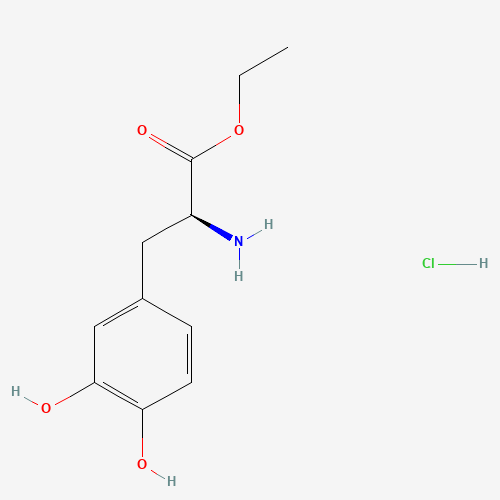
Etilevodopa hydrochloride
CAS number:39740-30-2 molecular formula:C11H16ClNO4
overview
compound introduction
Specs
| Chinese alias | 盐酸依替左多巴 | ||
| English alias | - | ||
| CAS number | 39740-30-2 | molecular formula | C11H16ClNO4 |
| molecular weight | 261.7 g/mol | Exact mass | ≥99% |
| PSA | 92.800 Ų | logp | - |
numbering system
No numbering system information yet
physicochemical properties
No physical and chemical property information yet
Safety information
No safety information yet
Production methods and uses
No production method and use information yet
Related
upstream information
No upstream information yet
downstream information
No downstream information yet
MSDS
Found 0 shareMSDS




