
Oritinib (SH-1028), an irreversible third-generation EGFR TKI , overcomes T790M-mediated resistance in non-small cell lung cancer . Oritinib (SH-1028), a mutant-selective inhibitor of EGFR kinase activity, inhibits EGFR WT , EGFR L858R , EGFR L861Q , EGFR L858R/T790M , EGFR d746-750 and EGFR d746-750/T790M kinases, with IC 50 s of 18, 0.7, 4, 0.1, 1.4 and 0.89 nM, respectively In Vitro Oritinib (SH-1028) binds irreversibly to EGFR kinase by targeting cysteine-797 residue in the ATP binding site via covalent bond formation. Oritinib (0.001-10 μM) potently and selectively targets mutant EGFR cell lines in vitro. Oritinib (0.1 μM) continuously inhibits the phosphorylation of EGFR in PC-9 and NCI-H1975 cells at lower concentrations or even drug-free for at least 6 h. MCE has not independently confirmed the accuracy of these methods. They are for reference only. Cell Proliferation AssayCell Line: A431 (EGFR WT ), H3255 (EGFR L858R ), PC-9 (EGFR d746-750 ) and NCI-H1975 (EGFR L858R/T790M ) cells Concentration: 0.001, 0.01, 0.1, 1, and 10 μM Incubation Time: 72 hours Result: Selectively inhibited EGFR-mutated NCI-H1975, H3255 and PC-9 cells, with IC 50 s of 3.93±1.12, 9.39±0.88 and 7.63±0.18 nmol/L, respectively, which were about 198-, 83- and 102-fold more sensitive than the inhibition of wild-type EGFR in A431 cells (IC 50 =778.89±134.74 nM). In Vivo Oral administration of Oritinib at a daily dose of 5 mg/kg significantly inhibits proliferation of tumor cells with EGFR sensitive mutation (exon 19 del) and resistant mutation (T790 M) for consecutive 14 days, with no TKI-induced weight loss in mouse xenograft models . Oritinib shows good bioavailability, and is distributed extensively from the plasma to the tissues . MCE has not independently confirmed the accuracy of these methods. They are for reference only. Animal Model: 6-8 weeks old female mice bearing NCI-H1975 and A431 xenograft models Dosage: 2.5, 5, and 15 mg/kg Administration: Orally administrated once daily for consecutive 14 days Result: Led to a significant inhibition of tumor cell growth in both PC-9 (exon 19 del) and NCI-H1975 (L858R/T790M) xenograft models. Animal Model: NCI-H1975 tumor-bearing mice Dosage: 2.5, 5, and 15 mg/kg (Pharmacokinetic Analysis) Administration: Oral administration for 1 day or 14 consecutive days. Result: The T max is 1.5-2 h, indicating rapidly distributed into tissues, including lung tumor tissues. The AUC 0–t values in plasma were 118, 300 and 931 ng×h/mL on Day 1, while 272, 308 and 993 ng×h/ml on Day 14, respectively. Form:Solid IC50& Target:EGFR (WT) 18 nM (IC 50 ) EGFR L858R 0.7 nM (IC 50 ) EGFR L861Q 4 nM (IC 50 ) EGFR L858R/T790M 0.1 nM (IC 50 ) EGFR d746-750 1.4 nM (IC 50 ) EGFR d746-750/T790M 0.89 nM (IC 50 )
All
Chemical Reagents
Biomedicine
Organic raw materials
Inorganic chemical industry
intermediate
Agricultural chemicals
Auxiliaries and catalysts
Fragrances and Flavors
Dyes and Pigments
Daily chemical industry
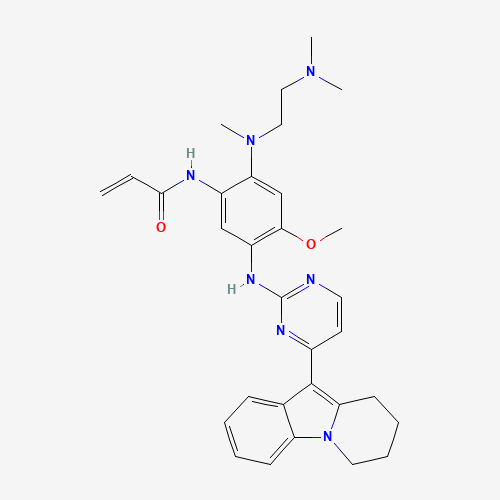
Oritinib
CAS number:2035089-28-0 molecular formula:C31H37N7O2
overview
compound introduction
Specs
| Chinese alias | 奥瑞替尼 | ||
| English alias | - | ||
| CAS number | 2035089-28-0 | molecular formula | C31H37N7O2 |
| molecular weight | 539.67 g/mol | Exact mass | ≥99% |
| PSA | - | logp | - |
numbering system
No numbering system information yet
physicochemical properties
No physical and chemical property information yet
Safety information
No safety information yet
Production methods and uses
No production method and use information yet
Related
upstream information
No upstream information yet
downstream information
No downstream information yet
MSDS
Found 0 shareMSDS