As a major constituent of cell membranes, sphingomyelin is found at particularly high concentrations in the membranes of nerve cells (in the myelin sheaths) and red blood cells. It was previously thoμght to have a purely structural role, similar to the function of phosphatidylcholine, throμgh intermolecular interactions mediated by the 2-amide group, the 3-hydroxy group and the 4,5-trans double bond of the sphingoid base. However, it is now appreciated that sphingomyelin has a high affinity for cholesterol and that these two lipids pack tightly into liquid-ordered domains among a liquid-disordered phase to form lipid rafts. These membrane microdomains are thoμght to function as signaling platforms that regulate the localization and interactions of proteins. But sphingomyelin does not just influence signaling as a component of lipid rafts — it is also a precursor to ceramides and other sphingolipid metabolites that comprise the sphingomyelin cycle or sphingolipid network.Milk SM has been used as a lipid standard.It is also suitable for detecting ceramide in feces and for differential scanning calorimetry. As a major constituent of cell membranes, sphingomyelin is found at particularly high concentrations in the membranes of nerve cells (in the myelin sheaths) and red blood cells. It was previously thought to have a purely structural role, similar to the function of phosphatidylcholine, through intermolecular interactions mediated by the 2-amide group, the 3-hydroxy group and the 4,5-trans double bond of the sphingoid base. However, it is now appreciated that sphingomyelin has a high affinity for cholesterol and that these two lipids pack tightly into liquid-ordered domains among a liquid-disordered phase to form lipid rafts. These membrane microdomains are thought to function as signaling platforms that regulate the localization and interactions of proteins. But sphingomyelin does not just influence signaling as a component of lipid rafts — it is also a precursor to ceramides and other sphingolipid metabolites that comprise the sphingomyelin cycle or sphingolipid network.
All
Chemical Reagents
Biomedicine
Organic raw materials
Inorganic chemical industry
intermediate
Agricultural chemicals
Auxiliaries and catalysts
Fragrances and Flavors
Dyes and Pigments
Daily chemical industry
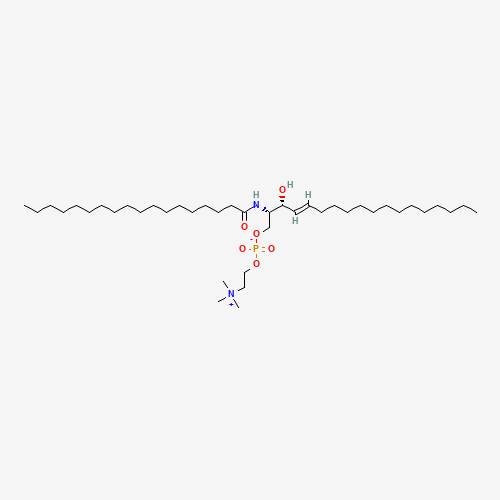
Sphingomyelin (Milk, Bovine)
CAS number:475662-40-9 molecular formula:分子式:
overview
compound introduction
Specs
| Chinese alias | - | ||
| English alias | C23 Sphingomyelin | SM(d18:1/23:0) | N-(tricosanoyl)-sphing-4-enine-1-phosphocholine | Sphingomyelin (Milk, Bovine) | N-tricosanoylsphing-4-enine-1-phosphocholine | ||
| CAS number | 475662-40-9 | molecular formula | 分子式: |
| molecular weight | 801.200 g/mol | Exact mass | ≥99% |
| PSA | 108.000 Ų | logp | 16.100 |
numbering system
No numbering system information yet
physicochemical properties
No physical and chemical property information yet
Safety information
No safety information yet
Production methods and uses
No production method and use information yet
Related
upstream information
No upstream information yet
downstream information
No downstream information yet
MSDS
Found 1 shareMSDS
475662-40-9 | Sphingomyelin (Milk, Bovine).pdf