
Cyclo(his-pro) TFA (Cyclo(histidyl-proline) TFA) is an orally active cyclic dipeptide structurally related to tyreotropin-releasing hormone Cyclo(his-pro) TFA could inhibit NF-κB nuclear accumulation. Cyclo(his-pro) TFA can cross the brain-blood-barrier and affect diverse inflammatory and stress responses . In Vitro Cyclo(his-pro) TFA (Cyclo(histidyl-proline) TFA; 50 μM; 1-48 hours) increases the nuclear level of Nrf2 and inhibits NF-κB nuclear translocation. Cyclo(His-Pro) alone has no effect on nuclear translocation of these transcription factors. Cyclo(his-pro) TFA (50 μM; prior to PQ exposure for 48 hours) abolishes protein nitration that followed paraquat (PQ) exposure and lessenes its functional consequences, as shown by decrease in cell apoptosis, detected by caspase 3 activity and by cytochrome c release. Cyclo(his-pro) TFA inhibits NF-κB nuclear accumulation induced by paraquat in rat pheochromocytoma PC12 cells via the Nrf2/heme oxygenase-1 pathway. MCE has not independently confirmed the accuracy of these methods. They are for reference only. Western Blot AnalysisCell Line: PC12 cells Concentration: 50 μM Incubation Time: 1, 2, 4, 8, 24, 48 hours Result: Increased the nuclear level of Nrf2 and inhibited NF-κB nuclear translocation. In Vivo Cyclo(his-pro) TFA (Cyclo(histidyl-proline) TFA; 1.8 mg/ear; topical application on the right ear; 30 min prior to TPA) reduces TPA-induced ear oedema confirming that it can exert anti-inflammatory effect. Cyclo(his-pro) TFA exerts in vivo anti-inflammatory effects in the central nervous system by down-regulating hepatic and cerebral TNFα expression thereby counteracting LPS-induced gliosis. Moreover, by up-regulating Bip, Cyclo(his-pro) increases the ER stress sensitivity andtriggers the unfolded protein response to alleviate the ER stress. MCE has not independently confirmed the accuracy of these methods. They are for reference only. Animal Model: Sixty two/three month-old male C57BL/6 mice (25-30 g)Dosage: 1.8 mg/ear Administration: Topical application on the right ear; 30 min prior to TPA Result: Reduced TPA-induced ear oedema. Form:Solid IC50& Target:NF-κB Human Endogenous Metabolite
All
Chemical Reagents
Biomedicine
Organic raw materials
Inorganic chemical industry
intermediate
Agricultural chemicals
Auxiliaries and catalysts
Fragrances and Flavors
Dyes and Pigments
Daily chemical industry
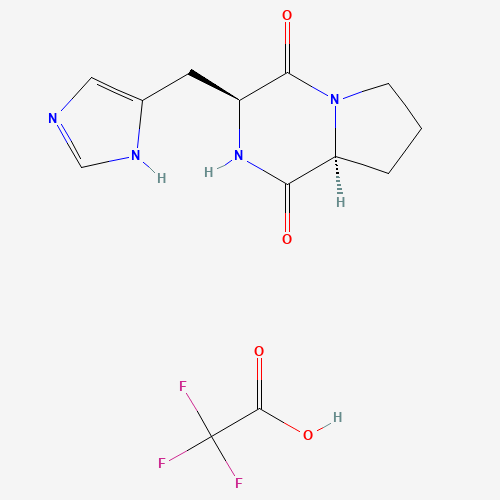
Cyclo(his-pro) TFA
CAS number:936749-56-3 molecular formula:C13H15F3N4O4
overview
compound introduction
Specs
| Chinese alias | 环(组氨酸)三氟乙酸 | ||
| English alias | - | ||
| CAS number | 936749-56-3 | molecular formula | C13H15F3N4O4 |
| molecular weight | 348.28 g/mol | Exact mass | ≥99% |
| PSA | - | logp | - |
numbering system
No numbering system information yet
physicochemical properties
No physical and chemical property information yet
Safety information
No safety information yet
Production methods and uses
No production method and use information yet
Related
upstream information
No upstream information yet
downstream information
No downstream information yet
MSDS
Found 0 shareMSDS