

Inolitazone dihydrochloride (Efatutazone dihydrochloride) is a novel high-affinity PPARγ agonist that is dependent upon PPARγ for its biological activity with IC 50 of 0.8 nM for growth inhibition. In Vitro Inolitazone dihydrochloride (Efatutazone dihydrochloride) upregulates the cell cycle kinase inhibitor, p21 WAF1/CIP1 . Silencing p21 WAF1/CIP1 rendered cells insensitive to Inolitazone. A 10 nM dose of Inolitazone activates PPARγ:RXRα-dependent transcription as demonstrated in a transient transfection assay utilizing a PPRE response element fused to a luciferase reporter gene (PPRE3-tk-luc). DRO cells are treated in culture with Inolitazone, Rosiglitazone, or Troglitazone at the indicated concentrations. DRO cells are transiently transfected with PPRE3-tk-luc to examine effective concentrations at which EC 50 occurs. The EC 50 s are 1 nM (Inolitazone), 65 nM (Rosiglitazone) and 631 nM (Troglitazone). Similarly, the calculated inhibitory concentration at IC 50 is 0.8 nM for Inolitazone, 75 nM for Rosiglitazone, and 1412 nM for Troglitazone. Inolitazone specifically activates PPARγ, but not PPARα or PPARδ. Exposure of 10 nM Inolitazone following transient transfection with the appropriate PPAR isoform (γ, α, or δ) and PPAR response element linked to a luciferase reporter in RIE rat small intestinal cell line, which does not express PPARs, yields increased luciferase activity only in the presence of PPARγ and PPRE3-tk-luc. DRO cells are growth inhibited by 10 nM Inolitazone (RS5444) through a PPARγ-dependent mechanism. MCE has not independently confirmed the accuracy of these methods. They are for reference only. In Vivo Inolitazone dihydrochloride (Efatutazone dihydrochloride) plus Paclitaxel demonstrate additive antiproliferative activity in cell culture and minimal ATC tumor growth. When Inolitazone is administered in the diet to athymic nude mice prior to DRO tumor cell implantation, tumor growth is inhibited in a dose responsive fashion. At the highest dose, 0.025% Inolitazone inhibits growth on day 32 by 94.4% as compared to that of control. In this treatment group, five of 10 animals do not develop demonstrable tumors. In the 0.0025% treatment group, tumor growth is inhibited by 62.3% compared to that of control on day 32 while the 0.00025% dose demonstrated no growth inhibitory activity as compared to control. Tumors is nest allowed to establish in the mouse and began 0.025% Inolitazone treatment of mice 1 week after DRO or ARO tumor cell implantation. Inolitazone treated animals demonstrate tumor growth inhibition of 68.9% in DRO tumors and 48.3% in ARO tumors as compared to that of their respective controls on day 35 . MCE has not independently confirmed the accuracy of these methods. They are for reference only. Form:Solid IC50& Target:PPARγ
All
Chemical Reagents
Biomedicine
Organic raw materials
Inorganic chemical industry
intermediate
Agricultural chemicals
Auxiliaries and catalysts
Fragrances and Flavors
Dyes and Pigments
Daily chemical industry
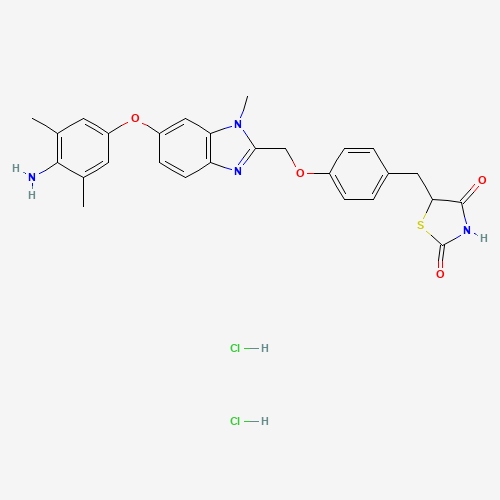
Inolitazone dihydrochloride
CAS number:223132-38-5 molecular formula:C27H28Cl2N4O4S
overview
compound introduction
Specs
| Chinese alias | 盐酸伊诺他酮 | ||
| English alias | 5-[(4-{[6-(4-Amino-3,5-dimethylphenoxy)-1-methyl-1H-benzimidazol-2-yl]methoxy}phenyl)methyl]-4-hydroxy-1,3-thiazol-2(5H)-one--hydrogen chloride (1/2) | Efatutazone dihydrochloride; CS-7017 dihydrochloride; RS5444 dihydrochloride | 2,4-Thiazolidinedione, 5 | ||
| CAS number | 223132-38-5 | molecular formula | C27H28Cl2N4O4S |
| molecular weight | 575.51 g/mol | Exact mass | ≥98% |
| PSA | 134.000 Ų | logp | - |
numbering system
No numbering system information yet
physicochemical properties
No physical and chemical property information yet
Safety information
No safety information yet
Production methods and uses
No production method and use information yet
Related
upstream information
No upstream information yet
downstream information
No downstream information yet
MSDS
Found 0 shareMSDS




