

ACP-5862 is a major active, circulating, pyrrolidine ring-opened metabolite of Acalabrutinib with an IC 50 of 5.0 nM for Bruton tyrosine kinase (BTK). ACP‐5862 is a weak time‐dependent inactivator of CYP3A4 and CYP2C8. Acalabrutinib is an orally active, irreversible, and highly selective BTK inhibitor , with an IC 50 of 3 nM and EC 50 of 8 nM. In Vivo Following a single oral dose of 100 mg Acalabrutinib, the half‐life of ACP‐5862 is 6.9 hours and the mean exposure is approximately twofold to threefold higher than that of Acalabrutinib. ACP-5862 (M27) is the major single metabolite in the systemic circulation and accountes for 57.4% and 42.1% of the AUC 0-t total radioactivity in male and female rat plasma, respectively. ACP-5862, the major human metabolite, is a relatively minor component in the systemic circulation and accountes for 6.1% and 8.1% of the AUC 0-t total radioactivity in male and female dog plasma, respectively . ACP-5862 (1 or 10 μM) has reversible protein binding of 98.6%, 99.8%, 94.3%, 98.6% in mouse, rat, dog, and human plasma . MCE has not independently confirmed the accuracy of these methods. They are for reference only. Form:Solid
All
Chemical Reagents
Biomedicine
Organic raw materials
Inorganic chemical industry
intermediate
Agricultural chemicals
Auxiliaries and catalysts
Fragrances and Flavors
Dyes and Pigments
Daily chemical industry
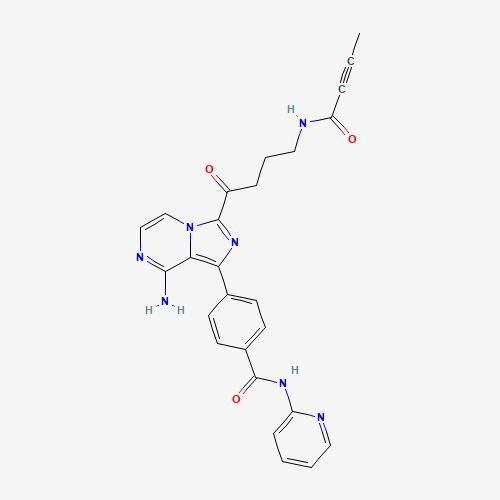
ACP-5862
CAS number:2230757-47-6 molecular formula:C26H23N7O3
overview
compound introduction
Specs
| Chinese alias | - | ||
| English alias | - | ||
| CAS number | 2230757-47-6 | molecular formula | C26H23N7O3 |
| molecular weight | 481.5 g/mol | Exact mass | ≥98% |
| PSA | - | logp | - |
numbering system
No numbering system information yet
physicochemical properties
No physical and chemical property information yet
Safety information
No safety information yet
Production methods and uses
No production method and use information yet
Related
upstream information
No upstream information yet
downstream information
No downstream information yet
MSDS
Found 0 shareMSDS




