

BMS-986202 is a potent, selective and orally active Tyk2 inhibitor that binds to Tyk2 JH2 with an IC 50 value of 0.19 nM and a K i of 0.02 nM. BMS-986202 is remarkably selective over other kinases including Jak family members. BMS-986202 is also a weak inhibitor of CYP2C19 with an IC 50 value of 14 μM. BMS-986202 can be used for IL-23-driven acanthosis, anti-CD40-induced colitis, and spontaneous lupus research. BMS-986202 is a de novo deuterium In Vitro Stable heavy isotopes of hydrogen, carbon, and other elements have been incorporated into drug molecules, largely as tracers for quantitation during the drug development process. Deuteration has gained attention because of its potential to affect the pharmacokinetic and metabolic profiles of drugs. Potential advantages of deuterated compounds: (1) Extend the half-life in vivo. Deuterated compounds may be able to prolong the pharmacokinetic characteristics of the compound, that is, prolong the half-life in vivo. This can improve compound safety, efficacy and tolerability, and increase ease of administration. (2) Improve oral bioavailability. Deuterated compounds may reduce the degree of unwanted metabolism (first-pass metabolism) in the gut wall and liver, allowing a greater proportion of the unmetabolized drug to reach its target site of action. High bioavailability determines its activity at low doses and better tolerance. (3) Improve metabolic characteristics. Deuterated compounds may reduce the formation of toxic or reactive metabolites and improve drug metabolism. (4) Improve drug safety. Deuterated compounds may reduce or eliminate adverse side effects of pharmaceutical compounds and are safe. (5) Preserve the therapeutic properties. Deuterated compounds are expected to retain similar biochemical potency and selectivity to hydrogen analogs in previous studies. MCE has not independently confirmed the accuracy of these methods. They are for reference only. In Vivo BMS-986202 (Compound 7; 3-30 mg/kg; p.o.; daily; for 9 days) treatment inhibits IL-23-driven acanthosis in mice . BMS-986202 (Compound 7; 0.4-10 mg/kg; p.o.) treatment inhibits IL-12/IL-18-induced IFNγ production in mice. BMS-986202 dose-dependently inhibits IFNγ production by 46% and 80% at doses of 2 mg/kg and 10 mg/kg, respectively . BMS-986202 (Compound 7; 7-10 mg/kg; p.o.) is stable in liver microsomes, with half lives of greater than 120 min in mouse, rat, monkey, and humans and 89 min in dog. The serum protein binding for BMS-986202 in these species ranges from 89.3% to 96.0%, leaving a good range of free fraction of drug available. BMS-986202 shows the oral bioavailability up to 62-100% . MCE has not independently confirmed the accuracy of these methods. They are for reference only. Animal Model: C57BL/6 female mice (9-11 weeks) injected with IL-23 Dosage: 3 mg/kg, 10 mg/kg, and 30 mg/kg Administration: Oral administration; daily; for 9 days Result: Inhibited ear swelling in a dose-responsive manner in IL-23-induced acanthosis in mice. Form:Solid IC50& Target:Tyk2 JH2 0.19 nM (IC 50 ) Tyk2 JH2 0.02 nM (Ki) CYP2C19 14 μM (IC 50 )
All
Chemical Reagents
Biomedicine
Organic raw materials
Inorganic chemical industry
intermediate
Agricultural chemicals
Auxiliaries and catalysts
Fragrances and Flavors
Dyes and Pigments
Daily chemical industry
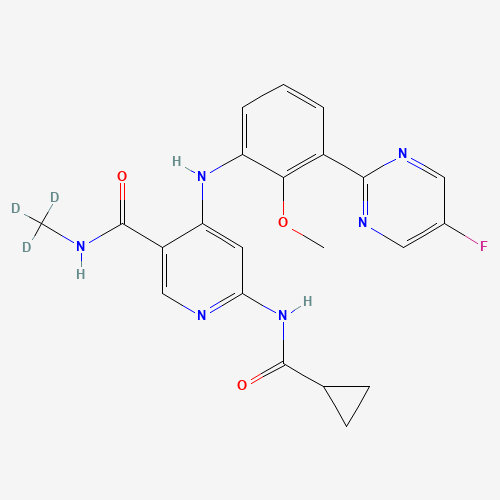
BMS-986202
CAS number:1771691-34-9 molecular formula:C22H18D3FN6O3
overview
compound introduction
Specs
| Chinese alias | - | ||
| English alias | 3-Pyridinecarboxamide, 6-((cyclopropylcarbonyl)amino)-4-((3-(5-fluoro-2-pyrimidinyl)-2-methoxyphenyl)amino)-N-(methyl-d3)- | 1771691-34-9 | MS-27882 | 6-(cyclopropanecarbonylamino)-4-[3-(5-fluoropyrimidin-2-yl)-2-methoxyanilino]-N-(trideuteriomethyl)pyrid | ||
| CAS number | 1771691-34-9 | molecular formula | C22H18D3FN6O3 |
| molecular weight | 439.46 g/mol | Exact mass | - |
| PSA | - | logp | - |
numbering system
No numbering system information yet
physicochemical properties
No physical and chemical property information yet
Safety information
No safety information yet
Production methods and uses
No production method and use information yet
Related
upstream information
No upstream information yet
downstream information
No downstream information yet
MSDS
Found 0 shareMSDS




