

Tebanicline dihydrochloride (Ebanicline dihydrochloride) is a nAChR modulator with potent, orally effective analgesic activity. It inhibits the binding of cytisine to α4β2 neuronal nAChRs with a K i of 37 pM In Vitro Tebanicline is a novel, potent cholinergic nAChR ligand with analgesic properties that shows preferential selectivity for neuronal nAChRs. It inhibits the binding of cytisine to α4β2 neuronal nAChRs with a K i of 37 pM. Functionally, tebanicline is an agonist. At the transfected human α4β2 neuronal nAChR in K177 cells, with increased 86 Rb + efflux as a measure of cation efflux, ABT-594 has an EC 50 value of 140 nM with an intrinsic activitycompared with (−)-nicotine of 130%; at the nAChR subtype expressed in IMR-32 cells, an EC 50 of 340 nM; at the F11 dorsal root ganglion cell line, an EC 50 of 1220 nM; and via direct measurement of ion currents, an EC 50 value of 56,000 nM at the human α7 homo-oligimeric nAChR produced in oocytesMCE has not independently confirmed the accuracy of these methods. They are for reference only. In Vivo Tebanicline is a potent antinociceptive agent with full efficacy in models of acute and persistent pain and that these effects are mediated predominately by an action at central neuronal nAChRs. Tebanicline produces significant antinociceptive effects in mice against both acute noxious thermal stimulation. ABT-594 is orally active, but 10-fold less potent by this route than after i.p. administration. The antinociceptive effect of ABT-594 is prevented, but not reversed, by the noncompetitive neuronal nicotinic acetylcholine receptor antagonist. Tebanicline has antinociceptive effects in rat models of acute thermal, persistent chemical, and neuropathic pain. Direct injection of tebanicline into the nucleus raphe magnus (NRM) is antinociceptive in a thermal threshold test and destruction of serotonergic neurons in the NRM attenuates the effect of systemic tebanicline. MCE has not independently confirmed the accuracy of these methods. They are for reference only. Form:Solid IC50& Target:Ki: 37 pM (nAChR)
All
Chemical Reagents
Biomedicine
Organic raw materials
Inorganic chemical industry
intermediate
Agricultural chemicals
Auxiliaries and catalysts
Fragrances and Flavors
Dyes and Pigments
Daily chemical industry
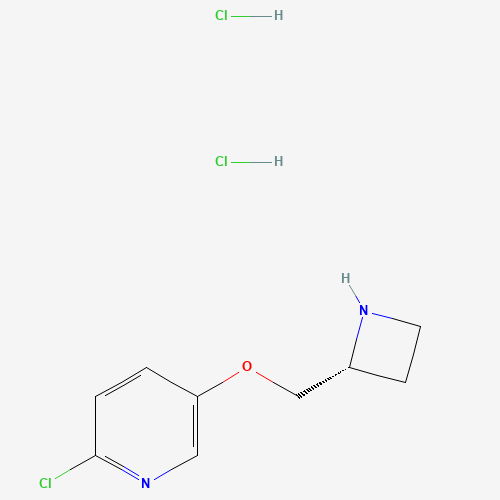
Tebanicline dihydrochloride
CAS number:209326-19-2 molecular formula:C9H13Cl3N2O
overview
compound introduction
Specs
| Chinese alias | 盐酸特巴尼克兰 | ||
| English alias | - | ||
| CAS number | 209326-19-2 | molecular formula | C9H13Cl3N2O |
| molecular weight | 271.57 g/mol | Exact mass | ≥98% |
| PSA | - | logp | - |
numbering system
No numbering system information yet
physicochemical properties
No physical and chemical property information yet
Safety information
No safety information yet
Production methods and uses
No production method and use information yet
Related
upstream information
No upstream information yet
downstream information
No downstream information yet
MSDS
Found 0 shareMSDS




