

AZD5582 是 IAP 拮抗剂,可以有效与 cIAP1,cIAP2 和 XIAP 的 BIR3 结构域结合, IC50 值分别为 15,21,15 nM。AZD5582 诱导凋亡 (apoptosis)。 Information AZD5582, a novel small-molecule IAP inhibitor, binds potently to the BIR3 domains ofcIAP1,cIAP2, andXIAPwithIC50values of 15, 21, and 15 Targets cIAP1 (Cell-free assay); XIAP (Cell-free assay); cIAP2 (Cell-free assay) 15 nM; 15 nM; 21 nM In vitro Human pancreatic cancer cells display different sensitivities to the synthetic IAP antagonist, AZD5582. Treating human pancreatic cancer cells with AZD5582 differentially induces apoptosis, dependent on the expression of p-Akt and p-XIAP. It targets cIAP1 to induce TNF-α-induced apoptosis. AZD5582 induces a decrease of Mcl-1 protein, a member of the Bcl-2 family, but not that of Bcl-2 and Bcl-xL. HNSCC (head and neck squamous cell carcinoma) cell lines SCC25, Cal27, and FaDu show a dose-dependent cytotoxic effect after treatment with AZD5582. In vivo After AZD5582 treatment, tumor growth and weight decrease, whereas cleaved caspase 3 expression increases in Panc-1-derived xenograft model. When administered intravenously to MDA-MB-231 xenograft-bearing mice, AZD5582 results in cIAP1 degradation and caspase-3 cleavage within tumor cells and causes substantial tumor regressions following two weekly doses of 3.0 mg/kg. Following a modest 0.5 mg/kg intravenous bolus dose of AZD5582 in mice, unbound plasma levels remain above the concentrations at which apoptosis induction and cell death are observed in MDA-MB-231 cells over the course of several hours. Although cIAP1 degradation happens very quickly upon exposure to AZD5582 apoptosis induction (as measured by the amount of cleaved caspase-3) takes longer to reach a maximal effect. A single agent AZD5582 does not exhibit broad-based cytotoxicity but instead should be employed in selected tumor settings expected to be sensitive to IAP inhibitors or in rational combinations with other targeted therapies. The dihydrochloride salt of AZD5582 has sufficient aqueous solubility (>7 mg/mL at pH 4−6) to enable formulation for intravenous administration at the projected efficacious doses. With respect to chemical stability, AZD5582 is found to be photostable and hydrolytically stable between pH 4−6, although some amide hydrolysis is observed under strongly acidic (pH 8) conditions. In addition, the compound is stable in the plasma of multiple species, with no compound degradation observed after several hours under physiological conditions. Cell Research(from reference) Cell lines:The human pancreatic cancer cell lines including BxPC-3, Miapaca-2, Panc-1, Panc0813, PL45, Capan-1, Capan-2 and AsPC-1 Concentrations:0, 0.01, 0.1, 0.5 μM Incubation Time:72 h
All
Chemical Reagents
Biomedicine
Organic raw materials
Inorganic chemical industry
intermediate
Agricultural chemicals
Auxiliaries and catalysts
Fragrances and Flavors
Dyes and Pigments
Daily chemical industry
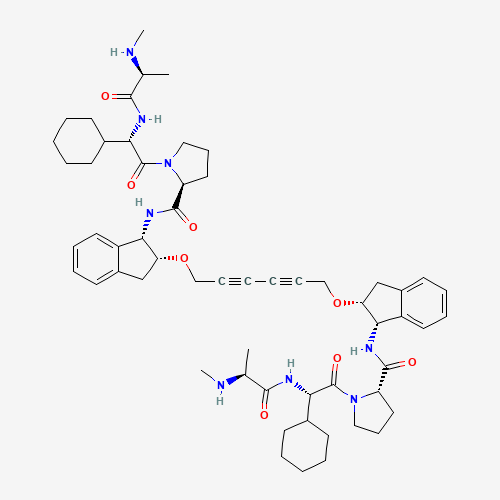
AZD5582
CAS number:1258392-53-8 molecular formula:C58H78N8O8
overview
compound introduction
Specs
| Chinese alias | - | ||
| English alias | L-Prolinamide,3,3'-[2,4-hexadiyne-1,6-diylbis[oxy[(1S,2R)-2,3-dihydro-1H-indene-2,1-diyl]]]bis[N-methyl-L-alanyl-(2S)-2-cyclohexylglycyl- | ||
| CAS number | 1258392-53-8 | molecular formula | C58H78N8O8 |
| molecular weight | 1015.29 g/mol | Exact mass | - |
| PSA | 200.000 Ų | logp | 5.317 |
numbering system
No numbering system information yet
physicochemical properties
No physical and chemical property information yet
Safety information
No safety information yet
Production methods and uses
No production method and use information yet
Related
upstream information
No upstream information yet
downstream information
No downstream information yet
MSDS
Found 0 shareMSDS




