

Angiotensin II human (Angiotensin II) TFA is a vasoconstrictor and a major bioactive peptide of the renin/angiotensin system. Angiotensin II human TFA plays a central role in regulating human blood pressure, which is mainly mediated by interactions between Angiotensin II and the G-protein-coupled receptors (GPCRs) Angiotensin II type 1 receptor (AT1R) and Angiotensin II type 2 receptor (AT2R). Angiotensin II human TFA stimulates sympathetic nervous stimulation, increases aldosterone biosynthesis and renal actions. Angiotensin II human TFA induces growth of vascular smooth muscle cells, increases collagen type I and III synthesis in fibroblasts, leading to thickening of the vascular wall and myocardium, and fibrosis. Angiotensin II human TFA also induces apoptosis . Angiotensin II human TFA induces capillary formation from endothelial cells via the LOX-1 dependent redox-sensitive pathway In Vitro Most of the known actions of Angiotensin II (Ang II) human are mediated by AT1 receptors, the AT2 receptor contributes to the regulation of blood pressure and renal function. Angiotensin II human raises blood pressure (BP) by a number of actions, the most important ones being vasoconstriction, sympathetic nervous stimulation, increased aldosterone biosynthesis and renal actions. Other Angiotensin II human actions include induction of growth, cell migration, and mitosis of vascular smooth muscle cells, increased synthesis of collagen type I and III in fibroblasts, leading to thickening of the vascular wall and myocardium, and fibrosis. These actions are mediated by type 1 Ang II receptors (AT 1 ). Angiotensin II (1 nM) TFA induces the expression of LOX-1 and VEGF and enhances capillary formation from human coronary endothelial cells in Matrigel assay. Angiotensin II-mediated expression of LOX-1 and VEGF, capillary formation, intracellular reactive oxygen species generation, and phosphorylation of p38 as well as p44/42 mitogen-activated protein kinases, are suppressed by anti-LOX-1 antibody, nicotinamide-adenine dinucleotide phosphate oxidase inhibitor apocynin and the Ang II type 1 receptor blocker Losartan, but not by the Ang II type 2 receptor blocker PD123319. MCE has not independently confirmed the accuracy of these methods. They are for reference only. In Vivo Angiotensin II human (5 mL of 1 nM; intraperitoneal injection; 200-250 g Sprague-Dawley rats) TFA induces a significant neutrophil recruitment that was maximal at 4 hours and had resolved by 24 hours. To distinguish the AT 1 receptor population that is critical for the pathogenesis of hypertension, osmotic minipumps are implanted s.c. into each animal to infuse Angiotensin II human (1000 ng/kg/min) acetate continuously for 4 weeks. Angiotensin II human acetate causes hypertension by activating AT 1 receptors in the kidney promoting sodium reabsorption. MCE has not independently confirmed the accuracy of these methods. They are for reference only. Form:Solid IC50& Target:AT1 Receptor AT2 Receptor
All
Chemical Reagents
Biomedicine
Organic raw materials
Inorganic chemical industry
intermediate
Agricultural chemicals
Auxiliaries and catalysts
Fragrances and Flavors
Dyes and Pigments
Daily chemical industry
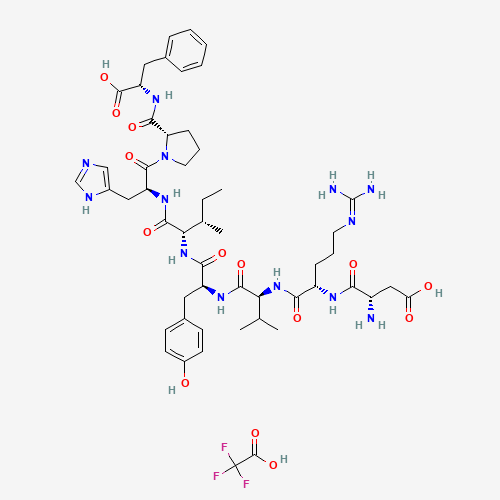
Angiotensin II human TFA
CAS number:2761969-44-0 molecular formula:C52H72F3N13O14
overview
compound introduction
Specs
| Chinese alias | 血管紧张素 II 人类 TFA | ||
| English alias | - | ||
| CAS number | 2761969-44-0 | molecular formula | C52H72F3N13O14 |
| molecular weight | 1160.20 g/mol | Exact mass | ≥99% |
| PSA | - | logp | - |
numbering system
No numbering system information yet
physicochemical properties
No physical and chemical property information yet
Safety information
No safety information yet
Production methods and uses
No production method and use information yet
Related
upstream information
No upstream information yet
downstream information
No downstream information yet
MSDS
Found 0 shareMSDS




