
Description In the standard derivatives for introduction of phosphoserine and phosphothreonine in Fmoc SPPS, the phosphate side chain is monoprotected as a benzyl ester. The phosphate group therefore retains an acidic proton, which helps prevent beta-elimination of the phosphate group during the piperidine treatment utilized to remove the Fmoc protecting group in Fmoc SPPS. However, the acidic phosphate group can promote premature cleavage of peptides from hyperacid-labile resins such as 2-chlorotrityl resins. Furthermore, the phosphate forms piperidine salts during peptide assembly; these salts react with the activated Fmoc-amino acid during the coupling reaction, consuming valuable reagents and reducing their concentration.Fmoc-Ser(PO(NPr)2)OH and Fmoc-Thr(PO(NPr)2)-OH are novel derivatives for introduction of phosphoserine and phosphothreonine in Fmoc SPPS, in which the phosphate group is fully protected as a phosphodiamidate. Model studies indicate these compounds, lacking the residual acidic proton, do not appear to suffer the aforementioned drawbacks of the currently employed monobenzylphosphate derivatives. Removal of the dimethyamino groups are removed during the course of the normal TFA cleavage and deprotection reaction. Description In the standard derivatives for introduction of phosphoserine and phosphothreonine in Fmoc SPPS, the phosphate side chain is monoprotected as a benzyl ester. The phosphate group therefore retains an acidic proton, which helps prevent beta-elimination of the phosphate group during the piperidine treatment utilized to remove the Fmoc protecting group in Fmoc SPPS. However, the acidic phosphate group can promote premature cleavage of peptides from hyperacid-labile resins such as 2-chlorotrityl resins. Furthermore, the phosphate forms piperidine salts during peptide assembly; these salts react with the activated Fmoc-amino acid during the coupling reaction, consuming valuable reagents and reducing their concentration.Fmoc-Ser(PO(NPr)2)OH and Fmoc-Thr(PO(NPr)2)-OH are novel derivatives for introduction of phosphoserine and phosphothreonine in Fmoc SPPS, in which the phosphate group is fully protected as a phosphodiamidate. Model studies indicate these compounds, lacking the residual acidic proton, do not appear to suffer the aforementioned drawbacks of the currently employed monobenzylphosphate derivatives. Removal of the dimethyamino groups are removed during the course of the normal TFA cleavage and deprotection reaction.
All
Chemical Reagents
Biomedicine
Organic raw materials
Inorganic chemical industry
intermediate
Agricultural chemicals
Auxiliaries and catalysts
Fragrances and Flavors
Dyes and Pigments
Daily chemical industry
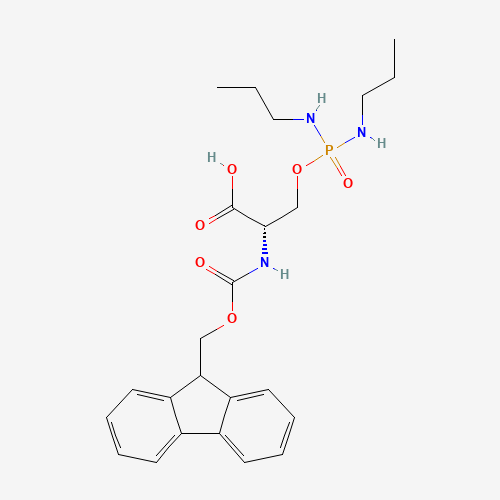
Fmoc-Ser(PO(NHPr)₂)-OH
CAS number:216061-08-4 molecular formula:
overview
compound introduction
Specs
| Chinese alias | - | ||
| English alias | Fmoc-Ser(PO(NH-CH₂-CH₂-CH₃)₂)-OH, Fmoc-protected phosphorylated serine amino acid building block, N-(((9H-Fluoren-9-yl)methoxy)carbonyl)-O-(bis(propylamino)phosphoryl)-L-serine | ||
| CAS number | 216061-08-4 | molecular formula | |
| molecular weight | 489.5 g/mol | Exact mass | ≥95% |
| PSA | - | logp | - |
numbering system
No numbering system information yet
physicochemical properties
No physical and chemical property information yet
Safety information
No safety information yet
Production methods and uses
No production method and use information yet
Related
upstream information
No upstream information yet
downstream information
No downstream information yet
MSDS
Found 0 shareMSDS