
Zeaxanthin dipalmitate (Physalien) is a wolfberry-derived carotenoid, has anti-inflammatory and anti-oxidative stress effects. Zeaxanthin dipalmitate directly interact with p2X7 receptor ( K d =81.2 nM) and adiponectin receptor 1 ( AdipoR1 ; K d =533 nM) in a positive dose-dependent manner. Zeaxanthin dipalmitate restores mitochondrial autophagy functions suppressed by ethanol intoxication. Zeaxanthin dipalmitate can be used in the research of alcoholic fatty liver disease (AFLD) and retinitis pigmentosa (RP) In Vitro Zeaxanthin dipalmitate (1 µM; 2 h) totally or partially reverses the down-regulation of Atg5, beclin-1, and LC3A/B by ethanol (250 mM), and the up-regulation of p62 by ethanol in BRL-3A cells. Zeaxanthin dipalmitate (1 µM; 2 h) partially recovers the ethanol-suppressed LC3B in BRL-3A cells. Zeaxanthin dipalmitate (1 µM; 2 h) partially recovers the ethanol-suppressed cell viability and ethanol-induced aspase-3/7 activity of BRL-3A cells. Zeaxanthin dipalmitate (1 µM; 2 h) recovers the ethanol-induced inhibition of mitophagy in BRL-3A cells. MCE has not independently confirmed the accuracy of these methods. They are for reference only. In Vivo Zeaxanthin dipalmitate (10 mg/kg; p.o.; daily for 2 weeks) reduces the serum ALT and AST levels increased by long-term ethanol challenge in at AFLD Model . Zeaxanthin dipalmitate (10 mg/kg; p.o.; daily for 2 weeks) effectively attenuates the histological injury . Zeaxanthin dipalmitate (10 mg/kg; p.o.; daily for 2 weeks) attenuates the AFLD-induced hepatic apoptosis (reveal by caspase-3/7 activity) and inflammation (TNF-α) in rat . Zeaxanthin dipalmitate (approximately 4 μM; intravitreal injection for once) improves the visual behavior of rd10 mice and delays the degeneration of retinal photoreceptors. Zeaxanthin dipalmitate (approximately 4 μM; intravitreal injection for once) improves the light responses of photoreceptors, bipolar cells and retinal ganglion cells. Zeaxanthin dipalmitate (approximately 4 μM; intravitreal injection for once) reduces the expression of genes that are involved in inflammation, apoptosis and oxidative stress in rd10 mice. MCE has not independently confirmed the accuracy of these methods. They are for reference only. Form:Solid IC50& Target:p2X7/AdipoR1 receptor
All
Chemical Reagents
Biomedicine
Organic raw materials
Inorganic chemical industry
intermediate
Agricultural chemicals
Auxiliaries and catalysts
Fragrances and Flavors
Dyes and Pigments
Daily chemical industry
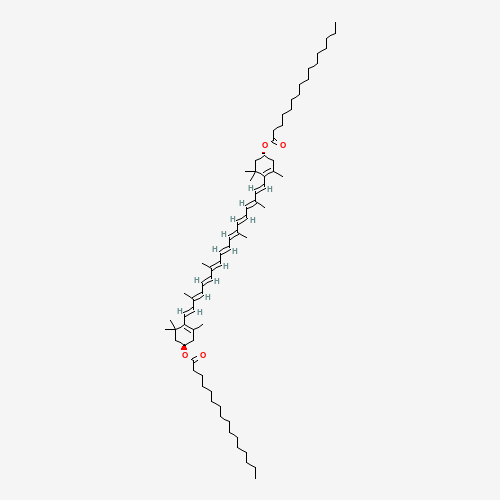
Zeaxanthin dipalmitate
CAS number:144-67-2 molecular formula:C72H116O4
overview
compound introduction
Specs
| Chinese alias | 玉米黄质二棕榈酸酯 | ||
| English alias | NCGC00182606-01 | .BETA.,.BETA.-CAROTENE-3,3'-DIOL, 3,3'-DIHEXADECANOATE, (3R,3'R)- | PHYSALIEN, ALL-TRANS- | CAS-144-67-2 | .BETA.-CAROTENE-3,3'-DIOL, DIPALMITATE, ALL-TRANS- | EINECS 205-635-9 | XACHQDDXHDTRLX-XLVVAOPESA-N | Piceid (cis-) | 570944I2YB | | ||
| CAS number | 144-67-2 | molecular formula | C72H116O4 |
| molecular weight | 1045.69 g/mol | Exact mass | ≥95% |
| PSA | 52.600 Ų | logp | 26.700 |
numbering system
No numbering system information yet
physicochemical properties
No physical and chemical property information yet
Safety information
No safety information yet
Production methods and uses
No production method and use information yet
Related
upstream information
No upstream information yet
downstream information
No downstream information yet
MSDS
Found 0 shareMSDS