

Infigratinib phosphate (BGJ-398 phosphate; NVP-BGJ398 phosphate) is a potent inhibitor of the FGFR family with IC 50 of 0.9 nM, 1.4 nM, 1 nM, and 60 nM for FGFR1 , FGFR2 , FGFR3 , and FGFR4 , respectively. In Vitro Infigratinib phosphate inhibits FGFR1, FGFR2, and FGFR3 with IC 50 =~1 nM, FGFR3 K650E with IC 50 =4.9 nM, and FGFR4 with IC 50 =60 nM. IC 50 values for all other kinases are in the μM range (FYN, LCK, YES, and ABL, IC 50 =1.9, 2.5, 1.1, and 2.3 μM, respectively) except for VEGFR2, KIT, and LYN, which are inhibited at submicromolar concentrations (IC 50 =0.18, 0.75, and 0.3 μM, respectively). Infigratinib inhibits the proliferation of the FGFR1-, FGFR2-, and FGFR3-dependent BaF3 cells with IC 50 values which are in the low nanomolar range and comparable to those observed for the inhibition of the receptors kinase activity in the enzymatic assay. For the remaining cells, all IC 50 values are greater than 1.5 μM except for VEGFR2 (IC 50 1449 and 938 nM), for which there is at least a 400-fold selectivity versus FGFR1, FGFR2, and FGFR3. Infigratinib (ranging between 1 nM and 10 μM) is potent at inhibiting cell growth of FGFR2 -mutant endometrial cancer cells. MCE has not independently confirmed the accuracy of these methods. They are for reference only. In Vivo Infigratinib is administered to athymic nude mice implanted subcutaneously with RT112/luc1 tumors: either as a 5 mg/kg intravenous bolus in NMP/PEG200 (1:9, v/v) or orally by gavage as a suspension in PEG300/D5W (2:1, v/v) at a 20 mg/kg dose. The relevant pharmacokinetic (PK) parameters indicate that the oral bioavailability of Infigratinib in this study is 32%. After intravenous dosing, Infigratinib shows a rapid distribution from the vascular compartment into the peripheral tissues, translating into a high volume of distribution (26 L/kg). The plasma clearance is high at 3.3 L/h/kg (61% of liver blood flow). The ratio of tumor to plasma after oral dosing based on AUC is determined to be 10 . Infigratinib (30 mg/kg) significantly inhibits the growth of FGFR2 -mutated endometrial cancer xenograft models. MCE has not independently confirmed the accuracy of these methods. They are for reference only. Form:Solid IC50& Target:FGFR1 0.9 nM (IC 50 ) FGFR2 1.4 nM (IC 50 ) FGFR3 1 nM (IC 50 ) FGFR4 60 nM (IC 50 )
All
Chemical Reagents
Biomedicine
Organic raw materials
Inorganic chemical industry
intermediate
Agricultural chemicals
Auxiliaries and catalysts
Fragrances and Flavors
Dyes and Pigments
Daily chemical industry
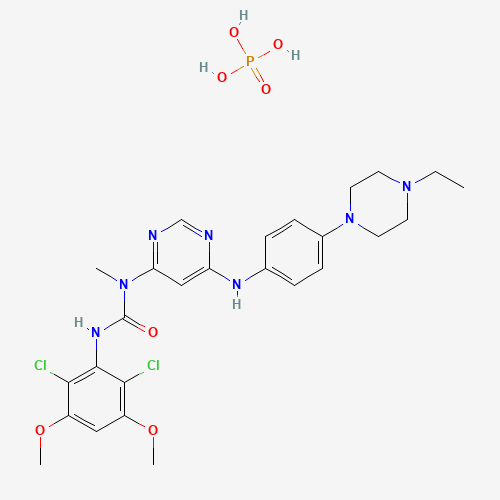
Infigratinib phosphate
CAS number:1310746-10-1 molecular formula:C26H34Cl2N7O7P
overview
compound introduction
Specs
| Chinese alias | 磷酸英菲格拉替尼 | ||
| English alias | N'-(2,6-DICHLORO-3,5-DIMETHOXYPHENYL)-N-(6-(4-(4-ETHYLPIPERAZIN-1-YL)ANILINO)PYRIMIDIN-4-YL)-N-METHYLUREA PHOSPHATE (1:1) | 3-(2,6-dichloro-3,5-dimethoxyphenyl)-1-[6-[4-(4-ethylpiperazin-1-yl)anilino]pyrimidin-4-yl]-1-methylurea;phosphoric acid | NVP-BGJ3 | ||
| CAS number | 1310746-10-1 | molecular formula | C26H34Cl2N7O7P |
| molecular weight | 658.47 g/mol | Exact mass | - |
| PSA | 173.000 Ų | logp | - |
numbering system
No numbering system information yet
physicochemical properties
No physical and chemical property information yet
Safety information
No safety information yet
Production methods and uses
No production method and use information yet
Related
upstream information
No upstream information yet
downstream information
No downstream information yet
MSDS
Found 0 shareMSDS




