

Prodigiosin (Prodigiosine) hydrochloride is a red pigment produced by bacteria as a bioactive secondary metabolite. Prodigiosin hydrochloride is a potent proapoptotic agent, and inhibits Wnt/β-catenin pathway. Prodigiosin hydrochloride has antibacterial, antifungal, antiprotozoal, antimalarial, immunosuppressive, and anticancer properties In Vitro Prodigiosin (25-500 nM; 24 hours) treatment reduces the viability of breast cancer cells, with IC 50 values at 48 h of 62.52 nM in MDA-MB-231 cells and 261.2 nM in MDA-MB-468 cells. Prodigiosin (25-500 nM; 24 hours) treatment significantly reduces the levels of phosphorylated LRP6 and DVL2, active β-catenin, and total β-catenin. Prodigiosin noticeably inhibits the phosphorylation of GSK3β at Ser9 in HEK293T cells, which is indicative of an increase in GSK3β activity. Prodigiosin can inhibit proliferation and induce apoptosis in breast cancer cells. Prodigiosin (25-500 nM; 24 hours) treatment dose-dependently blocks Wnt signaling activated by Wnt1, Wnt3, Wnt1/LRP6, Wnt3/LRP6, and Dishevelled 2 (DVL2) in transfected HEK293T cells. Prodigiosin treatment inhibits Wnt3A-CM-induced transcription in a dose-dependent manner. Prodigiosin inhibits transcription of the SuperTopFlash reporter activated by either Wnt transfection or Wnt3A treatment. When applied to cultures of chytrid fungi Batrachochytrium dendrobatidis and B. salamandrivorans , Prodigiosin causes significant growth inhibition, with MIC values of 10 μM and 50 μM, respectively. MCE has not independently confirmed the accuracy of these methods. They are for reference only. Cell Proliferation AssayCell Line: MDA-MB-231 and MDA-MB-468 cells Concentration: 10 nM, 25 nM, 50 nM, 100 nM, 250 nM, 500 nM, 1000 nM, 2500 nM, 5000 nM Incubation Time: 24 hours, 48 hours Result: Reduced the viability of breast cancer cells, with IC50 values at 48 h of 62.52 nM in MDA-MB-231 cells and 261.2 nM in MDA-MB-468 cells. Western Blot AnalysisCell Line: HEK293T cells Concentration: 50 nM, 100 nM, 250 nM, 500 nM Incubation Time: 24 hours Result: Significantly reduced the levels of phosphorylated LRP6 and DVL2, active β-catenin, and total β-catenin. In Vivo Prodigiosin (5 mg/kg; intraperitoneal injection; twice weekly; for 3 weeks) treatment significantly inhibits tumor growth. Prodigiosin treatment decreases tumor cell density and expression of the proliferation marker Ki-67 . MCE has not independently confirmed the accuracy of these methods. They are for reference only. Animal Model: Female BALB/c nude mice injected with MDA-MB-231 cells Dosage: 5 mg/kg Administration: Intraperitoneal injection; twice weekly; for 3 weeks Result: Significantly inhibited tumor growth in mice. Form:Solid IC50& Target:Plasmodium
All
Chemical Reagents
Biomedicine
Organic raw materials
Inorganic chemical industry
intermediate
Agricultural chemicals
Auxiliaries and catalysts
Fragrances and Flavors
Dyes and Pigments
Daily chemical industry
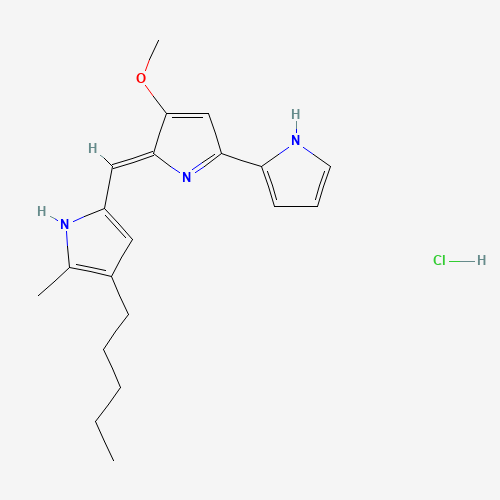
Prodigiosin hydrochloride
CAS number:56144-17-3 molecular formula:C20H26ClN3O
overview
compound introduction
Specs
| Chinese alias | 盐酸灵菌红素 | ||
| English alias | - | ||
| CAS number | 56144-17-3 | molecular formula | C20H26ClN3O |
| molecular weight | 359.89 g/mol | Exact mass | ≥98% |
| PSA | - | logp | - |
numbering system
No numbering system information yet
physicochemical properties
No physical and chemical property information yet
Safety information
No safety information yet
Production methods and uses
No production method and use information yet
Related
upstream information
No upstream information yet
downstream information
No downstream information yet
MSDS
Found 0 shareMSDS




