

Rho-Kinase-IN-2 (Compound 23) is an orally active, selective, and central nervous system (CNS)-penetrant Rho Kinase ( ROCK ) inhibitor (ROCK2 IC 50 =3 nM). Rho-Kinase-IN-2 can be used in Huntington’s research In Vitro Rho-Kinase-IN-2 (0-10 mM, 1 hour) treatment shows an increase in AKT phosphorylation and a decrease in MYPT1 phosphorylation. MCE has not independently confirmed the accuracy of these methods. They are for reference only. Western Blot AnalysisCell Line: A7r5 and PANC1 cells Concentration: 0-10 mM Incubation Time: 1 hour Result: Showed concentration-dependent effects, leading to an increase in AKT phosphorylation (EC 50 =28 nM) and a decrease in MYPT1 phosphorylation (IC 50 =14 nM). In Vivo Rho-Kinase-IN-2 (oral adiministration; 10 mg/kg; 6 times; 0.5, 1, 2, 4, 8, and 12 h) treatment shows dose- and time-dependent ROCK1 and ROCK2 target engagement . Rho-Kinase-IN-2 (oral adiministration; 10 or 20 mg/kg; QD or BID; 2 weeks) treatment shows excellent tolerability assessment . Rho-Kinase-IN-2 (oral adiministration; 1-20 mg/kg; once) treatment shows a direct dose- and time-dependent relationship between brain exposure and MYPT1 phosphorylation status . Rho-Kinase-IN-2 (oral adiministration; 10 or 20 mg/kg; once) treatment decreases in the mean arterial, systolic, diastolic blood pressure, and heart rate . Rho-Kinase-IN-2 (oral adiministration; 10 mg/kg; twice a day; 90 days) treatment leads to lower-than-expected brain concentrations . MCE has not independently confirmed the accuracy of these methods. They are for reference only. Animal Model: Male C57BL/6 mice Dosage: 10 mg/kg Administration: Oral adiministration; 10 mg/kg; 6 times; 0.5, 1, 2, 4, 8, and 12 h Result: Observed dose- and time-dependent ROCK1 and ROCK2 TE, with a free brain KiNativ ROCK1 and ROCK2 IC 50 =∼6 nM. Animal Model: 3−4 months old heterozygote Q175DN KI and wild-type littermate mice Dosage: 10 or 20 mg/kg Administration: Oral adiministration; 10 or 20 mg/kg; once a day or twice a day; 2 weeks Result: Scored neurological index normally at all doses although a slight loss in bodyweight (∼2%) in the 20 mg/kg treatment group. Animal Model: Heterozygote HTT zQ175DN knock-in mice Dosage: 1-20 mg/kg Administration: Oral adiministration; 1-20 mg/kg; once Result: Remained over MYPT1 IC 50 for over 2 h of the free brain at 10 mg/kg, and observed the dose- and time-dependent inhibition of MYPT1 phosphorylation in the striatum following acute in vivo dosing. Animal Model: CD1 mice Dosage: 10 and 20 mg/kg Administration: Oral adiministration; 10 or 20 mg/kg; once Result: Observed the decreases in the mean arterial (maximum change of 61.0 ± 8.5 mmHg from baseline), systolic (maximum change of 59.5 ± 8.4 mmHg from baseline), diastolic blood pressure (maximum change of 56.4 ± 9.0 mmHg from baseline), and heart rate (maximum change from predose of 107 bpm) when compared to the control group from ∼0.5 to 2 h post dose. Animal Model: Heterozygote Q175DN KI mouse model of HD Dosage: 10 mg/kg Administration: Oral adiministration; 10 mg/kg; twice a day; 90 days Result: Led to lower-than-expected brain concentrations compared to single dosing. Form:Solid IC50& Target:ROCK2 3 nM (IC 50 )
All
Chemical Reagents
Biomedicine
Organic raw materials
Inorganic chemical industry
intermediate
Agricultural chemicals
Auxiliaries and catalysts
Fragrances and Flavors
Dyes and Pigments
Daily chemical industry
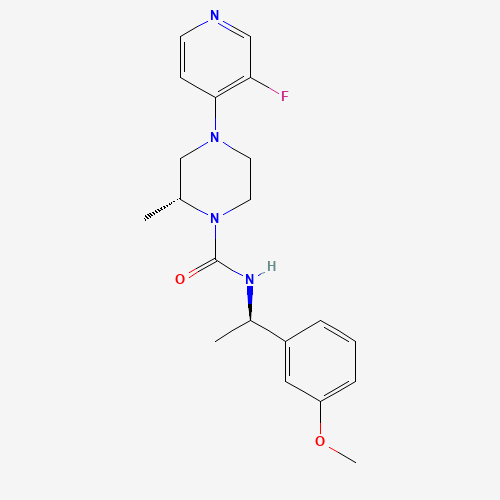
Rho-Kinase-IN-2
CAS number:2573071-18-6 molecular formula:C20H25FN4O2
overview
compound introduction
Specs
| Chinese alias | Rho-激酶-IN-2 | ||
| English alias | - | ||
| CAS number | 2573071-18-6 | molecular formula | C20H25FN4O2 |
| molecular weight | 372.44 g/mol | Exact mass | ≥99% |
| PSA | - | logp | - |
numbering system
No numbering system information yet
physicochemical properties
No physical and chemical property information yet
Safety information
No safety information yet
Production methods and uses
No production method and use information yet
Related
upstream information
No upstream information yet
downstream information
No downstream information yet
MSDS
Found 0 shareMSDS




