

Morphothiadin is a potent inhibitor on the replication of both wild-type and adefovir-resistant HBV with an IC 50 of 12 nM. In Vitro Morphothiadin is a potent inhibitor on the replication of both wild-type and adefovir-resistant HBV with an IC 50 of 12 nM. Morphothiadin (GLS4) shows no toxicity up to 25 μM. The cytotoxic dose whereby 50% of cells die (CC 50 ) for primary hepatocytes is 115 μM for Morphothiadin (P In Vivo The area under the concentration-time curve from 0 to 24 h (AUC 0-24 ) of Morphothiadin (GLS4) is 556 h•ng/mL. After intravenous administration of 10 mg/kg Morphothiadin, the total plasma clearance and apparent volume distribution are 4.2 liters/h/kg and 7.38 liters/kg, respectively. The bioavailability of Morphothiadin is 25.5%. It is found that virus titers have increased 83.5-fold in mice treated with 3.75 mg/kg per day of Morphothiadin, 28.3-fold among mice treated with 7.5 mg/kg per day, but only 3- to 6-fold among mice treated with the higher doses of Morphothiadin. There is generally an inverse relationship between Morphothiadin dose and virus titer, with the greatest rebound seen in mice treated with 3.75 mg/kg per day of Morphothiadin (540-fold) and the smallest rebound in mice treated with 60 mg/kg per day (23-fold) (P 7.5 mg/kg per day significantly suppresses the virus replication cycle throughout the treatment period, while Morphothiadin doses of >15 mg/kg per day suppresses virus for up to 2 weeks after the end of treatment. MCE has not independently confirmed the accuracy of these methods. They are for reference only. Cell Assay HepAD38 cells are grown to about 80% confluence in 0.3 μg/mL of tetracycline (TET). After the removal of TET, the cells are treated with different doses of Morphothiadin (GLS4), or no drug. Cell viability is monitored by 3-(4,5-dimethyl-2-thiazolyl)-2,5-diphenyl-2H-tetrazolium bromide (MTT) assay. MCE has not independently confirmed the accuracy of these methods. They are for reference only. Animal administration ICR mice are used to evaluate the pharmacokinetic (PK) properties of Morphothiadin (GLS4). Following oral administration of 10 mg/kg ( of body weight ) of Morphothiadin to male mice, the concentration of Morphothiadin in plasma is determined using liquid chromatography-tandem mass spectrometry (LC/MS/MS). For toxicity studies, ICR mice are given Morphothiadin by gavage over a 4-week period and then kept off drug for another 2 weeks. Groups consisting of 20 male plus 20 female mice are administered a vehicle (1% methyl-2-hydroxyethyl cellulose), 35.7, 118.9, or 356.6 mg/kg per day in a volume corresponding to 20 mL/kg. Ten mice per dose group are euthanized 2 weeks after the end of drug treatment. Body weight, food consumption, serum albumin levels, and adverse effects are determined . aladdin has not independently confirmed the accuracy of these methods. They are for reference only. Form:Solid IC50& Target:IC50: 12 nM (HBV)
All
Chemical Reagents
Biomedicine
Organic raw materials
Inorganic chemical industry
intermediate
Agricultural chemicals
Auxiliaries and catalysts
Fragrances and Flavors
Dyes and Pigments
Daily chemical industry
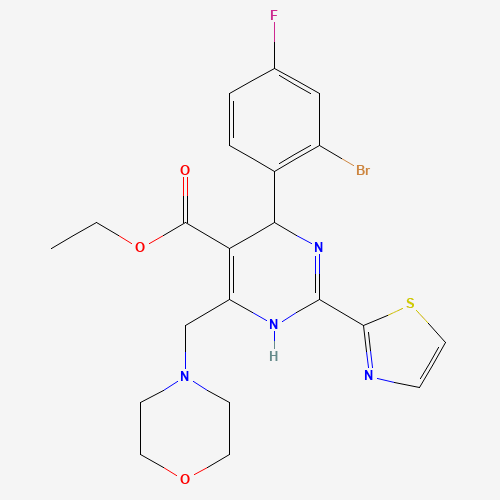
Morphothiadin
CAS number:1092970-12-1 molecular formula:C21H22BrFN4O3S
overview
compound introduction
Specs
| Chinese alias | 莫非赛定 | ||
| English alias | GLS4 | 4-(2-bromo-4-fluorophenyl)-1,4-dihydro-6-(4-morpholinylmethyl)-2-(2-thiazolyl)-5-pyrimidinecarboxylic acid, ethyl ester | ||
| CAS number | 1092970-12-1 | molecular formula | C21H22BrFN4O3S |
| molecular weight | 509.39 g/mol | Exact mass | ≥98% |
| PSA | 104.000 Ų | logp | 2.500 |
numbering system
No numbering system information yet
physicochemical properties
No physical and chemical property information yet
Safety information
No safety information yet
Production methods and uses
No production method and use information yet
Related
upstream information
No upstream information yet
downstream information
No downstream information yet
MSDS
Found 0 shareMSDS




