

Parsaclisib hydrochloride (INCB050465 hydrochloride) is a potent, selective and orally active inhibitor of PI3Kδ , with an IC 50 of 1 nM at 1 mM ATP. Parsaclisib hydrochloride shows approximately 20000-fold selectivity over other PI3K class I isoforms. Parsaclisib hydrochloride can be used for the research of relapsed or refractory B-cell malignancies In Vitro Parsaclisib (0.1-3000 nM; 4 d) inhibits proliferation of MCL and DLBCL cell lines. Parsaclisib (0.1-1000 nM; 2 h) inhibits anti-IgM-induced pAKT (Ser473) in the Ramos Burkitt’s lymphoma cell line, with an IC 50 of 1 nM. Parsaclisib inhibits the proliferation of human, dog, rat, and mouse primary B cells after activation of these receptors, with IC 50 s ranging from 0.2 to 1.7 nM. MCE has not independently confirmed the accuracy of these methods. They are for reference only. Cell Proliferation AssayCell Line: Jeko-1, Mino, JVM2, Rec-1, Pfeiffer, SU-DHL-5, SU-DHL-6, WSU-NHL, SU-DHL-4, SU-DHL-8, and WILL-2 cells Concentration: 0.1-3000 nM Incubation Time: 4 days Result: Resulted in a maximal inhibition of 70-90%, with IC 50 s of ≤10 nM in the four MCL cell lines. Pfeiffer, SU-DHL-5, SU-DHL-6, and WSU-NHL were highly sensitive, with IC 50 s from 2 to 8 nM. In Vivo Parsaclisib (10 mg/kg; oral gavage twice daily for 7-19 days) inhibits tumor growth in the BALB/c mice bearing the A20 murine lymphoma cells. Parsaclisib (0.1-10 mg/kg; p.o. twice daily) slows Pfeiffer xenograft tumor growth in a dose-dependent manner. And Parsaclisib was well tolerated. Parsaclisib (0.5-1 mg/kg; a single p.o.) inhibits pAKT (Ser473) in Pfeiffer subcutaneous mouse xenograft models. MCE has not independently confirmed the accuracy of these methods. They are for reference only. Animal Model: Female BALB/c mice (5-9 weeks) were inoculated with A20 cellsDosage: 10 mg/kg Administration: Oral gavage twice daily for 7-19 days Result: Resulted in significant tumor growth inhibition (TGI). Reduced the percentage of Tregs (CD4 + CD25 + FOXP3 + ) in tumors and spleens. Increased the ratio of CD4 + and CD8 + T cells to Tregs in spleens and tumors. Decreased the number of CD4 + CD44 high and CD8 + CD44 high T cells in both spleens and tumors. Form:Solid IC50& Target:PI3Kδ 1 nM (IC 50 )
All
Chemical Reagents
Biomedicine
Organic raw materials
Inorganic chemical industry
intermediate
Agricultural chemicals
Auxiliaries and catalysts
Fragrances and Flavors
Dyes and Pigments
Daily chemical industry
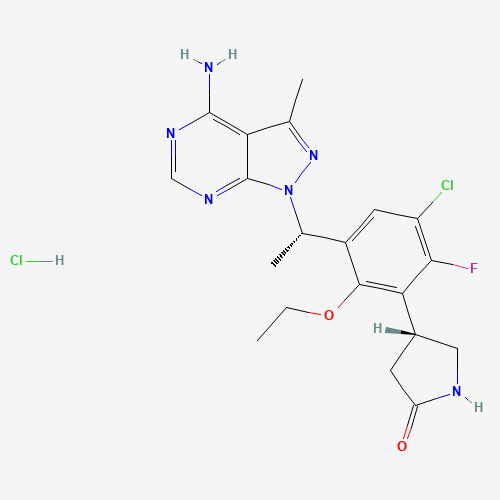
Parsaclisib hydrochloride
CAS number:1995889-48-9 molecular formula:C20H23Cl2FN6O2
overview
compound introduction
Specs
| Chinese alias | 盐酸帕沙克利西 | ||
| English alias | (R)-4-(3-((S)-1-(4-amino-3-methyl-1H-pyrazolo[3,4-d]pyrimidin-1-yl)ethyl)-5-chloro-2-ethoxy-6-fluorophenyl)pyrrolidin-2-one hydrochloride | (R)-4-(3-((S)-1-(4-Amino-3-methyl-1H-pyrazolo[3,4-d]pyrimidin-1-yl)ethyl)-5-chloro-2-ethoxy-6-fluorophenyl)pyrrolid | ||
| CAS number | 1995889-48-9 | molecular formula | C20H23Cl2FN6O2 |
| molecular weight | 469.34 g/mol | Exact mass | ≥98% |
| PSA | 108.000 Ų | logp | - |
numbering system
No numbering system information yet
physicochemical properties
No physical and chemical property information yet
Safety information
No safety information yet
Production methods and uses
No production method and use information yet
Related
upstream information
No upstream information yet
downstream information
No downstream information yet
MSDS
Found 0 shareMSDS




