

LHVS is a potent, non-selective, irreversible, cell-permeable cysteine protease and cathepsin inhibitor. LHVS decreases actin ring formation. LHVS inhibits T. gondii invasion with an IC 50 of 10 μM In Vitro LHVS (5 μM, 2 h) results in a 50% reduction of actin ring formation in wild-type osteoclasts when compared with untreated osteoclasts. LHVS acts in a dose-dependent manner on osteoclasts and at 5 μM, LHVS inhibits cathepsins K, L, S, and B. LHVS (1-5 nM) can inhibit specifically cathepsin S in HOM2 cells, leaving other cysteine proteases functionally active. LHVS impairs tachyzoite attachment by blocking the release of at least two key invasion proteins, MIC2 and M2AP, from the micronemes. LHVS (50 μM) selectively impairs microneme protein secretion. MCE has not independently confirmed the accuracy of these methods. They are for reference only. In Vivo LHVS (3-30 mg/kg, SC, once) shows anti-hyperalgesic effect in neuropathic rats. LHVS (30 nmol per rat, spinal delivery, daily) is antinociceptive in neuropathic rats. LHVS (1-50 nmol per rat, Intrathecal injection, daily) reverses established neuropathic mechanical hyperalgesia in 14-day neuropathic rats. MCE has not independently confirmed the accuracy of these methods. They are for reference only. Animal Model: Male Wistar rats (180-220 g)Dosage: 3-30 mg/kg Administration: SC, once Result: Produced a dose-dependent reversal of the mechanical hyperalgesia which lasted up to 3 h in neuropathic rats. In contrast, a single systemic administration of LHVS did not reverse mechanical allodynia in neuropathic rats. Animal Model: Male Wistar rats received a partial ligation of the left sciatic nerve (PNL)Dosage: 30 nmol per rat Administration: Spinal delivery, Daily Result: Failed to prevent the development of allodynia when continuous delivery from day 0 to day 7 post-PNL, but significantly reversed allodynia on day 7 post-PNL. In addition, the delivery of LHVS from day 7 to day 14 post-PNL significantly reversed established mechanical allodynia from day 8. Animal Model: Male Wistar rats received a partial ligation of the left sciatic nerve (PNL)Dosage: 1, 10 or 50 nmol per rat Administration: Intrathecal injection, Daily Result: Reduced established mechanical hyperalgesia. This effect was dose-dependent and remained significant until 3 h after administration of the highest dose. Form:Solid IC50& Target:cathepsin S cathepsin K cathepsin L Cathepsin B
All
Chemical Reagents
Biomedicine
Organic raw materials
Inorganic chemical industry
intermediate
Agricultural chemicals
Auxiliaries and catalysts
Fragrances and Flavors
Dyes and Pigments
Daily chemical industry
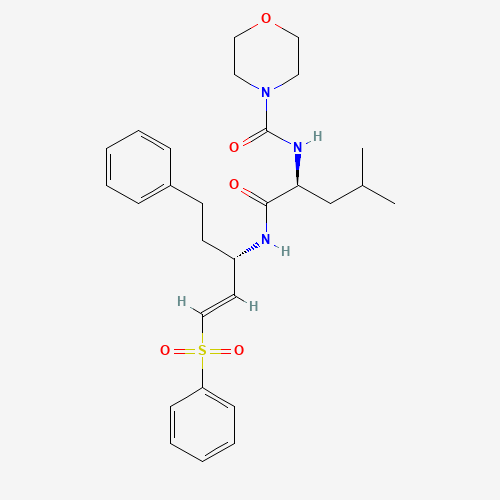
LHVS
CAS number:170111-28-1 molecular formula:C28H37N3O5S
overview
compound introduction
Specs
| Chinese alias | - | ||
| English alias | - | ||
| CAS number | 170111-28-1 | molecular formula | C28H37N3O5S |
| molecular weight | 527.68 g/mol | Exact mass | ≥99% |
| PSA | - | logp | - |
numbering system
No numbering system information yet
physicochemical properties
No physical and chemical property information yet
Safety information
No safety information yet
Production methods and uses
No production method and use information yet
Related
upstream information
No upstream information yet
downstream information
No downstream information yet
MSDS
Found 0 shareMSDS




