

K777 is a potent, orally active and irreversible cysteine protease inhibitor. K777 is also a potent CYP3A4 inhibitor with an IC 50 of 60 nM and a selective CCR4 antagonist featuring the potent chemotaxis inhibition. K777 irreversibly inhibits Cruzain, the major cysteine protease of Trypansoma cruzi , and cathepsins B and L . K777 is a broad-spectrum antiviral by targeting cathepsin-mediated cell entry. K777 inhibits SARS-CoV and EBOV pseudovirus entry with IC 50 values of 0.68 nM and 0.87 nM, respectively In Vitro K777 (K11777) can inhibit entry driven by other viral envelope proteins, including HIV-based pseudotypes bearing spikes from coronaviruses (SARS-CoV, HCoV-229E, NL63, MERS-CoV) or glycoproteins from filoviruses (EBOV, SUDV, TAFV, RESTV, BEBOV and MARV). K777 inhibits SARS-CoV, HCoV-229E, NL63, MERS-CoV, EBOV, SUDV, TAFV, RESTV, BEBOV, MARV and Nipah pseudovirus entry with IC 50 values of 0.68 nM, 1.48 nM, 6.78 nM, 46.12 nM, 0.87 nM, 1.14 nM, 2.26 nM, 3.37 nM, 5.91 nM, 1.9 nM and 0.42 nM, respectively. In contrast, 100 nM K777 does not inhibit infection mediated by envelope glycoproteins from an alphavirus (CHIKV), a rhabdovirus (VSV), a flavivirus (HCV), the retroviruses MLV-A and XMRV or two arenaviruses, Lassa and Junin virus. K777 alone demonstrates up to ~ 70% inhibition of 229E-S-mediated transduction. Simultaneous treatment with Camostat and K777 increases inhibition to ~ 90%. Similar inhibition patterns are obtained using the human intestinal epithelial cell line Caco-2, which express endogenous TMPRSS2 and cathepsins. K777 inhibits both CCL17 binding and CCL17-induced chemotaxis in Hut78 cells (IC 50 of 57 and 8.9 nM, respectively). The K777-mediated inhibition of chemotaxis is potent even in the presence of a 10-fold higher concentration of CCL17. K777 induces CCR4 internalization, with a ~50% reduction of cell surface CCR4. K777 does not inhibit CXCR4-induced chemotaxis or internalization and did not bring about Ca 2+ mobilization by itself. MCE has not independently confirmed the accuracy of these methods. They are for reference only. In Vivo K777 (K11777; 35-105 mg/kg; oral administration; twice a day; for 10 days; C57BL/6 IFN-γR-KO mice) treatment rescues mice from otherwise lethal infections. MCE has not independently confirmed the accuracy of these methods. They are for reference only. Animal Model: C57BL/6 IFN-γR-KO mice (6-8 weeks of age) injected with Cryptosporidium parvumDosage: 35 mg/kg, 70 mg/kg, and 105 mg/kg Administration: Oral administration; twice a day; for 10 days Result: Rescued mice from otherwise lethal infections. Form:Solid IC50& Target:CCR4 CYP3
All
Chemical Reagents
Biomedicine
Organic raw materials
Inorganic chemical industry
intermediate
Agricultural chemicals
Auxiliaries and catalysts
Fragrances and Flavors
Dyes and Pigments
Daily chemical industry
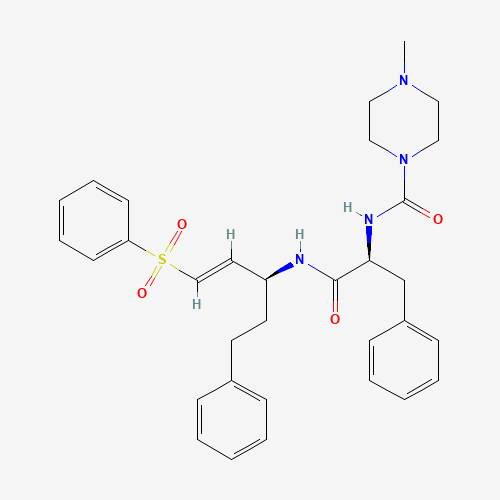
K777
CAS number:233277-99-1 molecular formula:C32H38N4O4S
overview
compound introduction
Specs
| Chinese alias | 中铬黄 | ||
| English alias | PB47841 | SLV213 | BDBM50229129 | HY-119293 | 4-Methyl-piperazine-1-carboxylic acid [(S)-1-((E)-(S)-3-benzenesulfonyl-1-phenethyl-allylcarbamoyl)-2-phenyl-ethyl]-amide | MS-30352 | ||
| CAS number | 233277-99-1 | molecular formula | C32H38N4O4S |
| molecular weight | 574.73 g/mol | Exact mass | - |
| PSA | 107.000 Ų | logp | 4.100 |
numbering system
No numbering system information yet
physicochemical properties
No physical and chemical property information yet
Safety information
No safety information yet
Production methods and uses
No production method and use information yet
Related
upstream information
No upstream information yet
downstream information
No downstream information yet
MSDS
Found 0 shareMSDS




