

Buparlisib Hydrochloride (BKM120 Hydrochloride) is a pan-class I PI3K inhibitor, with IC 50 of 52 nM/166 nM/116 nM/262 nM for p110α / p110β / p110δ / p110γ , respectively. In Vitro Buparlisib (BKM120) exhibits 50-300 nM activity for class I PI3K’s, including the most common p110α mutants. Additionally, NVP-BKM120 exhibits lower potency against class III and class IV PI3K's, where 2, 5, >5, and >25 μM biochemical activity is observed for inhibition of VPS34, mTOR, DNAPK, and PI4K, respectively. Buparlisib (BKM120) induces multiple myeloma (MM) cell apoptosis in both dose- and time-dependent manners. Buparlisib (BKM120) at concentrations ≥10 μM induces significant apoptosis in all tested MM cell lines at 24 h (P In Vivo In A2780 xenograft tumors, oral dosing of Buparlisib (BKM120) at 3, 10, 30, 60, and 100 mg/kg results in a dose dependent modulation of pAKT Ser473 . Partial inhibition of pAKT Ser473 is observed at 3 and 10 mg/kg, and near complete inhibition is observed at doses of 30, 60, or 100 mg/kg, respectively. Inhibition of pAKT (normalized to total AKT) tracked well with both plasma and tumor drug exposure . Mice receiving Buparlisib (BKM120) (5 μM per kg per day for 15 days) treatment has significantly smaller tumor burdens as compare with control mice, which are measured as tumor volume (P Animal administration Mice Six- to eight-week-old female severe combined immunodeficiency (SCID) mice are used. SCID mice are subcutaneously inoculated in the right flank with 1 million ARP-1 or MM.1S cells suspended in 50 μL phosphate-buffered saline (PBS). After palpable tumor developed (tumor diameter ≥5 mm), mice are treated with intraperitoneal injection of DMSO/PBS or Buparlisib (BKM120) (5 μM per kg per day) for 15 days. Tumor sizes are measured every 5 days, and blood samples are collected at the same period. Tumor burdens are evaluated by measuring tumor size and detecting circulating human kappa chain or lambda chain. aladdin has not independently confirmed the accuracy of these methods. They are for reference only. Form:Solid IC50& Target:p110α 52 nM (IC 50 ) p110α-H1047R 58 nM (IC 50 ) p110α-E545K 99 nM (IC 50 ) p110δ 116 nM (IC 50 ) p110β 166 nM (IC 50 ) p110γ 262 nM (IC 50 ) Vps34 2.4 μM (IC 50 ) mTOR 4.6 μM (IC 50 )
All
Chemical Reagents
Biomedicine
Organic raw materials
Inorganic chemical industry
intermediate
Agricultural chemicals
Auxiliaries and catalysts
Fragrances and Flavors
Dyes and Pigments
Daily chemical industry
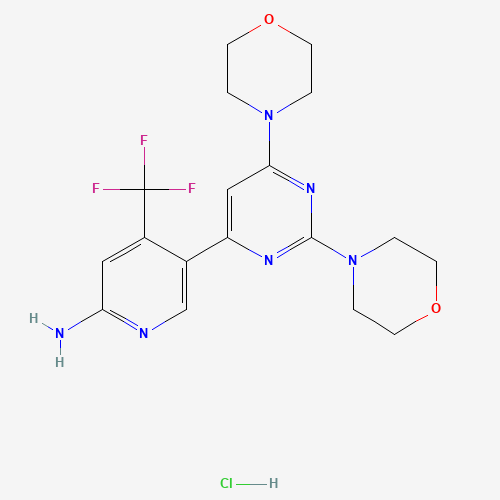
Buparlisib Hydrochloride
CAS number:1312445-63-8 molecular formula:C18H22ClF3N6O2
overview
compound introduction
Specs
| Chinese alias | 盐酸布帕利西布 | ||
| English alias | NVP-BKM120 Hydrochloride | 6-Methyl-2-oxo-1,2-dihydro-3-pyridinecarbonitrile # | NVP-BKM120 (Hydrochloride) | DTXSID50156980 | HY-15180 | 2-Pyridinamine, 5-(2,6-di-4-morpholinyl-4-pyrimidinyl)-4-(trifluoromethyl)-, hydrochloride (1:1) | 5-(2,6-Di-4-morpho | ||
| CAS number | 1312445-63-8 | molecular formula | C18H22ClF3N6O2 |
| molecular weight | 446.85 g/mol | Exact mass | ≥99% |
| PSA | 89.600 Ų | logp | - |
numbering system
No numbering system information yet
physicochemical properties
No physical and chemical property information yet
Safety information
No safety information yet
Production methods and uses
No production method and use information yet
Related
upstream information
No upstream information yet
downstream information
No downstream information yet
MSDS
Found 0 shareMSDS




