

K6PC-5, a ceramide derivative, is a sphingosine kinase 1(SPHK1) activator and elicites a rapid transient increase in intracellular calcium levels. K6PC-5 has the potential for skin diseases involving abnormal keratinocyte, and neurodegeneration and virus infection research In Vitro K6PC-5 (1-10 μM; 24 h) increases the involucrin and loricrin levels in a dose-dependent manner in normal human epidermal keratinocytes (NHEKs). K6PC-5 promotes differentiation and proliferation of keratinocytes via intracellular Ca 2+ signaling. In addition, K6PC-5 stimulates the phosphorylation of p42/44 extracellular signal-regulated kinase and c-Jun N-terminal kinase. K6PC-5 (1-10 μM; 24 h) promotes fibroblasts proliferation and collagen synthesis in human fibroblasts. K6PC-5 induces intracellular Ca 2+ concentration ([Ca 2+ ] i ) oscillations in human fibroblasts. K6PC-5 (10, 25, and 50 μM; 48 h) significantly attenuates EBOV-induced infection in EBOV-infected EA.hy926 cells. K6PC-5 significantly reduces the virus titers in supernatants of infected cells and strikingly decreased the amount of VP40 in a concentration-dependent manner. MCE has not independently confirmed the accuracy of these methods. They are for reference only. Western Blot AnalysisCell Line: Normal human epidermal keratinocytes (NHEKs) Concentration: 1 μM, 5 μM, 10 μM Incubation Time: 24 h Result: Increased the involucrin and loricrin levels in a dose-dependent manner. Cell Proliferation AssayCell Line: Human fibroblasts Concentration: 1 μM, 5 μM, 10 μM Incubation Time: 24 h Result: Promoted fibroblast proliferation and procollagen production in human fibroblasts significantly. In Vivo In intrinsically aged hairless mice (56 weeks old), 1% K6PC-5 is applied topically for 2 weeks. This K6PC-5 treatment significantly increases both the number of dermal fibroblasts and collagen production. As a consequence, dermal thickness also increased significantly. MCE has not independently confirmed the accuracy of these methods. They are for reference only. Animal Model: Intrinsically aged hairless mice (56 weeks old)Dosage: 1% (vehicle (PEG:EtOH = 7:3)) Administration: Topical application; twice daily for 2 weeks Result: Enhanced fibroblast proliferation, collagen production, and eventually increased dermal thickness. Form:Solid IC50& Target:SphK1
All
Chemical Reagents
Biomedicine
Organic raw materials
Inorganic chemical industry
intermediate
Agricultural chemicals
Auxiliaries and catalysts
Fragrances and Flavors
Dyes and Pigments
Daily chemical industry
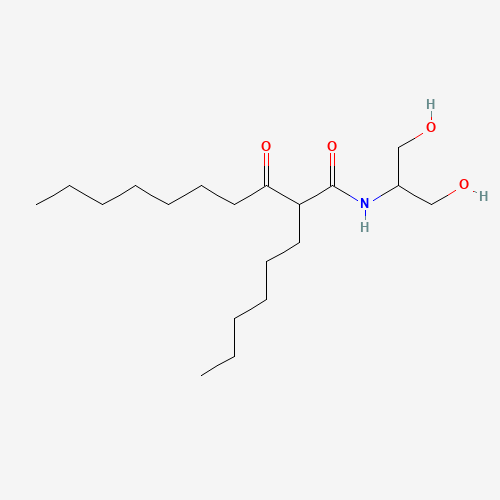
K6PC-5
CAS number:756875-51-1 molecular formula:C19H37NO4
overview
compound introduction
Specs
| Chinese alias | - | ||
| English alias | 9UO46U4GM1 | DTXSID50997113 | HY-124042 | N-(1,3-dihydroxypropan-2-yl)-2-hexyl-3-oxodecanamide | UNII-9UO46U4GM1 | F82343 | Dihydroxyisopropyl capryloylcaprylamide | MS-25262 | SCHEMBL23149790 | K6PC-5, >=98% (HPLC) | Q27273251 | C19H37NO4 | AKOS040748654 | ||
| CAS number | 756875-51-1 | molecular formula | C19H37NO4 |
| molecular weight | 343.5 g/mol | Exact mass | ≥99% |
| PSA | 86.600 Ų | logp | 4.200 |
numbering system
No numbering system information yet
physicochemical properties
No physical and chemical property information yet
Safety information
No safety information yet
Production methods and uses
No production method and use information yet
Related
upstream information
No upstream information yet
downstream information
No downstream information yet
MSDS
Found 0 shareMSDS




