
CNDAC hydrochloride is a metabolite of the orally active agent Sapacitabine , and a nucleoside analog. CNDAC hydrochloride induces DNA damage and apoptosis. In Vitro CNDAC has a unique mechanism of action: after incorporation into DNA, it induces single-strand breaks (SSBs) that are converted into double-strand breaks (DSBs) when cells go through a second S phase. Lack of Rad51D and XRCC3 sensitizes cells to CNDAC (0-1 μM; 24 h). CNDAC (0-100 μM; 3 days) inhibits proliferation of HL-60 and THP-1 cells. CNDAC (0-10 μM; 3-6 days) induces apoptosis in HL-60 and THP-1 cells. CNDAC (6 μM; 48 h) induces cell cycle arrest in the G2 phase following a delayed S phase in HCT116 cells. MCE has not independently confirmed the accuracy of these methods. They are for reference only. Cell Viability AssayCell Line: Rad51D-deficient 51D1, Rad51D-complemented 51D1.3, wild-type AA8 and XRCC3-deficient irs1SF CHO cells Concentration: 0-1 μM Incubation Time: 24 h Result: Inhibited cell survival with IC 50 s of 0.006, 0.32, 0.48 and 0.0053 μM against Rad51D-deficient 51D1, Rad51D-complemented 51D1.3, wild-type AA8 and XRCC3-deficient irs1SF cell lines, respectively. Cell Proliferation AssayCell Line: HL-60 and THP-1 cells Concentration: 0-100 μM Incubation Time: 3 days Result: Inhibited proliferation with IC 50 s of 1.5832 μM and 0.84 μM against HL-60 and THP-1 cells, respectively. Apoptosis AnalysisCell Line: HL-60 and THP-1 cells Concentration: 0, 0.5, 1, 2, 3, 4, 5 and 10 μM Incubation Time: 3, 4, 5, and 6 days Result: Induced apoptosis in both cells. Cell Cycle AnalysisCell Line: HCT116 Concentration: 6 μM Incubation Time: 48 h Result: 36 and 36% of cells were arrested in late-S and G2/M phases, respectively. In Vivo CNDAC (20mg/kg; i.p.; daily for 10 days) shows antitumor activity in mice. MCE has not independently confirmed the accuracy of these methods. They are for reference only. Animal Model: CDF1 mice, P388 tumor modelDosage: 20 mg/kg Administration: Intraperitoneal injection, daily for 10 days Result: Greatly increased the survival time and survival rate. Form:Solid
All
Chemical Reagents
Biomedicine
Organic raw materials
Inorganic chemical industry
intermediate
Agricultural chemicals
Auxiliaries and catalysts
Fragrances and Flavors
Dyes and Pigments
Daily chemical industry
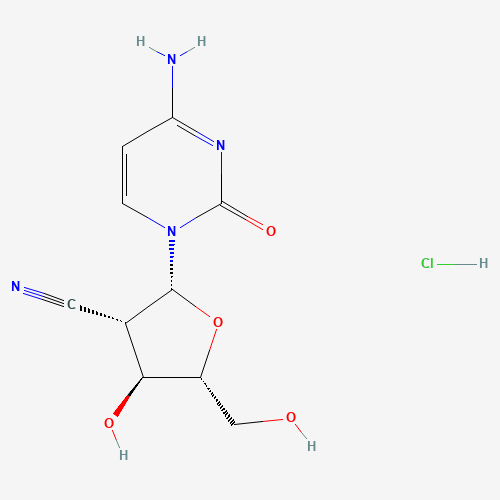
CNDAC hydrochloride
CAS number:134665-72-8 molecular formula:C10H13ClN4O4
overview
compound introduction
Specs
| Chinese alias | CNDAC盐酸盐 | ||
| English alias | CNDAC MONOHYDROCHLORIDE | RADGOCITABINE HYDROCHLORIDE | (2R,3S,4S,5R)-2-(4-amino-2-oxopyrimidin-1-yl)-4-hydroxy-5-(hydroxymethyl)oxolane-3-carbonitrile;hydrochloride | 2/'-Cyano-2/'-deoxyarabinofuranosylcytosine | 2'-Cyano-2'-deoxyarabinofuranosylcytosine | ||
| CAS number | 134665-72-8 | molecular formula | C10H13ClN4O4 |
| molecular weight | 288.69 g/mol | Exact mass | ≥99% |
| PSA | 132.000 Ų | logp | - |
numbering system
No numbering system information yet
physicochemical properties
No physical and chemical property information yet
Safety information
No safety information yet
Production methods and uses
No production method and use information yet
Related
upstream information
No upstream information yet
downstream information
No downstream information yet
MSDS
Found 0 shareMSDS