
Information S 38093 is ahistamine H3antagonist/inverse agonist with a moderate affinity for rat, mouse and human H3 receptors (Ki= 8.8, 1.44 and 1.2 μM, respectively) and no affinity for other histaminergic receptors. Targets human H3 receptor ; mouse H3 receptor ; rat H3 receptor 1.2 μM(Ki); 1.44 μM(Ki); 8.8 μM(Ki) In vitro In cellular models, the compound was able to antagonize mice H3 receptors (KB = 0.65 μM) and to suppress cAMP decrease induced by an H3 agonist via human H3 receptors (KB = 0.11 μM). Among the four histaminergic receptor subtypes, S 38093 is selective for the H3 receptor, its binding affinity for H1, H2 and H4 receptors being negligible. In vivo S 38093, a novel brain-penetrant antagonist/inverse agonist of H3 receptors, on AHN (proliferation, maturation and survival) in 3-month-old and in aged 16-month-old mice. In aged animals, S 38093 induced a reversal of age-dependent effects on hippocampal brain-derived neurotrophic factor (BDNF) BDNF-IX, BDNF-IV and BDNF-I transcripts and increased vascular endothelial growth factor (VEGF) expression. The effects of chronic administration of S 38093 were assessed on a neurogenesis-dependent “context discrimination (CS) test” in aged mice. While ageing altered mouse CS, chronic S 38093 treatment significantly improved CS. Chronic S 38093 treatment increases adult hippocampal neurogenesis and may provide an innovative strategy to improve age-associated cognitive deficits. S 38093 is found to be active at a mean pharmacological dose of 0.3–1\u2009mg/kg p.o./i.p. in animal behavioral tests of working memory (Morris water maze in rats; spontaneous alternation and concurrent serial alternation tests in mice; delayed matching to sample in aged monkeys) and episodic-like memory (social and object recognition tests in rats; contextual discrimination task in mice). S 38093 also improves attention, executive functioning, and cognitive flexibility in MPTP-treated monkeys. Moreover, in line with its H3 antagonist/inverse agonist properties, S 38093 dose-dependently increases extracellular histamine levels in the prefrontal cortex and facilitates cholinergic transmission in the prefrontal cortex and hippocampus of rats after both acute and chronic administrations. S 38093 was rapidly absorbed in mouse and rat (Tmax= 0.25-0.5h), slowly in monkey (2h), with a bioavailability ranging from 20 to 60% and t1/2 ranging from 1.5h to 7.4h. The compound was widely distributed with a moderate volume of distribution and low protein binding. The brain distribution of S 38093 was rapid and high. Cell Research(from reference) Cell lines:HEK-293 cells Concentrations:0.01-100 μM Incubation Time:1 h
All
Chemical Reagents
Biomedicine
Organic raw materials
Inorganic chemical industry
intermediate
Agricultural chemicals
Auxiliaries and catalysts
Fragrances and Flavors
Dyes and Pigments
Daily chemical industry
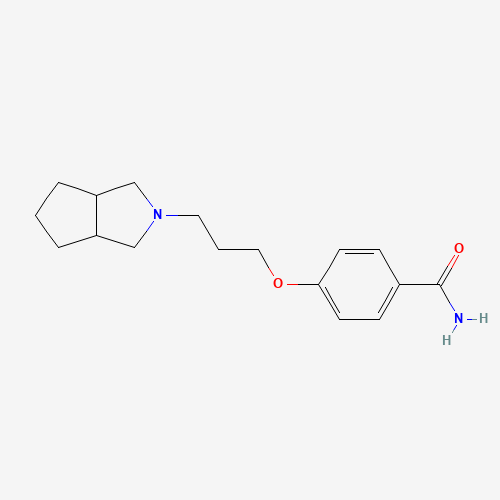
S 38093
CAS number:862896-30-8 molecular formula:C17H24N2O2
overview
compound introduction
Specs
| Chinese alias | - | ||
| English alias | CCG-267363 | HY-104003 | S38093; S 38093 | s8598 | BCP29144 | AKOS037515534 | HMS3886F12 | S 38093 | SCHEMBL3348406 | s38093 free | 4-(3-(hexahydrocyclopenta[c]pyrrol-2(1H)-yl)propoxy)benzamide | 4-(3-{octahydrocyclopenta[c]pyrrol-2-yl}propoxy)benzamide | | ||
| CAS number | 862896-30-8 | molecular formula | C17H24N2O2 |
| molecular weight | 288.38 g/mol | Exact mass | ≥98% |
| PSA | 55.600 Ų | logp | 2.201 |
numbering system
No numbering system information yet
physicochemical properties
No physical and chemical property information yet
Safety information
No safety information yet
Production methods and uses
No production method and use information yet
Related
upstream information
No upstream information yet
downstream information
No downstream information yet
MSDS
Found 0 shareMSDS