

Nelonemdaz (Salfaprodil) potassium is an NR2B-selective and uncompetitive antagonist of N-methyl-D-aspartate (NMDA) . Nelonemdaz potassium is also a free radical scavenger. Nelonemdaz potassium has excellent neuroprotection against NMDA- and free radical-induced cell death In Vitro Nelonemdaz potassium (10-300 μM) shows apparent neuroprotection against 300 μM N-methyl-d-aspartate (NMDA) at doses as low as 30 μM. Nelonemdaz potassium (10-500 μM) inhibits the electrophysiologic response of cultured cortical neurons to 300 μM NMDA in a concentration-dependent manner. Nelonemdaz potassium (0.1-1 μM) produces a marked reduction of Fe 2+ -induced neurotoxicity, even at doses of 0.1 to 0.3 μM. Nelonemdaz potassium (0.1-1 μM) blocks the degeneration of neurons and glia in cortical cell cultures. Nelonemdaz potassium (0-350 μM) effectively scavenges superoxide radicals (IC 50 =63.07±1.44 μM), nitric oxide (IC 50 =155.8±4.88 μM), and hydroxyl radicals (IC 50 =58.45±1.74 μM). Nelonemdaz potassium (0.78-12.5 μM) decreases the amount of antimycin A-induced ROS/RNS formation in a dose-dependent manner, with an IC 50 of 2.21±0.11 μM. Nelonemdaz potassium (0.19-12.5 μM) inhibits malondialdehyde (MDA) formation with an IC 50 of 2.72±0.26 μM. Nelonemdaz potassium (0-125 μM) effectively reduces iron-ascorbate-induced lipid peroxidation (IC 50 =24.56±0.07 μM). MCE has not independently confirmed the accuracy of these methods. They are for reference only. In Vivo Nelonemdaz potassium (0.5-20 mg/kg; i.v.) reduces cerebral infarct evolving 24 h after 60-mins occlusion of the middle cerebral artery occlusion (MCAO) substantially and dose dependently . Nelonemdaz potassium (5 mg/kg; i.v.) protects white matter such as axons and myelin as well as gray matter from ischemic brain injury . MCE has not independently confirmed the accuracy of these methods. They are for reference only. Animal Model: Male Sprague-Dawley rats (260 to 300 g) (clip occlusion model) Dosage: 0.5-20 mg/kg Administration: I.v. administration 5 mins after reperfusion Result: Produced a large neuroprotective effect, with a maximal reduction in infarct volume of 66% at doses of 2.5 to 5 mg/kg. Not observed neuronal damage in the most vulnerable cortical area after administration of 5 mg/kg. Animal Model: Male Sprague-Dawley rats (260 to 300 g) (intraluminal thread occlusion model) Dosage: 5 mg/kg Administration: I.v. administration 30 mins after reperfusion Result: Did not change physiologic variables such as arterial pH, PCO 2 , PO 2 , and hematocrit. Reduced infarct volume evolving in the cortex and the striatum substantially. Reduced white matter damage in the striatum and external capsule markedly. Form:Solid IC50& Target:NMDA
All
Chemical Reagents
Biomedicine
Organic raw materials
Inorganic chemical industry
intermediate
Agricultural chemicals
Auxiliaries and catalysts
Fragrances and Flavors
Dyes and Pigments
Daily chemical industry
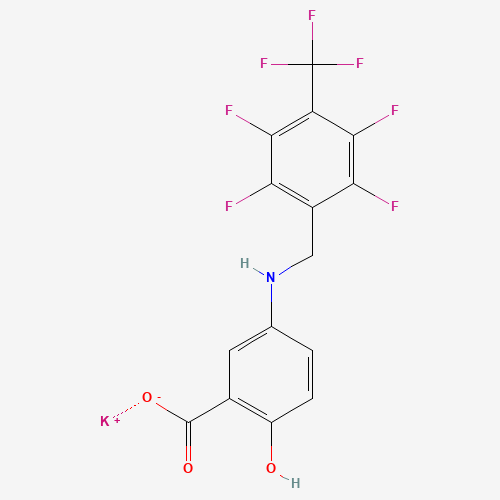
Nelonemdaz potassium
CAS number:916214-57-8 molecular formula:C15H7F7KNO3
overview
compound introduction
Specs
| Chinese alias | 奈洛奈德钾 | ||
| English alias | - | ||
| CAS number | 916214-57-8 | molecular formula | C15H7F7KNO3 |
| molecular weight | 421.31 g/mol | Exact mass | ≥98% |
| PSA | 72.400 Ų | logp | - |
numbering system
No numbering system information yet
physicochemical properties
No physical and chemical property information yet
Safety information
No safety information yet
Production methods and uses
No production method and use information yet
Related
upstream information
No upstream information yet
downstream information
No downstream information yet
MSDS
Found 0 shareMSDS




