
ZSET1446 is a novel cognitive enhancer that significantly improves learning deficits in various types of Alzheimer disease (AD) models. In Vitro ZSET1446 (100 pM-10 nM) exerts limited effects on the basal neuronal excitability and synaptic transmission. ZSET1446 potentiates the facilitatory effect of nAChR stimulation on sPSC frequency. ZSET1446 potentiates the increase in sIPSC frequency by local application of nicotine (5 µM; 2 minutes) without affecting the basal sIPSC frequency at the range of 10 pM to 1 nM. MCE has not independently confirmed the accuracy of these methods. They are for reference only. In Vivo ZSET1446 enhances object recognition memory in mice and ameliorates cognitive impairment caused by scopolamine in rats. Concomitant administration of subeffective doses of ZSET1446 and memantine significantly ameliorates the cognitive performance in the novel object recognition task in both mice and rats. Moreover, oral administration of ZSET1446 or memantine increases the extracellular level of ACh in the hippocampus as compared with the control. Further, concomitant administration of subeffective doses of ZSET1446 and memantine significantly increases the extracellular level of ACh as compared with the group of ZSET1446 or memantine alone. ZSET1446 (0.002, 0.01, and 0.1 mg/kg, p.o.) ameliorates cognitive deficits of SAMP8 after 4, 8, 12, and 16 weeks of treatment in a novel object recognition test. ZSET1446 also reduces grading scores of SAMP8 after 16 weeks of treatment. Further, 8-week treatment of ZSET1446 significantly reduces the total number of Aβ-positive granules in the hippocampus. MCE has not independently confirmed the accuracy of these methods. They are for reference only. Animal administration The experimental apparatus consists of a Plexiglas open-field box [25 cm (width) × 41 cm (length) × 17 cm (depth), model TP-105], the floor of which is covered with sawdust. The apparatus is located in a sound-attenuated room. The procedure for the novel object recognition task consists of three different sessions: habituation, training, and retention sessions. Each mouse is individually habituated to the box, with 10 min of exploration in the absence of objects (day 1: habituation session). ZSET1446 at doses of 0.001, 0.003, 0.01, and 0.03 mg/kg and/or memantine at doses of 3 and 10 mg/kg is orally administered 60 min before the training trial. In the experiment of injection of nicotinic receptor antagonists, oral administration of ZSET1446 and i.p. injection of mechamylamine or DHbE at each dose of 1 mg/kg are given 60 min before the training trial. During the training session, two different novel objects are symmetrically fixed to the floor in the box, and each animal is allowed to explore in the box for 10 min (day 2: training session). These objects are different in shape and color but similar in size. The mice are considered to be exploring the object when the mouse is facing, touching, or sniffing the object. The time spent for exploring each object is manuallymeasured by a stopwatch. In the training session, locomotor activity is simultaneously measured for a period of 10 min automatically, using an Animex Auto placed under the open-field box. After the training trial, mice are immediately returned to their home cages. aladdin has not independently confirmed the accuracy of these methods. They are for reference only. Form:Solid
All
Chemical Reagents
Biomedicine
Organic raw materials
Inorganic chemical industry
intermediate
Agricultural chemicals
Auxiliaries and catalysts
Fragrances and Flavors
Dyes and Pigments
Daily chemical industry
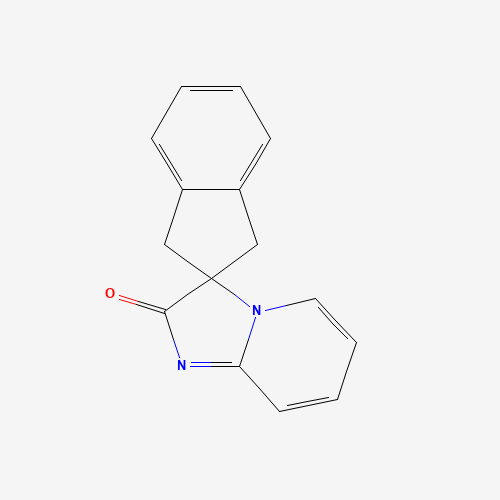
ZSET1446
CAS number:887603-94-3 molecular formula:C15H12N2O
overview
compound introduction
Specs
| Chinese alias | - | ||
| English alias | A13764 | HY-11013 | spiro[1,3-dihydroindene-2,3'-imidazo[1,2-a]pyridine]-2'-one | BCP33073 | 1',3'-Dihydro-2H-spiro[imidazo[1,2-a]pyridine-3,2'-inden]-2-one | Q27268838 | ZSET-1446 | ST101 | SB18912 | ||
| CAS number | 887603-94-3 | molecular formula | C15H12N2O |
| molecular weight | 236.27 g/mol | Exact mass | - |
| PSA | 32.700 Ų | logp | 1.900 |
numbering system
No numbering system information yet
physicochemical properties
No physical and chemical property information yet
Safety information
No safety information yet
Production methods and uses
No production method and use information yet
Related
upstream information
No upstream information yet
downstream information
No downstream information yet
MSDS
Found 0 shareMSDS