

Ertiprotafib is an inhibitor of PTP1B, IkB kinase β (IKK-β) , and a dual PPARα and PPARβ agonist, with an IC 50 of 1.6 μM for PTP1B, 400 nM for IKK-β , an EC 50 of ~1 μM for PPARα/PPARβ. In Vitro Ertiprotafib is a potent inhibitor of IKK-β, with an IC 50 value of 400±40 nM, which is much lower than that required for the half-maximal inhibition of the p-nitrophenyl phosphatase activity of PTP1B. The reported IC 50 value of Ertiprotafib against PTP1B ranges from 1.6 to 29 μM depending on the assay conditions. Ertiprotafib is at least a dual PPARα and PPARβ agonist with EC 50 values for transactivation of 1 μM. Such activities readily explain the observations with suprapharmacologic doses of these. MCE has not independently confirmed the accuracy of these methods. They are for reference only. In Vivo As seen with treatment of ob/ob mice, both Ertiprotafib and compound 3 seem to significantly improve glucose metabolism in rats. At 25 mg/kg/day, these compounds decrease both fasting blood glucose and insulin levels compared with vehicle treated rats. Furthermore, both Ertiprotafib and compound 3 increase glucose disposal after an oral challenge. It is noteworthy that lipid levels are also reduced in treated animals. Both triglyceride and free fatty acid levels are substantially reduced in rats treated with 25 mg/kg/day of either compound. To summarize, both Ertiprotafib and compound 3 seem to be robust agents in improving glucose utilization in fa/fa rats while also decreasing lipid levels in these animals. Decreased lipid levels may be unexpected for a pure PTP1b inhibitor. It is more telling, as mentioned above, that rats treated with suprapharmacologic doses of Ertiprotafib show signs of PPAR family activation. MCE has not independently confirmed the accuracy of these methods. They are for reference only. Animal administration Mice, Rats Male Ob/ob mice and Zucker fa/fa rats are used. They are kept on a 12-h/12-h light/dark cycle and fed Rodent Diet 5001 (for mice and rats) from Purina Mills. Compounds are dosed orally by gavage in an aqueous suspension of 2% Tween 80 and 0.5% methylcellulose. Whole blood (5 μL) is used for glucose readings via tail nick for measurement using the Ascensia Elite XL glucometer and glucose strips by preloading a strip into the meter and touching the end to a small drop of blood on each tail. Insulin levels are quantified by enzyme-linked immunosorbent assay . aladdin has not independently confirmed the accuracy of these methods. They are for reference only. Form:Solid IC50& Target:PTP1B|1.6 μM (IC|50|)|IKK-β|400 nM (IC|50|)|PPARα|~1 μM (EC|50|)|PPARβ|~1 μM (EC|50|)
All
Chemical Reagents
Biomedicine
Organic raw materials
Inorganic chemical industry
intermediate
Agricultural chemicals
Auxiliaries and catalysts
Fragrances and Flavors
Dyes and Pigments
Daily chemical industry
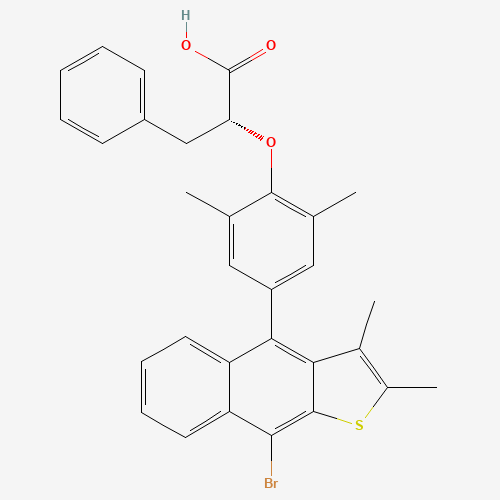
Ertiprotafib
CAS number:251303-04-5 molecular formula:C31H27BrO3S
overview
compound introduction
Specs
| Chinese alias | 埃替普罗替尼 | ||
| English alias | Ertiprotafib [USAN:INN] | Ertiprotafib [USAN] | BENZENEPROPANOIC ACID, .ALPHA.-(4-(9-BROMO-2,3-DIMETHYLNAPHTHO(2,3-B)THIEN-4-YL)-2,6-DIMETHYLPHENOXY)-, (.ALPHA.R)- | FONCZICQWCUXEB-RUZDIDTESA-N | SCHEMBL6703442 | Ertiprotafib | DB06521 | BDBM50209683 | 2- | ||
| CAS number | 251303-04-5 | molecular formula | C31H27BrO3S |
| molecular weight | 559.51 g/mol | Exact mass | - |
| PSA | 74.800 Ų | logp | 9.200 |
numbering system
No numbering system information yet
physicochemical properties
No physical and chemical property information yet
Safety information
No safety information yet
Production methods and uses
No production method and use information yet
Related
upstream information
No upstream information yet
downstream information
No downstream information yet
MSDS
Found 0 shareMSDS




