

Lerociclib dihydrochloride (G1T38 dihydrochloride) is a potent and selective inhibitor of CDK4 / CDK6 , with IC 50 s of 1 nM and 2 nM for CDK4 / CyclinD1 and CDK6 / CyclinD3 , respectively. In Vitro Within the CDK family, Lerocyclib is least selective against CDK9/cyclin T, ~30 fold between CDK4/cyclin D1 and CDK9/ cyclin T at the biochemical IC 50 . Lerociclib produces a robust and sustained G1 arrest in CDK4/6 dependent cells with an EC 50 of ~20 nM. A dose dependent increase of cells in the G1 phase of the cell cycle is observed when CDK4/6 dependent WM2664 cells are treated with G1T38 for 24 hours. This arrest is maintained through 300 nM, more than 300x the biochemical IC 50 . WM2664 cells treated with 30-1000 nM of Lerociclib for 24 hours exhibits a complete inhibition of RB phosphorylation compared to vehicle controls. Treatment with G1T38 reduces RB phosphorylation within 1 hour post-treatment and generates near complete inhibition of RB phosphorylation by 16 hours post-treatment. G1T38 produces a robust inhibition of proliferation in a diverse array of tumor cell lines including breast, melanoma, leukemia and lymphoma with EC 50 concentrations as low as 23 nM. MCE has not independently confirmed the accuracy of these methods. They are for reference only. In Vivo In this HER2 + breast cancer model, Mice treated with Lerociclib elicits 8% tumor regression after 21 days of treatment while control animals have a 577% increase in tumor burden over the same treatment period. Compared to the vehicle-treated mice, daily treatment with 100 mg/kg of Lerociclib or palbociclib shows tumor regression within 10 days in the MCF7 xenograft model. After 27 days of treatment, tumor growth inhibition is observed in the 10, 50, and 100 mg/kg Lerociclib cohorts (approximately 12%, 74%, and 90% inhibition, respectively). Daily oral palbociclib treatment causes an 18%, 66%, and 87% tumor growth inhibition in the 10, 50, and 100 mg/kg dosage cohorts, respectively. Interestingly, at 50 mg/kg, Lerociclib is significantly more efficaciou than palbociclib. Similar results are seen in the ER + ZR-75-1 breast cancer xenograft model when comparing Lerocyclib and palbociclib at the 50 mg/kg dose. Lerociclib treated mice exhibits 77% TGI with an overall 60% tumor growth delay demonstrating Lerociclib alone is highly efficacious in this NSCLC tumor model . MCE has not independently confirmed the accuracy of these methods. They are for reference only. Form:Solid IC50& Target:Cdk4/cyclin D1 1 nM (IC 50 ) cdk6/cyclin D3 2 nM (IC 50 ) CDK9/Cyclin T 28 nM (IC 50 ) CDK5/p35 832 nM (IC 50 ) Cdk5/p25 1.2 μM (IC 50 ) cdk2/cyclin A 1.5 μM (IC 50 ) CDK2/cyclinE 3.6 μM (IC 50 ) CDK1/cyclinB1 2.4 μM (IC 50 ) CDK7/Cyclin H/MAT1 2.4 μM (IC 50 )
All
Chemical Reagents
Biomedicine
Organic raw materials
Inorganic chemical industry
intermediate
Agricultural chemicals
Auxiliaries and catalysts
Fragrances and Flavors
Dyes and Pigments
Daily chemical industry
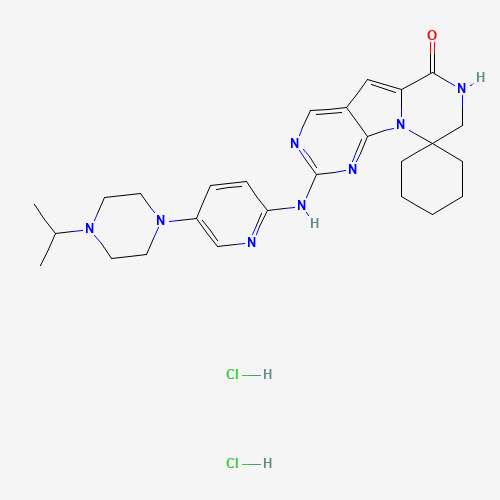
Lerociclib dihydrochloride
CAS number:2097938-59-3 molecular formula:C26H36Cl2N8O
overview
compound introduction
Specs
| Chinese alias | 盐酸乐罗昔利 | ||
| English alias | SCHEMBL23711495 | Spiro(cyclohexane-1,9'(6'H)-pyrazino(1',2':1,5)pyrrolo(2,3-d)pyrimidin)-6'-one, 7',8'-dihydro-2'-((5-(4-(1-methylethyl)-1-piperazinyl)-2-pyridinyl)amino)-, hydrochloride (1:2) | 4-[[5-(4-propan-2-ylpiperazin-1-yl)pyridin-2-yl]amino]spiro | ||
| CAS number | 2097938-59-3 | molecular formula | C26H36Cl2N8O |
| molecular weight | 547.52 g/mol | Exact mass | ≥99% |
| PSA | 91.200 Ų | logp | - |
numbering system
No numbering system information yet
physicochemical properties
No physical and chemical property information yet
Safety information
No safety information yet
Production methods and uses
No production method and use information yet
Related
upstream information
No upstream information yet
downstream information
No downstream information yet
MSDS
Found 0 shareMSDS




