

RWJ-56110 dihydrochloride is a potent, selective, peptide-mimetic inhibitor of PAR-1 activation and internalization (binding IC 50 =0.44 uM) and shows no effect on PAR-2, PAR-3, or PAR-4. RWJ-56110 dihydrochloride inhibits the aggregation of human platelets induced by both SFLLRN-NH2 ( IC 50 =0.16 μM) and thrombin ( IC 50 =0.34 μM), quite selective relative to U46619 . RWJ-56110 dihydrochloride blocks angiogenesis and blocks the formation of new vessels in vivo. RWJ-56110 dihydrochloride induces cell apoptosis In Vitro Proteinase-activated receptors (PARs) are a family of G protein-coupled receptors activated by the proteolytic cleavage of their N-terminal extracellular domain, exposing a new amino terminal sequence that functions as a tethered ligand to activate the receptors. RWJ56110 inhibits the aggregation of human platelets induced by both SFLLRN-NH2 (IC 50 =0.16 μM) and thrombin (IC 50 =0.34 μM) while being quite selective relative to collagen and the thromboxane mimetic U46619 . RWJ-56110 dihydrochloride is fully inhibits thrombin-induced RASMC proliferation with an IC 50 value of 3.5 μM. RWJ-56110 dihydrochloride shows blockade of thrombin’s action with RASMC calcium mobilization (IC 50 =0.12 μM), as well as with HMVEC (IC 50 =0.13 μM) and HASMC calcium mobilization (IC 50 =0.17 μM). RWJ56110 (0.1-10 μM; 24-96 hours) inhibits endothelial cell growth dose-dependently, with half-maximal inhibitory concentration of RWJ56110 is approximately 10 μM. RWJ56110 (0.1-10 μM; 6 hours) inhibits DNA synthesis of endothelial cells in a thymidine incorporation assays. Endothelial cells are in fast-growing state (50-60% confluence), RWJ56110 inhibits cell DNA synthesis in a dose-dependent manner, but when cells that are in the quiescent state (100% confluent), the inhibitory effect of PAR-1 antagonists is much less pronounced. RWJ56110 (0.1-10 μM; pretreatment for 15 min) inhibits thrombin-induced Erk1/2 activation in a concentration-dependent manner. However, when endothelial cells are stimulated by FBS (final concentration 4%), it reduces partially the activated levels of Erk1/2. RWJ56110 (30 μM; 24 hours) has an inhibitory effect on endothelial cell cycle progression. It reduces the percentage of cells in the S phase, while alterations in the percentages of G1 and G2/M cells are less pronounced. MCE has not independently confirmed the accuracy of these methods. They are for reference only. Western Blot AnalysisCell Line: Endothelial cells Concentration: 0 μM; 3 μM; 1 μM; 3 μM; 10 μM Incubation Time: Pretreatment for 15 min Result: Resulted in MAPK activation in Endothelial cells. Cell Cycle AnalysisCell Line: Endothelial cells Concentration: 0 μM; 3 μM; 1 μM; 3 μM; 10 μM Incubation Time: Pretreatment for 15 min Result: Reduced cell number in S phase. Form:Solid IC50& Target:IC50: 0.44 uM (PAR-1) IC50: 0.16 μM (the aggregation of human platelets induced by SFLLRN-NH2) IC50: 0.34 μM (the aggregation of human platelets induced by thrombin)
All
Chemical Reagents
Biomedicine
Organic raw materials
Inorganic chemical industry
intermediate
Agricultural chemicals
Auxiliaries and catalysts
Fragrances and Flavors
Dyes and Pigments
Daily chemical industry
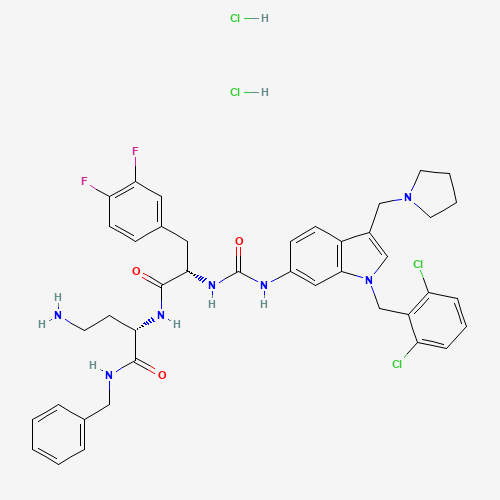
RWJ-56110 dihydrochloride
CAS number:2387505-58-8 molecular formula:C41H45Cl4F2N7O3
overview
compound introduction
Specs
| Chinese alias | RWJ-56110 二盐酸盐 | ||
| English alias | - | ||
| CAS number | 2387505-58-8 | molecular formula | C41H45Cl4F2N7O3 |
| molecular weight | 863.65 g/mol | Exact mass | ≥99% |
| PSA | - | logp | - |
numbering system
No numbering system information yet
physicochemical properties
No physical and chemical property information yet
Safety information
No safety information yet
Production methods and uses
No production method and use information yet
Related
upstream information
No upstream information yet
downstream information
No downstream information yet
MSDS
Found 0 shareMSDS




