

dCBP-1 is a potent and selective heterobifunctional degrader of p300/CBP based on Cereblon ligand. dCBP-1 is exceptionally potent at killing multiple myeloma cells and ablates oncogenic enhancer activity driving MYC expression In Vitro dCBP-1 (10-1000 nM; 6 hours) treatment shows near-complete degradation of p300/CBP in MM1S cells. dCBP-1 is also able to induce near-complete p300/CBP degradation across other multiple myeloma cell lines tested, including MM1R, KMS-12-BM, and KMS34. ? Treatment of the human haploid cell line HAP1 for 6 h with dCBP-1 reveals almost complete loss of both CBP and p300 between 10 and 1000 nM doses. A time course analysis with 250 nM dCBP-1 revealed almost complete degradation of p300/CBP within an hour of treatment. MCE has not independently confirmed the accuracy of these methods. They are for reference only. Western Blot AnalysisCell Line: Multiple myeloma cell line MM1S Concentration: 10 nM, 100 nM, 250 nM, 500 nM, 1000 nM Incubation Time: 6 hours Result: Revealed rapid degradation with near-complete loss of p300/CBP after 2 hours. Form:Solid IC50& Target:p300/CBP Cereblon
All
Chemical Reagents
Biomedicine
Organic raw materials
Inorganic chemical industry
intermediate
Agricultural chemicals
Auxiliaries and catalysts
Fragrances and Flavors
Dyes and Pigments
Daily chemical industry
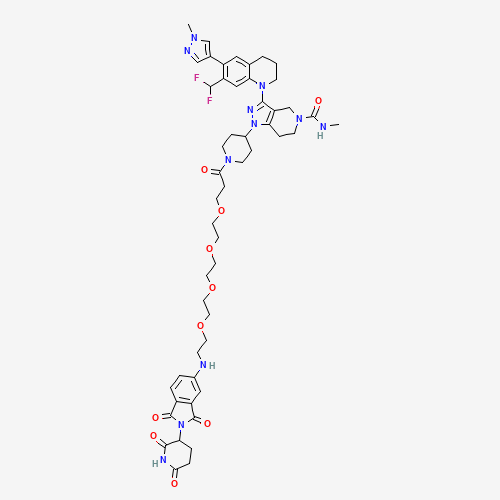
dCBP-1
CAS number:2484739-25-3 molecular formula:C51H63F2N11O10
overview
compound introduction
Specs
| Chinese alias | - | ||
| English alias | - | ||
| CAS number | 2484739-25-3 | molecular formula | C51H63F2N11O10 |
| molecular weight | 1028.11 g/mol | Exact mass | ≥99% |
| PSA | 224.000 Ų | logp | 1.600 |
numbering system
No numbering system information yet
physicochemical properties
No physical and chemical property information yet
Safety information
No safety information yet
Production methods and uses
No production method and use information yet
Related
upstream information
No upstream information yet
downstream information
No downstream information yet
MSDS
Found 0 shareMSDS




