

ELN-441958 is a potent, neutral, competitive and selective bradykinin B 1 receptor antagonist with a K i of 0.26 nM against native human bradykinin B 1 receptor. ELN-441958 has high oral bioavailability, and has low CNS exposure in the mouse In Vitro ELN-441958 is selective for primate over rodent B 1 receptors with a rank order potency (K B , nanomolar) of human (0.12 ± 0.02) ~ rhesus monkey (0.24 ± 0.01) > rat (1.5 ± 0.4) > mouse (14 ± 4). ELN-441958 has good permeability and metabolic stability. MCE has not independently confirmed the accuracy of these methods. They are for reference only. In Vivo ELN-441958 (1-10 mg/kg; s.c.; once) dose-dependently reduces carrageenan-induced thermal hyperalgesia in a rhesus monkey tail-withdrawal model . ELN-441958 (0-10 mg/kg; i.v. or p.o.) exhibits a favorable pharmacokinetic profile in the rat and rhesus monkey . MCE has not independently confirmed the accuracy of these methods. They are for reference only. Animal Model: Adult male and female rhesus monkeys Dosage: 1, 3, or 10 mg/kg Administration: Subcutaneous injection, 30 min before carrageenan injection Result: Increased the tail-withdrawal latencies in a dose-dependent manner. Animal Model: Rhesus monkeys or Sprague-Dawley rats Dosage: 2.5 or 10 mg/kg for rats, 1 mg/kg or 5 mg/kg for rhesus monkeys Administration: Intravenous injection (2.5 mg/kg and 1 mg/kg) or oral administration (10 mg/kg and 5 mg/kg) (Pharmacokinetic Analysis) Result: In rats: When dosed intravenously, showed a moderate volume of distribution (2.7 L/kg, approximately four times total body water) and a moderate clearance (0.96 L/h/kg, approximately 24% of hepatic blood flow). The terminal plasma half-life of this compound in rats was 1.7 h. When dosed orally, the concentrations increased to a maximum of 1.2 g/mL at 2 h after dosing. The oral availability was 57%. In rhesus monkeys: When dosed intravenously, showed a moderate volume of distribution (2.7 L/kg) and a moderate clearance (0.49 L/h/kg, approximately 32% of hepatic blood flow). The terminal plasma half-life was 3.9 h. When dosed orally, the concentrations increased to a maximum of 3.6 g/mL at 3.3 h after dosing. The calculated oral bioavailability was greater than 100%. Form:Solid IC50& Target:K i : 0.26 nM (native human bradykinin B 1 receptor)
All
Chemical Reagents
Biomedicine
Organic raw materials
Inorganic chemical industry
intermediate
Agricultural chemicals
Auxiliaries and catalysts
Fragrances and Flavors
Dyes and Pigments
Daily chemical industry
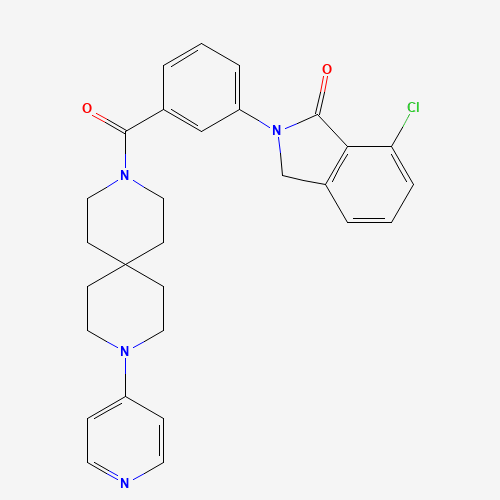
ELN-441958
CAS number:913064-47-8 molecular formula:C29H29ClN4O2
overview
compound introduction
Specs
| Chinese alias | - | ||
| English alias | ARYQHSWJGHCGJS-UHFFFAOYSA-N | SB12691 | Q27278818 | ELN 441958 | SCHEMBL1712902 | BCP23812 | 7-chloro-2-[3-(9-pyridin-4-yl-3,9-diazaspiro[5.5]undecane-3-carbonyl)phenyl]-3H-isoindol-1-one | 7-chloro-2-(3-(9-(pyridin-4-yl)-3,9-diazaspiro[5.5]undecane-3-car | ||
| CAS number | 913064-47-8 | molecular formula | C29H29ClN4O2 |
| molecular weight | 501 g/mol | Exact mass | ≥99% |
| PSA | 56.800 Ų | logp | 4.400 |
numbering system
No numbering system information yet
physicochemical properties
No physical and chemical property information yet
Safety information
No safety information yet
Production methods and uses
No production method and use information yet
Related
upstream information
No upstream information yet
downstream information
No downstream information yet
MSDS
Found 0 shareMSDS




