
K-756 is a direct and selective tankyrase ( TNKS ) inhibitor, which inhibits the ADP-ribosylation activity of TNKS1 and TNKS2 with IC 50 s of 31 and 36 nM, respectively. In Vitro K-756 is a novel and selective Wnt/β-catenin pathway inhibitor targeting tankyrase (TNKS). TNKS is one of the members of the PARP family (it is also known as PARP5). K-756 binds to the induced pocket of TNKS and inhibits its enzyme activity. To study the isoform selectivity of K-756, the PARP family enzyme inhibitory activity at 10 μM is evaluated. K-756 inhibits TNKS1 and TNKS2 by 97% and 100%, respectively. In contrast, the inhibitory activity of K-756 against PARP1, PARP2, PARP3, PARP6, PARP7, and PARP11 is less than 13%. K-756 inhibits the cell growth of APC-mutant colorectal cancer COLO 320DM and SW403 cells by inhibiting the Wnt/β-catenin pathway. K-756 strongly inhibits the reporter activity in DLD-1/TCF-Luc cells with an IC 50 of 110 nM, but does not inhibit DLD-1/mtTCF-Luc cells, even at 1,000 nM. APC-mutant colorectal cancer cell line COLO 320DM and SW403 cells are treated with K-756 and after 144 hours, cell growth inhibition is measured by an XTT assay. The application of K-756 inhibits the cell growth of COLO 320DM with a GI 50 of 780 nM. K-756 also inhibits SW403 with a GI 50 of 270 nM. MCE has not independently confirmed the accuracy of these methods. They are for reference only. In Vivo DLD-1/TCF-Luc cell xenografts are created in SCID mice. Vehicle (0.5% MC400) or K-756 is administered orally once a day for 3 days at 100, 200, and 400 mg/kg. The Wnt/β-catenin signal inhibition in the tumor is detected by measuring FGF20 and LGR5 and luciferase activity. The expression of FGF20 and reporter activity are significantly decreased at doses of 100 mg/kg and above at 3-day administration. The expression of LGR5 is significantly decreased at doses of 200 mg/kg and above at 3-day administration. The maximum inhibitory activity is reached with the administration of K-756 at a dose of 400 mg/kg at 3-day administration. The Wnt/β-catenin signal inhibition at a dose of 400 mg/kg is observed from 1-day administration . MCE has not independently confirmed the accuracy of these methods. They are for reference only. Form:Solid IC50& Target:TNKS1 31 nM (IC 50 ) TNKS2 36 nM (IC 50 )
All
Chemical Reagents
Biomedicine
Organic raw materials
Inorganic chemical industry
intermediate
Agricultural chemicals
Auxiliaries and catalysts
Fragrances and Flavors
Dyes and Pigments
Daily chemical industry
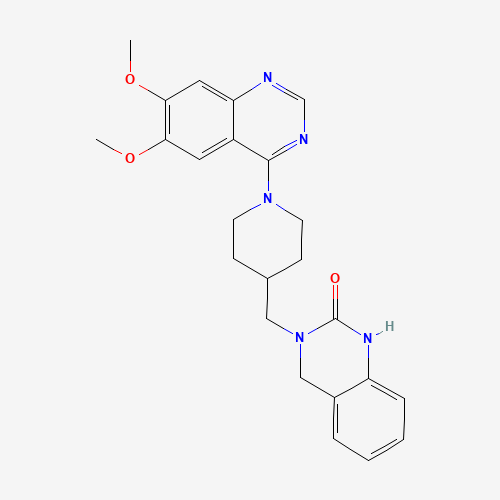
K-756
CAS number:130017-40-2 molecular formula:C24H27N5O3
overview
compound introduction
Specs
| Chinese alias | - | ||
| English alias | 3-{[1-(6,7-dimethoxyquinazolin-4-yl)piperidin-4-yl]methyl}-3,4-dihydroquinazolin-2(1H)-one | 3-[1-(6,7-Dimethoxy-quinazolin-4-yl)-piperidin-4-ylmethyl]-3,4-dihydro-1H-quinazolin-2-one | DTXSID401121877 | BDBM50468269 | GWXCGEJJQFHPPA-UHFFFAOYSA-N | K-756, | ||
| CAS number | 130017-40-2 | molecular formula | C24H27N5O3 |
| molecular weight | 433.5 g/mol | Exact mass | ≥99% |
| PSA | 79.800 Ų | logp | 3.100 |
numbering system
No numbering system information yet
physicochemical properties
No physical and chemical property information yet
Safety information
No safety information yet
Production methods and uses
No production method and use information yet
Related
upstream information
No upstream information yet
downstream information
No downstream information yet
MSDS
Found 0 shareMSDS