

MitoTam bromide, hydrobromide, a Tamoxifen derivative, is an electron transport chain ( ETC ) inhibitor. MitoTam bromide, hydrobromide reduces mitochondrial membrane potential in senescent cells and affects mitochondrial morphology. MitoTam bromide, hydrobromide is an effective anticancer agent, suppresses respiratory complexes (CI-respiration) and disrupts respiratory supercomplexes (SCs) formation in breast cancer cells. In Vitro MitoTam (0.5 μM-56 μM; 24 hours) kills breast cancer cell Lines and nonmalignant cells with an IC 50 range from 0.65 μM to 55.9 μM. MitoTam (2.5 μM; 2-24 hours) results in stronger activation of the apoptotic pathway in MCF7 Her2 high cells compared with mock MCF7 cells. MitoTam (0.05 μM-1 μM; 3 days) causes a concentration-dependent induction of apoptosis in breast cancer cells, while there was no effect for non-malignant breast epithelial cellsMCE has not independently confirmed the accuracy of these methods. They are for reference only. Cell Viability AssayCell Line: Breast Cancer Cell Lines: BT474, MCF7, MCF7 Her2 high , MCF7 Her2 low , MDA-MB-231, MDA-MB-436, MDA-MB-453, SK-BR-3, T47D; NeuTL cells; Nonmalignant Cells: A014578, H9c2 cells Concentration: 0.5 μM-56 μM Incubation Time: 24 hours Result: Killed breast cancer cells MCF7, MCF7 Her2 high , MCF7 Her2 low with IC 50 values of 1.25 μM, 0.65 μM and 1.45 μM respectively. Western Blot AnalysisCell Line: MCF7 mock cells, MCF7 Her2 high cells Concentration: 2.5 μM Incubation Time: 2 hours, 4 hours, 8 hours, 16 hours, 24 hours Result: Revealed accelerated cleavage of procaspase-9, Parp1/2 and proapoptotic Bax, decreased the antiapoptotic Bcl-2 protein in Her2high cells. Apoptosis AnalysisCell Line: MCF-7 cells, 4T1 cells and MCF-10a cells Concentration: 0.05 μM-1 μM Incubation Time: 3 days Result: Resulted in apoptosis in MCF7 and 4T1 cells. In Vivo MitoTam (intraperitoneal injection; 2 μg/g; once a week; 4 weeks) decreases β-gal staining of lungs from MitoTam-treated mice, accompaning by a inhibition in the expression of senescence markers p16Ink4a, p21waf1 and PAI comparing control mice sup>. MitoTam (intraperitoneal injection; 0.54 μmol/mouse; twice a week; 2 weeks) inhibits growth of syngeneic tumors by 80% . MitoTam (intraperitoneal injection; 0.25 μmol/mouse; twice a week; 2 weeks) slows down the growth of MCF7 mock tumors and stops tumor progression after two doses; suppresses Her2 high carcinomas decreased threefold from the original size with complete disappearance . MCE has not independently confirmed the accuracy of these methods. They are for reference only. Animal Model: 18-month-old or 2-month-old FVB/N miceDosage: 2 μg/g Administration: Intraperitoneal injection; 2 μg/g; once a week; 4 weeks Result: Eliminated senescent cells also in vivo. Animal Model: FVB/N c-neu mouse Dosage: 0.54 μmol/mouse Administration: Intraperitoneal injection; 0.54 μmol/mouse; twice a week; 2 weeks Result: Suppressed Her2 high breast carcinomas. Animal Model: Balb/c nude mice with MCF7 mock or MCF7 Her2 high cells Dosage: 0.25 μmol/mouse/dose Administration: Intraperitoneal injection; 0.25 μmol/mouse/dose; twice a week; 2 weeks Result: Prevented reaching the ethical endpoint in all situations, slowed down the growth of MCF7 mock tumors and suppressed Her2 high carcinomas decreased. Form:Solid
All
Chemical Reagents
Biomedicine
Organic raw materials
Inorganic chemical industry
intermediate
Agricultural chemicals
Auxiliaries and catalysts
Fragrances and Flavors
Dyes and Pigments
Daily chemical industry
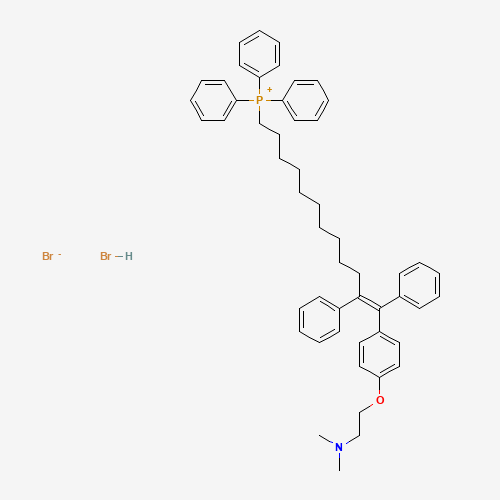
MitoTam bromide, hydrobromide
CAS number:1634624-73-9 molecular formula:C52H60Br2NOP
overview
compound introduction
Specs
| Chinese alias | MitoTam 溴化物、氢溴化物 | ||
| English alias | - | ||
| CAS number | 1634624-73-9 | molecular formula | C52H60Br2NOP |
| molecular weight | 905.82 g/mol | Exact mass | ≥98% |
| PSA | - | logp | - |
numbering system
No numbering system information yet
physicochemical properties
No physical and chemical property information yet
Safety information
No safety information yet
Production methods and uses
No production method and use information yet
Related
upstream information
No upstream information yet
downstream information
No downstream information yet
MSDS
Found 0 shareMSDS




