
Gilteritinib (ASP2215) hemifumarate is a potent and ATP-competitive FLT3 / AXL inhibitor with IC 50 of 0.29 nM/0.73 nM, respectively. In Vitro Of the 78 tyrosine kinases tested, Gilteritinib (ASP2215) inhibits FLT3, leukocyte tyrosine kinase (LTK), anaplastic lymphoma kinase (ALK), and AXL kinases by over 50% at 1 nM with an IC 50 value of 0.29 nM for FLT3, approximately 800-fold more potent than for c-KIT. Gilteritinib inhibits the activity of eight of the 78 tested kinases by over 50% at concentrations of either 1 nM (FLT3, LTK, ALK, and AXL) or 5 nM (TRKA, ROS, RET, and MER). The IC 50 s are 0.29 nM for FLT3 and 0.73 nM for AXL. Gilteritinib inhibits FLT3 at an IC 50 that is approximately 800-fold more potent than the concentration required to inhibit c-KIT (230 nM). The antiproliferative activity of Gilteritinib is evaluated against MV4-11 and MOLM-13 cells, which endogenously express FLT3-ITD. After 5 days of treatment, Gilteritinib inhibits the growth of MV4-11 and MOLM-13 cells with mean IC 50 s of 0.92 nM (95% CI: 0.23-3.6 nM) and 2.9 nM (95% CI: 1.4-5.8 nM), respectively. Growth suppression of MV4-11 cells is accompanied by inhibition of FLT3 phosphorylation. Relative to vehicle control cells, phosphorylated FLT3 levels are 57%, 8%, and 1% after 2 h of treatment with 0.1 nM, 1 nM, and 10 nM Gilteritinib, respectively. In addition, doses as low as 0.1 nM or 1 nM result in the suppression of phosphorylated ERK, STAT5, and AKT, all of which are downstream targets of FLT3 activation. To investigate the effects of Gilteritinib on AXL inhibition, MV4-11 cells that expressed exogenous AXL are treated with Gilteritinib. At concentrations of 1 nM, 10 nM, and 100 nM for 4 h, Gilteritinib treatment decreases phosphorylated AXL levels by 38%, 29%, and 22%, respectively. MCE has not independently confirmed the accuracy of these methods. They are for reference only. In Vivo In MV4-11 xenografted-mice, the concentration of Gilteritinib (ASP2215) in tumors is more than 20-fold higher than that in plasma with oral administration of Gilteritinib at 10 mg/kg for 4 days. Treatment of Gilteritinib for 28 days results in dose-dependent inhibition of MV4-11 tumor growth and induces complete tumor regression at more than 6 mg/kg. Further, Gilteritinib decreases tumor burden in bone marrow and prolonged the survival of mice intravenously transplanted with MV4-11 cells . MCE has not independently confirmed the accuracy of these methods. They are for reference only. Cell Assay The effect of Gilteritinib on MV4-11 and MOLM-13 cells is assessed using the CellTiter-Glo Luminescent Cell Viability Assay. Subsequent studies are conducted to examine the effect of Gilteritinib and Quizartinib on Ba/F3 cells expressing either FLT3-ITD, FLT3-D835Y, FLT3-ITD-D835Y, FLT3-ITD-F691 L, or FLT3-ITD-F691I. MV4-11 and MOLM-13 cells are treated with DMSO or increasing concentrations of Gilteritinib (0.01, 0.1, 1, 10, and 100 nM) for 5 days, and cell viability is measured using CellTiter-Glo. MCE has not independently confirmed the accuracy of these methods. They are for reference only. Form:Solid IC50& Target:IC50: 0.29 nM (FLT3), IC50: 0.35 nM (LTK), 0.73 nM (AXL), 1.2 nM (EML4-ALK), 230 nM (c-KIT)
All
Chemical Reagents
Biomedicine
Organic raw materials
Inorganic chemical industry
intermediate
Agricultural chemicals
Auxiliaries and catalysts
Fragrances and Flavors
Dyes and Pigments
Daily chemical industry
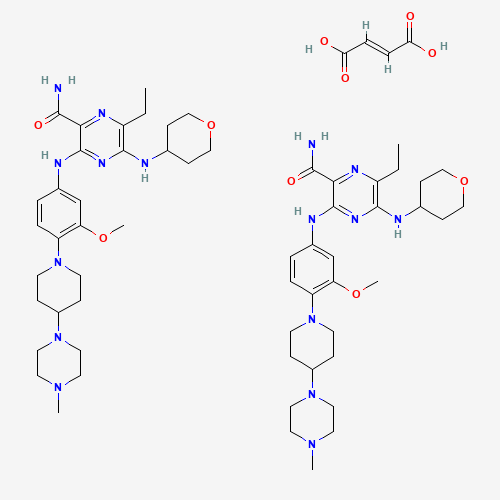
Gilteritinib hemifumarate
CAS number:1254053-84-3 molecular formula:C29H44N8O3 0.5C4H4O4
overview
compound introduction
Specs
| Chinese alias | 吉特替尼半富马酸盐 | ||
| English alias | Gilteritinib hemifumarate | GILTERITINIB FUMARATE [JAN] | ASP2215 hemifumarate | ASP-2215 hemifumarate | 2-Pyrazinecarboxamide, 6-ethyl-3-((3-methoxy-4-(4-(4-methyl-1-piperazinyl)-1-piperidinyl)phenyl)amino)-5-((tetrahydro-2H-pyran-4-yl)amino)-, (2E)-2-bu | ||
| CAS number | 1254053-84-3 | molecular formula | C29H44N8O3 0.5C4H4O4 |
| molecular weight | 610.75 g/mol | Exact mass | ≥99% |
| PSA | 317.000 Ų | logp | - |
numbering system
No numbering system information yet
physicochemical properties
No physical and chemical property information yet
Safety information
No safety information yet
Production methods and uses
No production method and use information yet
Related
upstream information
No upstream information yet
downstream information
No downstream information yet
MSDS
Found 0 shareMSDS