All
Chemical Reagents
Biomedicine
Organic raw materials
Inorganic chemical industry
intermediate
Agricultural chemicals
Auxiliaries and catalysts
Fragrances and Flavors
Dyes and Pigments
Daily chemical industry

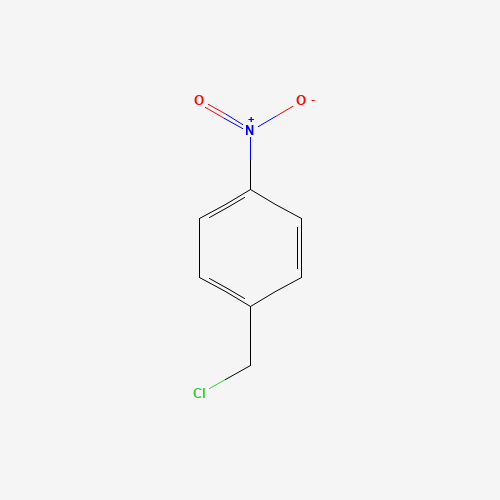
1-(chloromethyl)-4-nitrobenzene

Dangerous Goods

CAS number:100-14-1    molecular formula:C7H6ClNO2

overview

compound introduction

物理描述 | 苯, 1-(氯甲基)-4-硝基- 是一种固体。(EPA, 1998)

Specs

Chinese alias1-(氯甲基)-4-硝基苯
English alias4-nitrophenylmethyl chloride | p-Nitro benzylchloride | Q27159602 | NCGC00258126-01 | alpha-Chloro-p-nitrotoluene | 3BLD9LVT3X | AKOS000119805 | NSC 9803 | Benzene, 1-(chloromethyl)-4-nitro- | HSDB 6323 | BENZENE, 1-CHLOROMETHYL-4-NITRO- [HSDB] | UNII-3BL
CAS number100-14-1molecular formulaC7H6ClNO2
molecular weight171.58Exact mass化学纯(CP)
PSA45.8logp2.5

numbering system

CAS100-14-1
UNII3BLD9LVT3X
ChEBI ID87406
WikidataQ27159602
ChEMBL IDCHEMBL176410
UN Number3261
NSC NumberNSC Number: NSC9803
PubChem CID7482
Nikkaji NumberJ4.978F
DSSTox Substance IDDTXSID4025745
European Community (EC) Number202-822-7
PubChem Reference Collection SID505521670
MEP ID_25Q1B3APZ

physicochemical properties

XLogP32.5
Density1.5647 (NTP, 1992) - Denser than water; will sink
Complexity138
Exact Mass171.0087061
Boiling Point230 °C @760 [mm Hg]
Formal Charge0
Melting Point71 °C
Vapor Pressure0.05 [mm Hg] @25 °C
Chemical ClassesNitrogen Compounds -> Nitros, Aromatic
Heavy Atom Count11
Molecular Weight171.58
Monoisotopic Mass171.0087061
Isotope Atom Count0
Physical DescriptionPlates or needles from alcohol
Rotatable Bond Count1
Hydrogen Bond Donor Count0
Covalently-Bonded Unit Count1
Hydrogen Bond Acceptor Count2
Topological Polar Surface Area45.8 Ų
Defined Atom Stereocenter Count0
Defined Bond Stereocenter Count0
Undefined Atom Stereocenter Count0
Undefined Bond Stereocenter Count0

Safety information

DOT Label:
Corrosive
First Aid:
6. Rush to a health care facility. (EPA, 1998)
Fire Hazards:
Incompatible with sodium hydroxide. (EPA, 1998)
Fire Fighting:
This material may burn but does not ignite readily. Small fires: dry chemical, carbon dioxide, water spray or foam. Large fires: Water spray, fog or foam. Move container from fire area if you can do it without risk. (EPA, 1998)
Toxicity Data:
LCLo (rat) = 280 mg/m3/4h
Health Hazards:
Poisonous if swallowed or dust is inhaled. (EPA, 1998)
Reactive Group:
Nitro, Nitroso, Nitrate, and Nitrite Compounds, Organic
Adverse Effects:
Toxic Pneumonitis - Inflammation of the lungs induced by inhalation of metal fumes or toxic gases and vapors.
Hazards Summary:
Poisonous by ingestion and inhalation; [CAMEO] Corrosive; Causes burns; A lachrymator; May cause pneumonitis and pulmonary edema after inhalation of high concentrations; [MSDSonline]
Reactivity Profile:
Incompatible with sodium hydroxide. [EPA, 1998]. A halogenated aromatic nitro compound. Aromatic nitro compounds range from slight to strong oxidizing agents. If mixed with reducing agents, including hydrides, sulfides and nitrides, they may begin a vigorous reaction that culminates in a detonation. The aromatic nitro compounds may explode in the presence of a base such as sodium hydroxide or potassium hydroxide even in the presence of water or organic solvents. The explosive tendencies of aromatic nitro compounds are increased by the presence of multiple nitro groups.
Nonfire Spill Response:
Large spills: dike far ahead of spill for alter disposal. (EPA, 1998)
Regulatory Information:
New Zealand EPA Inventory of Chemical Status: 4-Nitrobenzyl chloride: Does not have an individual approval but may be used under an appropriate group standard
Air and Water Reactions:
May react slowly with water. (NTP, 1992)
Isolation and Evacuation:
FIRE: If tank, rail tank car or highway tank is involved in a fire, ISOLATE for 800 meters (1/2 mile) in all directions; also, consider initial evacuation for 800 meters (1/2 mile) in all directions. (ERG, 2024)
Hazard Classes and Categories:
Hazardous to the aquatic environment (Long-term) - Category 1
Protective Action Criteria (PAC):
PAC-3: 12 [mg/m3]
Personal Protective Equipment (PPE):
For emergency situations, wear a positive pressure, pressure-demand, full facepiece self-contained breathing apparatus (SCBA) or pressure- demand supplied air respirator with escape SCBA and a fully-encapsulating, chemical resistant suit. (EPA, 1998)

Production methods and uses

No production method and use information yet

Related

upstream information

No upstream information yet

downstream information

No downstream information yet

MSDS

Found 1 shareMSDS
100-14-1 | 4-nitrobenzyl chloride | 4-nitrobenzyl chloride | p-nitrobenzyl chloride | p-nitrophenyl chloromethane