All
Chemical Reagents
Biomedicine
Organic raw materials
Inorganic chemical industry
intermediate
Agricultural chemicals
Auxiliaries and catalysts
Fragrances and Flavors
Dyes and Pigments
Daily chemical industry

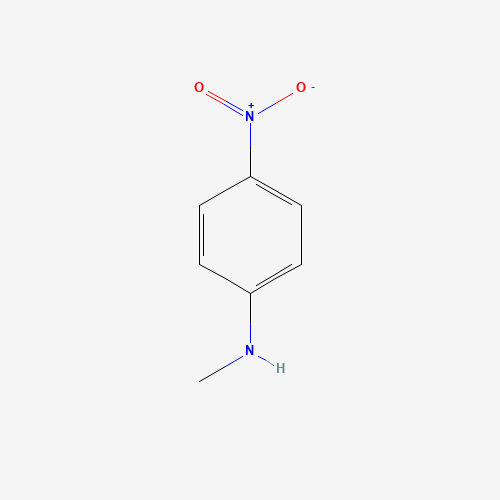
N-methyl-4-nitroaniline

Dangerous Goods

CAS number:100-15-2    molecular formula:C7H8N2O2

overview

compound introduction

物理描述 | N-甲基-4-硝基苯胺为棕色-黄色棱柱体,带有紫色反光(来自乙醇)或黄色粉末。(NTP, 1992)

Specs

Chinese aliasN-甲基-对硝基苯胺 | 甲基(4-硝基苯基)胺 | 4-硝基-N-甲基苯胺 | 4-(甲基氨基)硝基苯
English aliasN-METHYL-4-NITROBENZENAMINE | methyl(4-nitrophenyl)amine | 4-(Methylamino)nitrobenzene | N-(4-Nitrophenyl)-N-methylamine
CAS number100-15-2molecular formulaC7H8N2O2
molecular weight152.15Exact mass≥98%(GC)
PSA57.9logp2

numbering system

CAS100-15-2
UNIIJ836WLV9BW
HMDB IDHMDB0255170
WikidataQ11234217
ChEMBL IDCHEMBL1329734
UN Number1661
NSC NumberNSC Number: NSC5390
PubChem CID7483
Nikkaji NumberJ37.757K
DSSTox Substance IDDTXSID7025635
European Community (EC) Number202-823-2
PubChem Reference Collection SID500807130
MEP ID_25Q1B3S4C

physicochemical properties

XLogP32
Density1.201 at 311 °F (NTP, 1992) - Denser than water; will sink
Complexity136
Exact Mass152.058577502
Solubilityless than 1 mg/mL at 66 °F (NTP, 1992)
Boiling PointDecomposes (NTP, 1992)
Formal Charge0
Melting Point306 °F (NTP, 1992)
Vapor Pressure0.00764 [mmHg]
Chemical ClassesNitrogen Compounds -> Nitroanilines
Heavy Atom Count11
Molecular Weight152.15
Monoisotopic Mass152.058577502
Isotope Atom Count0
Physical DescriptionBrownish-yellow or yellow solid; [CAMEO] Yellow crystalline powder; [Alfa Aesar MSDS]
Rotatable Bond Count1
Dissociation Constantsiupacpka
Kovats Retention IndexStandard non-polar: 1707
Hydrogen Bond Donor Count1
Covalently-Bonded Unit Count1
Hydrogen Bond Acceptor Count3
Topological Polar Surface Area57.9 Ų
Defined Atom Stereocenter Count0
Defined Bond Stereocenter Count0
Undefined Atom Stereocenter Count0
Undefined Bond Stereocenter Count0

Safety information

DOT Label:
Poison
First Aid:
INGESTION: DO NOT INDUCE VOMITING. If the victim is conscious and not convulsing, give 1 or 2 glasses of water to dilute the chemical and IMMEDIATELY call a hospital or poison control center. Be prepared to transport the victim to a hospital if advised by a physician. If the victim is convulsing or unconscious, do not give anything by mouth, ensure that the victim's airway is open and lay the victim on his/her side with the head lower than the body. DO NOT INDUCE VOMITING. IMMEDIATELY transport the victim to a hospital. (NTP, 1992)
Fire Hazards:
Flash point data for this chemical are not available; however, it is probably combustible. (NTP, 1992)
Fire Fighting:
Fires involving this material can be controlled with a dry chemical, carbon dioxide or Halon extinguisher. (NTP, 1992)
Health Hazards:
ACUTE/CHRONIC HAZARDS: When heated to decomposition this chemical emits toxic fumes of nitrogen oxides. (NTP, 1992)
Reactive Group:
Amines, Aromatic
Adverse Effects:
Methemoglobinemia - The presence of increased methemoglobin in the blood; the compound is classified as secondary toxic effect
Hazards Summary:
May cause irritation; [NTP] May cause irritation; May induce methemoglobinemia; Toxic by ingestion, inhalation, and skin absorption; May have cumulative adverse effects to organs; [Alfa Aesar MSDS] See p-Nitroaniline.
Reactivity Profile:
N-METHYL-4-NITROANILINE has a vigorous exothermic reaction with carbaryl sulfate when heated above 167 °F. (NTP, 1992)
Nonfire Spill Response:
STORAGE PRECAUTIONS: You should keep this material in a tightly closed container under an inert atmosphere, and store it at refrigerated temperatures. (NTP, 1992)
Regulatory Information:
REACH Registered Substance: Status: Active Update: 02-05-2018 https://echa.europa.eu/registration-dossier/-/registered-dossier/24168
Air and Water Reactions:
This chemical may be sensitive to prolonged exposure to air. Insoluble in water.
Isolation and Evacuation:
FIRE: If tank, rail tank car or highway tank is involved in a fire, ISOLATE for 800 meters (1/2 mile) in all directions; also, consider initial evacuation for 800 meters (1/2 mile) in all directions. (ERG, 2024)
Hazard Classes and Categories:
Aquatic Chronic 3 (17.9%)
Personal Protective Equipment (PPE):
RECOMMENDED RESPIRATOR: Where the neat test chemical is weighed and diluted, wear a NIOSH-approved half face respirator equipped with an organic vapor/acid gas cartridge (specific for organic vapors, HCl, acid gas and SO2) with a dust/mist filter. (NTP, 1992)

Production methods and uses

purpose
Industry Uses:
Stabilizing agent
General Manufacturing Information:
Industry Processing Sectors: All Other Chemical Product and Preparation Manufacturing

Related

upstream information

No upstream information yet

downstream information

No downstream information yet

MSDS

Found 1 shareMSDS
100-15-2 | N-Methyl-4-nitroaniline.pdf