All
Chemical Reagents
Biomedicine
Organic raw materials
Inorganic chemical industry
intermediate
Agricultural chemicals
Auxiliaries and catalysts
Fragrances and Flavors
Dyes and Pigments
Daily chemical industry

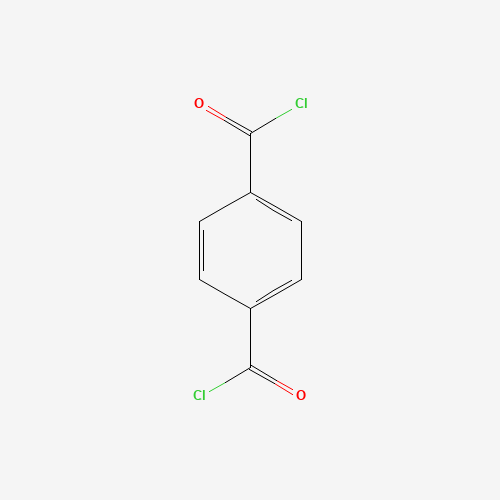
benzene-1,4-dicarbonyl chloride

Dangerous Goods

CAS number:100-20-9    molecular formula:C8H4Cl2O2

overview

compound introduction

交联白蛋白

Specs

Chinese alias1,4-苯二碳酰二氯;对酞酰氯
English aliasTPC | Terephthaloyl chloride, >=99%, flakes | Terephthalic dichloride | Terephthalic acid dichloride | p-Phthalyl dichloride | Terephthaloyl chloride | Q-201791 | DTXCID506653 | HSDB 5332 | Q7702072 | SCHEMBL68148 | CAS-100-20-9 | terephthalic chloride |
CAS number100-20-9molecular formulaC8H4Cl2O2
molecular weight203.02Exact mass≥99%
PSA34.1logp4

numbering system

CAS100-20-9
UNIIG247CO9608
WikidataQ7702072
ChEMBL IDCHEMBL1893301
WikipediaTerephthaloyl_chloride
NSC NumberNSC Number: NSC41885
ICSC Number0331
PubChem CID7488
Deprecated CAS188665-55-6
Nikkaji NumberJ4.979D
DSSTox Substance IDDTXSID7026653
European Community (EC) Number202-829-5
PubChem Reference Collection SID505411653
MEP ID_25Q1B3AQ4

physicochemical properties

LogP0.88 (calculated)
XLogP34
Density1.32 g/cm³
Color/FormCOLORLESS NEEDLES
Complexity173
Exact Mass201.9588348
SolubilitySolubility in water: reaction
Flash Point180 °C
Boiling Point266 °C @760 [mm Hg]
Formal Charge0
Melting Point79.5-84 °C
Vapor PressureVapor pressure, Pa at 20 °C: 320
Chemical ClassesToxic Gases & Vapors -> Acid Halides
Heavy Atom Count12
Molecular Weight203.02
Monoisotopic Mass201.9588348
Isotope Atom Count0
Physical DescriptionWHITE POWDER OR COLOURLESS NEEDLES WITH PUNGENT ODOUR.
Rotatable Bond Count2
Food Contact SubstancesFCS -> FDA Inventory of Effective Food Contact Substance (FCS) Notifications
Hydrogen Bond Donor Count0
Covalently-Bonded Unit Count1
Hydrogen Bond Acceptor Count2
Other Experimental PropertiesDECOMPOSES IN WATER AND ALCOHOL
Topological Polar Surface Area34.1 Ų
Defined Atom Stereocenter Count0
Defined Bond Stereocenter Count0
Undefined Atom Stereocenter Count0
Undefined Bond Stereocenter Count0

Safety information

Fire Hazards:
Combustible. Gives off irritating or toxic fumes (or gases) in a fire. Finely dispersed particles form explosive mixtures in air.
Safe Storage:
Separated from strong oxidants. Dry. Well closed. Do NOT store or transport in containers made from metal.
Fire Fighting:
Use dry sand, powder, carbon dioxide. NO hydrous agents.
Toxicity Data:
LC50 (rat) = 700 mg/m3/4h
Eye Prevention:
Wear safety goggles or eye protection in combination with breathing protection.
Adverse Effects:
Toxic Pneumonitis - Inflammation of the lungs induced by inhalation of metal fumes or toxic gases and vapors.
Exposure Routes:
Serious by all routes of exposure.
Fire Prevention:
NO open flames. Closed system, dust explosion-proof electrical equipment and lighting. Prevent deposition of dust.
Hazards Summary:
A reproductive effector; Causes asphyxiation by upper airway obstruction after lethal-dose inhalation studies of mice; [RTECS] Dust/air mixture may be explosive; Reacts with water producing hydrogen chloride; A corrosive substance that can cause injury to the skin, eyes, and respiratory tract; Inhalation may cause upper airway edema and pulmonary edema; [ICSC] A skin irritant; Reacts with water; A corrosive substance that can cause injury to the skin, eyes, and respiratory tract; A lachrymator; Inhalation may cause chemical pneumonitis; Effects in high-dose animal studies include lacrimation, changes in renal tubules and other changes to the brain; [MSDSonline]
Inhalation Risk:
A harmful concentration of airborne particles can be reached quickly when dispersed.
Skin Prevention:
Protective clothing. Protective gloves.
Physical Dangers:
Dust explosion possible if in powder or granular form, mixed with air.
Spillage Disposal:
Personal protection: chemical protection suit and particulate filter respirator adapted to the airborne concentration of the substance. Sweep spilled substance into covered plastic containers. Carefully collect remainder. Then store and dispose of according to local regulations.
First Aid Measures:
Ingestion First Aid: Rinse mouth. Give one or two glasses of water to drink. Do NOT induce vomiting. Refer for medical attention .
Signs and Symptoms:
Ingestion Exposure: Abdominal pain. Nausea. Vomiting. Diarrhoea. Shock or collapse.
Exposure Prevention:
PREVENT DISPERSION OF DUST!
Ingestion Prevention:
Do not eat, drink, or smoke during work.
Inhalation Prevention:
Use local exhaust or breathing protection.
Regulatory Information:
New Zealand EPA Inventory of Chemical Status: Terephthaloyl dichloride: Does not have an individual approval but may be used under an appropriate group standard
Hazard Classes and Categories:
Specific target organ toxicity - Single exposure - Category 2 (systemic toxicity)
Effects of Short Term Exposure:
The substance is corrosive to the eyes, skin and respiratory tract. Corrosive on ingestion. Exposure could cause asphyxiation due to swelling in the throat. Inhalation may cause lung oedema.
Protective Action Criteria (PAC):
PAC-3: 31 [mg/m3]
Skin, Eye, and Respiratory Irritations:
SKIN IRRITANT.

Production methods and uses

purpose
Uses:
CROSS-LINKING AGENT FOR POLYURETHANES AND POLYSULFIDES
Consumer Uses:
Not Known or Reasonably Ascertainable
Industry Uses:
Monomers
General Manufacturing Information:
Industry Processing Sectors: Plastics Material and Resin Manufacturing

Related

upstream information

No upstream information yet

downstream information

No downstream information yet

MSDS

Found 1 shareMSDS
100-20-9 | p-phthaloyl chloride