All
Chemical Reagents
Biomedicine
Organic raw materials
Inorganic chemical industry
intermediate
Agricultural chemicals
Auxiliaries and catalysts
Fragrances and Flavors
Dyes and Pigments
Daily chemical industry

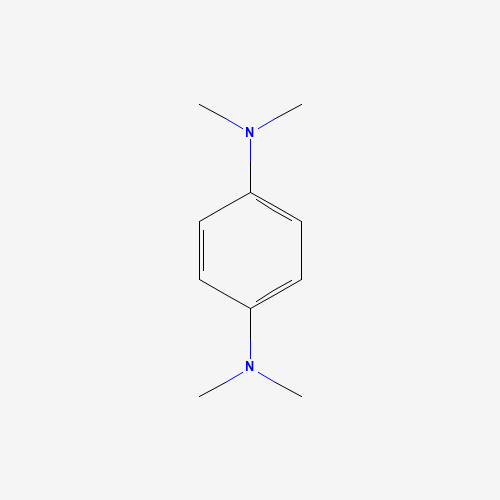
1-N,1-N,4-N,4-N-tetramethylbenzene-1,4-diamine

CAS number:100-22-1    molecular formula:C10H16N2

overview

compound introduction

物理描述 | 鳞片状或暗绿色固体。(NTP, 1992)

Specs

Chinese alias-
English aliasN,N,N',N'-Tetramethyl-p-phenylenediamine
CAS number100-22-1molecular formulaC10H16N2
molecular weight164.25Exact mass-
PSA6.5logp2.6

numbering system

CAS100-22-1
UNIIP4P3AC32ZB
HMDB IDHMDB0244279
WikidataQ408762
ChEMBL IDCHEMBL1393325
PubChem CID7490
Nikkaji NumberJ4.980H
DSSTox Substance IDDTXSID201370133
European Community (EC) Number202-831-6
PubChem Reference Collection SID516572345
MEP ID_25Q1B3AQ6

physicochemical properties

XLogP32.6
Complexity108
Exact Mass164.131348519
Solubilityless than 1 mg/mL at 70 °F (NTP, 1992)
Flash Pointgreater than 235 °F (NTP, 1992)
Boiling Point500 °F at 760 mmHg (NTP, 1992)
Formal Charge0
Melting Point120 to 124 °F (NTP, 1992)
Vapor Pressure0.07 [mmHg]
Chemical ClassesNitrogen Compounds -> Amines, Aromatic
Heavy Atom Count12
Molecular Weight164.25
Monoisotopic Mass164.131348519
Isotope Atom Count0
Physical DescriptionSolid; Drab green solid; [NTP] Grey powder; [Sigma-Aldrich MSDS]
Rotatable Bond Count2
Hydrogen Bond Donor Count0
Covalently-Bonded Unit Count1
Hydrogen Bond Acceptor Count2
Topological Polar Surface Area6.5 Ų
Defined Atom Stereocenter Count0
Defined Bond Stereocenter Count0
Undefined Atom Stereocenter Count0
Undefined Bond Stereocenter Count0

Safety information

First Aid:
INGESTION: DO NOT INDUCE VOMITING. If the victim is conscious and not convulsing, give 1 or 2 glasses of water to dilute the chemical and IMMEDIATELY call a hospital or poison control center. Be prepared to transport the victim to a hospital if advised by a physician. If the victim is convulsing or unconscious, do not give anything by mouth, ensure that the victim's airway is open and lay the victim on his/her side with the head lower than the body. DO NOT INDUCE VOMITING. IMMEDIATELY transport the victim to a hospital. (NTP, 1992)
Fire Hazards:
This chemical is probably combustible. (NTP, 1992)
Fire Fighting:
Fires involving this material can be controlled with a dry chemical, carbon dioxide or Halon extinguisher. (NTP, 1992)
Toxicity Data:
LCLo (mouse) = 780 mg/m3/10min
Health Hazards:
ACUTE/CHRONIC HAZARDS: When heated to decomposition this compound emits toxic fumes. It is an irritant. (NTP, 1992)
Reactive Group:
Amines, Phosphines, and Pyridines
Hazards Summary:
Causes irritability and acute pulmonary edema in inhalation lethal-concentration studies of mice; [RTECS] May cause irritation; Toxic by inhalation; Harmful by ingestion and skin absorption; Targets the kidney; [Sigma-Aldrich MSDS] See N,N-Diethyl-p-phenylenediamine.
Ecotoxicity Values:
USDA APHIS Chemical Effects: collection=usda_chemeffect&query_type=synonym&query='^100-22-1$'
Reactivity Profile:
N,N,N',N'-TETRAMETHYL-P-PHENYLENEDIAMINE can burn in air to give toxic NOx gases (NTP, 1992). Neutralizes acids in exothermic reactions to form salts plus water. May be incompatible with isocyanates, halogenated organics, peroxides, phenols (acidic), epoxides, anhydrides, and acid halides. Flammable gaseous hydrogen may be generated in combination with strong reducing agents, such as hydrides.
Nonfire Spill Response:
STORAGE PRECAUTIONS: You should keep this material in a tightly closed container under an inert atmosphere, and store it at refrigerated temperatures. STORE AWAY FROM SOURCES OF IGNITION. (NTP, 1992)
Regulatory Information:
New Zealand EPA Inventory of Chemical Status: Tetramethyl-p-phenylenediamine: Does not have an individual approval but may be used under an appropriate group standard
Air and Water Reactions:
This compound may be sensitive to air and heat. (NTP, 1992). Insoluble in water.
Hazard Classes and Categories:
Acute Tox. 4 *
Personal Protective Equipment (PPE):
RECOMMENDED RESPIRATOR: Where the neat test chemical is weighed and diluted, wear a NIOSH-approved half face respirator equipped with an organic vapor/acid gas cartridge (specific for organic vapors, HCl, acid gas and SO2) with a dust/mist filter. (NTP, 1992)

Production methods and uses

purpose
Uses:
Sources/Uses: The hydrochloride form is used as a reagent in analytical chemistry; [ChemIDplus]

Related

upstream information

No upstream information yet

downstream information

No downstream information yet

MSDS

Found 0 shareMSDS