All
Chemical Reagents
Biomedicine
Organic raw materials
Inorganic chemical industry
intermediate
Agricultural chemicals
Auxiliaries and catalysts
Fragrances and Flavors
Dyes and Pigments
Daily chemical industry

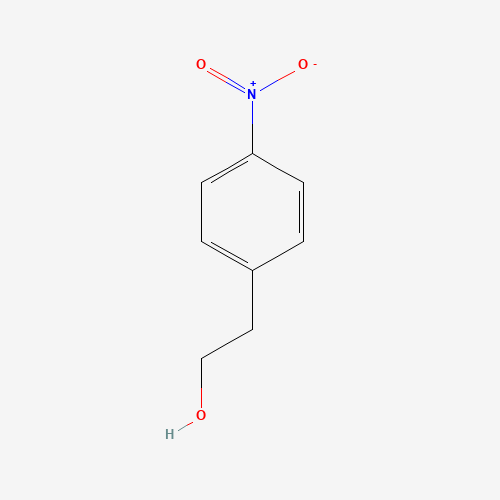
2-(4-nitrophenyl)ethanol

CAS number:100-27-6    molecular formula:C8H9NO3

overview

compound introduction

物理描述 | 对硝基苯乙基醇呈黄色针状(来自含水甲醇)或橙色固体。(NTP, 1992)

Specs

Chinese alias-
English alias2-(4-Nitrophenyl)ethanol; 2-(p-Nitrophenyl)ethanol; p-Nitrophenethyl alcohol
CAS number100-27-6molecular formulaC8H9NO3
molecular weight167.16Exact mass-
PSA66.1logp1.1

numbering system

CAS100-27-6
WikidataQ72494303
ChEMBL IDCHEMBL1485974
NSC NumberNSC Number: NSC55519
PubChem CID7494
Nikkaji NumberJ28.538B
DSSTox Substance IDDTXSID7025764
European Community (EC) Number202-835-8
PubChem Reference Collection SID500743493
MEP ID_26F0RLM81

physicochemical properties

XLogP31.1
Complexity147
Exact Mass167.058243149
Solubilityless than 0.1 mg/mL at 64 °F (NTP, 1992)
Boiling Point351 °F at 16 mmHg (NTP, 1992)
Formal Charge0
Melting Point144 to 147 °F (NTP, 1992)
Heavy Atom Count12
Molecular Weight167.16
Monoisotopic Mass167.058243149
Isotope Atom Count0
Physical DescriptionP-nitrophenethyl alcohol appears as yellow needles (from aqueous methanol) or orange solid. (NTP, 1992)
Rotatable Bond Count2
Hydrogen Bond Donor Count1
Covalently-Bonded Unit Count1
Hydrogen Bond Acceptor Count3
Topological Polar Surface Area66.1 Ų
Defined Atom Stereocenter Count0
Defined Bond Stereocenter Count0
Undefined Atom Stereocenter Count0
Undefined Bond Stereocenter Count0

Safety information

First Aid:
INGESTION: DO NOT INDUCE VOMITING. If the victim is conscious and not convulsing, give 1 or 2 glasses of water to dilute the chemical and IMMEDIATELY call a hospital or poison control center. Be prepared to transport the victim to a hospital if advised by a physician. If the victim is convulsing or unconscious, do not give anything by mouth, ensure that the victim's airway is open and lay the victim on his/her side with the head lower than the body. DO NOT INDUCE VOMITING. IMMEDIATELY transport the victim to a hospital. (NTP, 1992)
Fire Hazards:
Flash point data for this chemical are not available; however, it is probably combustible. (NTP, 1992)
Fire Fighting:
Fires involving this material can be controlled with a dry chemical, carbon dioxide or Halon extinguisher. (NTP, 1992)
Health Hazards:
SYMPTOMS: Structurally similar chemicals may cause methemoglobinemia. (NTP, 1992)
Reactive Group:
Nitro, Nitroso, Nitrate, and Nitrite Compounds, Organic
Reactivity Profile:
A nitrated alcohol. Flammable and/or toxic gases are generated by the combination of alcohols with alkali metals, nitrides, and strong reducing agents. They react with oxoacids and carboxylic acids to form esters plus water. Oxidizing agents convert them to aldehydes or ketones. Alcohols exhibit both weak acid and weak base behavior. They may initiate the polymerization of isocyanates and epoxides.
Nonfire Spill Response:
STORAGE PRECAUTIONS: You should store this material under ambient temperatures. (NTP, 1992)
Regulatory Information:
The Australian Inventory of Industrial Chemicals: Chemical: Benzeneethanol, 4-nitro-
Air and Water Reactions:
Insoluble in water.
Other Safety Information:
Chemical Assessment: Evaluation - Chemicals not considered for in depth evaluation - Not commercially active in Australia
Hazard Classes and Categories:
Eye Irrit. 2A (100%)
Personal Protective Equipment (PPE):
RECOMMENDED RESPIRATOR: Where the neat test chemical is weighed and diluted, wear a NIOSH-approved half face respirator equipped with an organic vapor/acid gas cartridge (specific for organic vapors, HCl, acid gas and SO2) with a dust/mist filter. (NTP, 1992)

Production methods and uses

No production method and use information yet

Related

upstream information

No upstream information yet

downstream information

No downstream information yet

MSDS

Found 1 shareMSDS
100-27-6 | 4-Nitrophenethyl alcohol.pdf