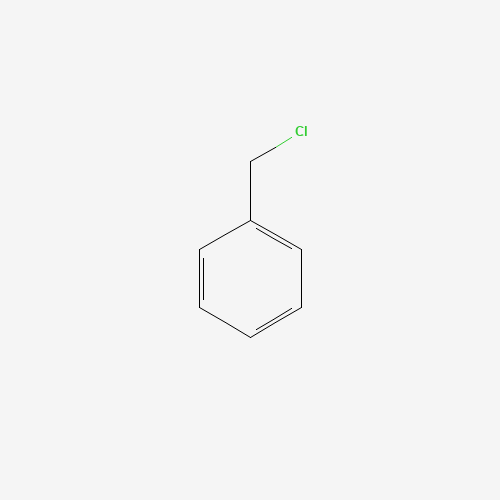
DOT Label:
Poison Corrosive
First Aid:
Swallow: Medical attention immediately - If this chemical has been swallowed, get medical attention immediately.
Fire Hazards:
Combustible. Gives off irritating or toxic fumes (or gases) in a fire. Above 67 °C explosive vapour/air mixtures may be formed.
Safe Storage:
Separated from food and feedstuffs and incompatible materials. See Chemical Dangers. Dry. Ventilation along the floor. Store only if stabilized.
Fire Fighting:
Use powder, AFFF, foam, carbon dioxide. In case of fire: keep drums, etc., cool by spraying with water.
Target Organs:
Eyes, skin, respiratory system, central nervous system
Toxicity Data:
LC50 (rat) = 150 ppm/2H
Eye Prevention:
Wear safety goggles or eye protection in combination with breathing protection.
Fire Potential:
Flammable and moderately explosive when exposed to heat or flame.
Health Hazards:
ERG2024, Guide 156 (Benzyl chloride): · Runoff from fire control or dilution water may be corrosive and/or toxic and cause environmental contamination.
OSHA Standards:
Permissible Exposure Limit: Table Z-1 8-hr Time Weighted Avg: 1 ppm (5 mg/cu m).
Reactive Group:
Halogenated Organic Compounds
Adverse Effects:
ACGIH Carcinogen - Confirmed Animal.
Exposure Routes:
inhalation, ingestion, skin and/or eye contact
Fire Prevention:
NO open flames. Above 67 °C use a closed system and ventilation.
Hazards Summary:
The major hazards encountered in the use and handling of benzyl chloride stem from both its toxicologic and chemical/physical properties. Toxic by all routes (ie, oral, dermal, inhalation), exposure to benzyl chloride may occur occupationally at sites where the substance is used as a chemical intermediate in the synthesis of a wide range of commercial products (eg, dyes, perfumes, resins, plasticizers, and pesticides), or environmentally, from industrial sources, incinerators, and certain floor tiles. This colorless to slightly yellow liquid is an severe irritant to skin, eyes, and mucous membranes. Lung damage, pulmonary edema, permanent eye damage, and CNS depression are all possible. While the OSHA permissible exposure level for benzyl chloride is set at 5 mg/cu m (1 ppm), as an 8-ho...
Inhalation Risk:
A harmful contamination of the air can be reached rather quickly on evaporation of this substance at 20 °C, on spraying much faster.
Skin Prevention:
Protective gloves. Protective clothing.
Special Reports:
Lijinsky W et al; J Nat'l Cancer Inst 76 (6): 1231-5 (1986). Route: oral, gavage; Species: rats and mice.
DOT ID and Guide:
1738 156
Disposal Methods:
A good candidate for liquid injection incineration at a temperature range of 650 to 1,600 °C and a residence time of 0.1 to 2 seconds. A good candidate for rotary kiln incineration at a temperature range of 820 to 1,600 °C and residence times of seconds for liquids and gases, and hours for solids.
Flammable Limits:
Flammability: Class IIIA Combustible Liquid: Fl.P. at or above 140 °F and below 200 °F.
Toxicity Summary:
Toxic by all routes (ie, oral, dermal, inhalation), exposure to benzyl chloride may occur occupationally at sites where the substance is used as a chemical intermediate in the synthesis of a wide range of commercial products (eg, dyes, perfumes, resins, plasticizers, and pesticides), or environmentally, from air contaminated by industrial sources, incinerators, and certain floor tiles. This colorless to slightly yellow liquid is an extreme irritant to skin, eyes, and mucous membranes. Symptomatology may include severe irritation of the upper respiratory tract (with coughing), conjuctivitis, dizziness, weakness, headache, tremors in eyelids and fingers, increased bilirubin in blood, and decrease in number of leukocytes. Lung damage, pulmonary edema, permanent eye damage, and CNS depressi...
EC Classification:
Symbol: T; R: 45-22-23-37/38-41-48/22; S: 53-45; Note: E
RCRA Requirements:
P028; As stipulated in 40 CFR 261.33, when benzyl chloride, as a commercial chemical product or manufacturing chemical intermediate or an off-specification commercial chemical product or a manufacturing chemical intermediate, becomes a waste, it must be managed according to federal and/or state hazardous waste regulations. Also defined as a hazardous waste is any container or inner liner used to hold this waste or any residue, contaminated soil, water, or other debris resulting from the cleanup of a spill, into water or on dry land, of this waste. Generators of small quantities of this waste may qualify for partial exclusion from hazardous waste regulations (40 CFR 261.5(e)).
Spillage Disposal:
Personal protection: chemical protection suit including self-contained breathing apparatus. Do NOT let this chemical enter the environment. Collect leaking and spilled liquid in covered non-metallic containers as far as possible. Absorb remaining liquid in sand or inert absorbent. Then store and dispose of according to local regulations.
UN Classification:
UN Hazard Class: 6.1; UN Subsidiary Risks: 8; UN Pack Group: II
Environmental Fate:
ATMOSPHERIC FATE: According to a model of gas/particle partitioning of semivolatile organic compounds in the atmosphere(1), benzyl chloride, which has a vapor pressure of 1.23 mm Hg at 25 °C(2), is expected to exist solely as a vapor in the ambient atmosphere. Vapor-phase benzyl chloride is degraded in the atmosphere by reaction with photochemically-produced hydroxyl radicals(SRC); the half-life for this reaction in air is estimated to be 7 days(SRC), calculated from its rate constant of 2.90X10⁻¹² cu cm/molecule-sec at 25 °C(3). Benzyl chloride does not contain chromophores that absorb at wavelengths >290 nm(4) and, therefore, is not expected to be susceptible to direct photolysis by sunlight(SRC).
First Aid Measures:
Ingestion First Aid: Rinse mouth. Refer for medical attention .
Reactivity Profile:
Halogenated aliphatic compounds, such as BENZYL CHLORIDE, are moderately or very reactive. Halogenated organics generally become less reactive as more of their hydrogen atoms are replaced with halogen atoms. Materials in this group are incompatible with strong oxidizing and reducing agents. Also, they are incompatible with many amines, nitrides, azo/diazo compounds, alkali metals, and epoxides.
Signs and Symptoms:
irritation eyes, skin, nose; lassitude (weakness, exhaustion); irritability; headache; skin eruption; pulmonary edema
Storage Conditions:
Should be closed in tightly closed containers in a cool, well-ventilated area away from sunlight, heat, moisture, active metals, oxidizers. Metal containers involving the transfer of this chemical should be grounded and bonded. ... Drums must be equipped with self-closing valves, pressure vacuum bungs; and flame arresters. Use only non-sparking tools and equipment, especially when opening and closing containers of this chemical. Sources of ignition, such as smoking and open flames, are prohibited where this chemical is used, handled or stored in a manner that could create a potential fire or explosion hazard.
Exposure Prevention:
AVOID ALL CONTACT! AVOID EXPOSURE OF (PREGNANT) WOMEN!
EPA IRIS Information:
Cancer Sites: Endocrine
Ecotoxicity Excerpts:
/AQUATIC SPECIES/ Benzyl chloride produced differential cytotoxicity for a mutant of Saccharomyces cerevisiae, the extent of which was dependent on the presence of genes regulating DNA repair
Ingestion Prevention:
Do not eat, drink, or smoke during work. Wash hands before eating.
RAIS Toxicity Values:
Oral Slope Factor Reference: IRIS Current
Inhalation Prevention:
Use ventilation, local exhaust or breathing protection.
NIOSH Recommendations:
Recommended Exposure Limit: 15 Minute Ceiling value: 1 ppm (5 mg/cu m).
Nonfire Spill Response:
SMALL SPILL: Cover with DRY earth, DRY sand or other non-combustible material followed with plastic sheet to minimize spreading or contact with rain. Use clean, non-sparking tools to collect material and place it into loosely covered plastic containers for later disposal. (ERG, 2024)
Air and Water Reactions:
A lachrymator. Slightly soluble in water.
Effluent Concentrations:
Benzyl chloride has been detected in various unidentified industrial effluents(1). In the USA, benzyl chloride is emitted to the atmosphere from its commercial production and use at an estimated rate of 45,000 lbs/year with the emissions originating from scrubber vents, vacuum jets, storage and fugitive emissions, and equipment leaks(2). Stack emissions from waste incineration have been found to contain benzyl chloride(3). Emissions of benzyl chloride from floor tile manufactured with butyl benzyl phthalate have been reported(4).
ICSC Environmental Data:
The substance is toxic to aquatic organisms.
Packaging and Labelling:
Do not transport with food and feedstuffs.
Fire Fighting Procedures:
Inhaltion - /Provide/ fresh air, rest. /Keep person in/ half-upright position. Skin /exposure/ - remove contaminated clothes. Rinse skin with plenty of water or shower. Eyes /exposure/ - First rinse with plenty of water for several minutes (remove contact lenses if easily possible). Ingestion - rinse mouth.
Isolation and Evacuation:
Evacuation: ERG2024, Guide 156 (Benzyl chloride): · If tank, rail tank car or highway tank is involved in a fire, ISOLATE for 800 meters (1/2 mile) in all directions; also, consider initial evacuation for 800 meters (1/2 mile) in all directions.
Other Safety Information:
Chemical Assessment: IMAP assessments - Benzene, (chloromethyl)-: Human health tier II assessment
Soil Adsorption/Mobility:
The Koc of benzyl chloride is estimated as 100(SRC), using a log Kow of 2.30(1) and a regression-derived equation(2). According to a classification scheme(3), this estimated Koc value suggests that benzyl chloride is expected to have high mobility in soil.
DOT Hazard Classification:
Placard/Label(s)
Atmospheric Concentrations:
INDOOR: The ambient indoor air of various residential homes in North Carolina was found to contain mean benzyl chloride levels of 6.23 ppb during winter-time monitoring while the outdoor air contained no detectable levels(1).
EPA Hazardous Waste Number:
P028; An acute hazardous waste when a discarded commercial chemical product or manufacturing chemical intermediate or an off-specification commercial chemical product or a manufacturing chemical intermediate.
NFPA Hazard Classification:
NFPA Instability Rating: 1 - Materials that in themselves are normally stable but that can become unstable at elevated temperatures and pressures.
Respirator Recommendations:
Important additional information about respirator selection
Accidental Release Measures:
Spill or Leak: ERG2024, Guide 156 (Benzyl chloride): · Use clean, non-sparking tools to collect material and place it into loosely covered plastic containers for later disposal.
Lower Explosive Limit (LEL):
1.1%
Populations at Special Risk:
Those individuals with preexisting eye, skin, allergic, liver or kidney disease or preexisting respiratory conditions including underlying cardiopulmonary disease may be more sensitive to the effects of benzyl chloride exposure. Persons exposed to other irritants might /also/ be more sensitive.
Artificial Pollution Sources:
Benzyl chloride's production and use in the manufacture of benzyl compounds, perfumes, pharmaceutical products, dyes, synthetic tannins, and artificial resins(1) as well as in the manufacture of photographic developer, penicillin precursors, gasoline gum inhibitors, quarternary compounds, and intermediates(2) may result in its release to the environment through various waste streams(SRC).
Environmental Biodegradation:
AEROBIC: Benzyl chloride, present at 100 mg/L, reached 70.9% of its theoretical BOD in 2 weeks using an activated sludge inoculum at 30 mg/L in the Japanese MITI test(1). Benzyl chloride biodegraded readily with the formation of dechlorinated products during a 2-day incubation period using raw sewage and raw sewage acclimated to non-chlorinated compounds(2). However, since benzyl chloride is subject to hydrolysis(3-5), it is probably the biodegradation of benzyl alcohol that is measured in these studies(SRC).
Evidence for Carcinogenicity:
A3; Confirmed animal carcinogen with unknown relevance to humans.
Sediment/Soil Concentrations:
Benzyl chloride has been detected, not quantified in the soil-sediment-water matrix of the Love Canal near Niagara, NY(1).
Threshold Limit Values (TLV):
TLV-TWA (Time Weighted Average): 1 ppm [1990]
Effects of Long Term Exposure:
The substance may have effects on the liver and kidneys. This may result in tissue lesions. This substance is possibly carcinogenic to humans. Animal tests show that this substance possibly causes toxicity to human reproduction or development.
Hazard Classes and Categories:
Eye Dam. 1
Effects of Short Term Exposure:
The substance is corrosive to the eyes. The vapour is irritating to the eyes, skin and respiratory tract. Inhalation of the vapour or aerosol may cause lung oedema. The substance may cause effects on the central nervous system. This may result in unconsciousness.
Environmental Bioconcentration:
An estimated BCF of 20 was calculated in fish for benzyl chloride(SRC), using a log Kow of 2.30(1) and a regression-derived equation(2). According to a classification scheme(3), this BCF suggests the potential for bioconcentration in aquatic organisms is low(SRC).
Explosive Limits and Potential:
Explosive limits, vol% in air: 1.1-14.0
Standard Transportation Number:
49 360 12; Benzyl chloride
Volatilization from Water/Soil:
The Henry's Law constant for benzyl chloride is estimated as 4.1X10⁻⁴ atm-cu m/mole(SRC) derived from its vapor pressure, 1.23 mm Hg(1), and water solubility, 525 mg/L(2). This Henry's Law constant indicates that benzyl chloride is expected to volatilize rapidly from water surfaces(3). Based on this Henry's Law constant, the volatilization half-life from a model river (1 m deep, flowing 1 m/sec, wind velocity of 3 m/sec)(3) is estimated as 6 hours(SRC). The volatilization half-life from a model lake (1 m deep, flowing 0.05 m/sec, wind velocity of 0.5 m/sec)(3) is estimated as 5 days(SRC). The potential for volatilization of benzyl chloride from dry soil surfaces may exist(SRC) based upon its vapor pressure(1).
State Drinking Water Guidelines:
(FL) FLORIDA 0.5 ug/l
Antidote and Emergency Treatment:
Advanced treatment: Consider orotracheal or nasotracheal intubation for airway control in the patient who is unconscious, has severe pulmonary edema, or is in severe respiratory distress. Consider drug therapy for pulmonary edema ... . Positive-pressure ventilation techniques with a bag valve mask device may be beneficial. Consider drug therapy for pulmonary edema ... . Consider administering a beta agonist such as albuterol for severe bronchospasm ... . Monitor cardiac rhythm and treat arrhythmias if necessary ... Start IV administration of D5W /SRP: "To keep open", minimal flow rate/. Use 0.9% saline (NS) or lactated Ringer's (LR) if signs of hypovolemia are present. For hypotension with signs of hypovolemia, administer fluid cautiously. Watch for signs of fluid overload ... .Treat se...
Permissible Exposure Limit (PEL):
TWA 1 ppm (5 mg/m3)
Protective Action Criteria (PAC):
PAC-3: 50 [ppm]
Recommended Exposure Limit (REL):
C 1 ppm (5 mg/m3) [15-minute]
Shipment Methods and Regulations:
The International Maritime Dangerous Goods Code lays down basic principles for transporting hazardous chemicals. Detailed recommendations for individual substances and a number of recommendations for good practice are included in the classes dealing with such substances. A general index of technical names has also been compiled. This index should always be consulted when attempting to locate the appropriate procedures to be used when shipping any substance or article.
Critical Temperature and Pressure:
772 °F = 411 °C = 684 K (estimated); 567 psia = 38.5 atm = 3.91 mN/sq m (estimated)
Environmental Abiotic Degradation:
The rate constant for the vapor-phase reaction of benzyl chloride with photochemically-produced hydroxyl radicals is 2.90X10⁻¹² cu cm/molecule-sec at 25 °C(SRC) using a structure estimation method(1). This corresponds to an atmospheric half-life of about 7 days at an atmospheric concentration of 5X10+5 hydroxyl radicals per cu cm(2). The aqueous hydrolysis rate constant for benzyl chloride has been found to range from 0.042X10⁻⁵ sec-1 at 0.1 °C to 1.38X10⁻⁵ sec-1 at 25 °C(3-7) which corresponds to half-lives of 0.58 to 19.1 days, respectively(SRC). The rate of aqueous hydrolysis has been found to be independent of pH up to pH 13.0(6). The aqueous hydrolysis products of benzyl chloride are benzyl alcohol and hydrogen chloride(5,6). Benzyl chloride does not contain chromophores that absor...
Probable Routes of Human Exposure:
Occupations involving potential exposure to benzyl chloride: algicide makers, benzyl alcohol and chloride workers, benzyl ester makers, butyl benzyl phthalate workers, drug makers, dye-int makers, dye makers, dyers, disinfectant makers, extreme-pressure-lubricant makers and users, analytical chemists, petrol additive workers, germicide makers, motor fuel blenders, perfume makers, pharmaceutical workers, photographic-developer makers, quaternary-ammonium-compd workers, resin makers, rubber makers, tannin makers, wetting-agent makers, synthetic organic chemists. /from table/
Environmental Water Concentrations:
SURFACE WATER: Benzyl chloride was detected, not quantified in one of 17 samples collected from the Delaware River in October 1976(1).
Occupational Exposure Limits (OEL):
MAK (Maximale Arbeitsplatz Konzentration): skin absorption (H); carcinogen category: 2
Environmental Fate/Exposure Summary:
Benzyl chloride's production and use in the manufacture of benzyl compounds, perfumes, pharmaceutical products, dyes, synthetic tannins, and artificial resins as well as in the manufacture of photographic developer, penicillin precursors, gasoline gum inhibitors, quarternary compounds, and intermediates may result in its release to the environment through various waste streams. If released to air, a vapor pressure of 1.23 mm Hg at 25 °C indicates benzyl chloride will exist solely as a vapor in the atmosphere. Vapor-phase benzyl chloride will be degraded in the atmosphere by reaction with photochemically-produced hydroxyl radicals; the half-life for this reaction in air is estimated to be 7 days. Benzyl chloride does not contain chromophores that absorb at wavelengths >290 nm and, theref...
Shipping Name/ Number DOT/UN/NA/IMO:
IMO 6.1; Benzyl chloride
Emergency Response Planning Guidelines:
ERPG-3: 50 ppm - one hour exposure limit: 3 = life threatening health effects [AIHA]
Skin, Eye, and Respiratory Irritations:
Vapors irritate skin ... .
Exposure Control and Personal Protection:
RD50 (Exposure concentration producing a 50% respiratory rate decrease): 17.0 [ppm]
Other Standards Regulations and Guidelines:
Emergency Response Planning Guidelines (ERPG): ERPG(1) 1 ppm (no more than mild, transient effects) for up to 1 hr exposure. Odor should be detectable near ERPG-1.; ERPG(2) 10 ppm (without serious, adverse effects) for up to 1 hr exposure; ERPG(3) 50 ppm (not life threatening) up to 1 hr exposure.
EPA Provisional Peer-Reviewed Toxicity Values:
Weight-Of-Evidence (WOE): See the IRIS entry for Benzyl Chloride
Immediately Dangerous to Life or Health (IDLH):
See: 100447
Hazard Quotient Level 3 or Cancer Risk Level 1E-04:
Soil Saturation Concentration (mg/kg): 1.46e+03
Hazard Quotient Level 0.1 or Cancer Risk Level 1E-06:
Soil Saturation Concentration (mg/kg): 1.46e+03