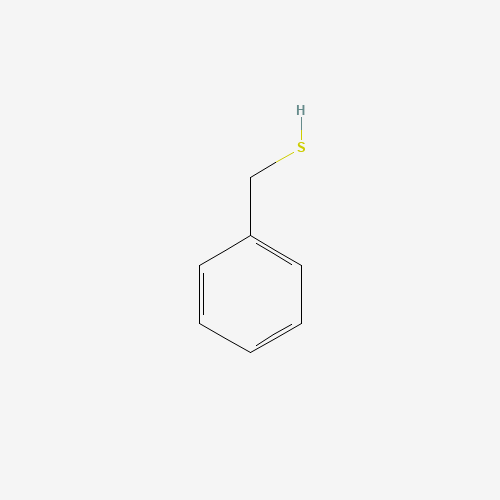
Toxicity Data:
LC50 (rat) > 235 ppm/4h
Fire Potential:
Flammable when exposed to heat or flame.
Adverse Effects:
Lacrimator (Lachrymator) - A substance that irritates the eyes and induces the flow of tears.
Hazards Summary:
A lachrymator; A skin, eye, and respiratory tract irritant; Inhalation of high concentrations can cause mild CNS depression; [CHEMINFO] Causes weakness, ataxia, and cyanosis in lethal inhalation studies of mice; [RTECS] Safe when used as a flavoring agent in food; [JECFA] An irritant; May have CNS effects; [MSDSonline] See Thiols.
Special Reports:
EPA/Office of Pollution Prevention and Toxics; High Production Volume (HPV) Challenge Program's Robust Summaries and Test Plans. Available from: http://www.epa.gov/chemrtk/viewsrch.htm on Benzenemethanethiol (100-53-8) as of June 2, 2005.
Disposal Methods:
SRP: The most favorable course of action is to use an alternative chemical product with less inherent propensity for occupational exposure or environmental contamination. Recycle any unused portion of the material for its approved use or return it to the manufacturer or supplier. Ultimate disposal of the chemical must consider: the material's impact on air quality; potential migration in soil or water; effects on animal, aquatic, and plant life; and conformance with environmental and public health regulations.
FDA Requirements:
Benzyl mercaptan is a food additive permitted for direct addition to food for human consumption as a synthetic flavoring substance and adjuvant in accordance with the following conditions: a) they are used in the minimum quantity required to produce their intended effect, and otherwise in accordance with all the principles of good manufacturing practice, and 2) they consist of one or more of the following, used alone or in combination with flavoring substances and adjuvants generally recognized as safe in food, prior-sanctioned for such use, or regulated by an appropriate section in this part.
Ecotoxicity Values:
EC50 Daphnia magna straus (Waterflea, age <24 hr; immobilization) 0.15 mg/L/48 hr; static, temperature 19.5-20.5 °C, dissolved oxygen >2 mg/L, pH 7.97-8.17 /99.45% pure Benzyl mercaptan/
Environmental Fate:
ATMOSPHERIC FATE: According to a model of gas/particle partitioning of semivolatile organic compounds in the atmosphere(1), benzyl mercaptan, which has an estimated vapor pressure of 0.47 mm Hg at 25 °C(SRC), determined from a fragment constant method(2), is expected to exist solely as a vapor in the ambient atmosphere. Vapor-phase benzyl mercaptan is degraded in the atmosphere by reaction with photochemically-produced hydroxyl radicals(SRC); the half-life for this reaction in air is estimated to be 9 hours(SRC), calculated from its rate constant of 4.5X10⁻¹¹ cu cm/molecule-sec at 25 °C(SRC) that was derived using a structure estimation method(3). Benzyl mercaptan does contain chromophores that absorb at wavelengths >290 nm and therefore is expected to be susceptible to direct photolysi...
Storage Conditions:
In general, materials which are toxic as stored or which can decompose into toxic components ... should be stored in a cool, well-ventilated place, out of direct rays of the sun, away from areas of high fire hazard, and should be periodically inspected... Incompatible materials should be isolated from each other.
Preventive Measures:
SRP: Local exhaust ventilation should be applied wherever there is an incidence of point source emissions or dispersion of regulated contaminants in the work area. Ventilation control of the contaminant as close to its point of generation is both the most economical and safest method to minimize personnel exposure to airborne contaminants.
Regulatory Information:
New Zealand EPA Inventory of Chemical Status: Benzyl mercaptan: Does not have an individual approval but may be used under an appropriate group standard
Human Toxicity Excerpts:
/SIGNS AND SYMPTOMS/ Can cause mild irritation to mucous membranes.
Fire Fighting Procedures:
To fight fire use foam, carbon dioxide, dry chemical.
Soil Adsorption/Mobility:
Using a structure estimation method based on molecular connectivity indices(1), the Koc of benzyl mercaptan can be estimated to be 520(SRC). According to a classification scheme(2), this estimated Koc value suggests that benzyl mercaptan is expected to have low mobility in soil.
Natural Pollution Sources:
...BENZYL MERCAPTAN, WHICH ORIGINATES FROM A WEED (LAND CRESS), SOMETIMES PRESENT IN GRASSLAND.
Non-Human Toxicity Values:
LC50 Rat inhalation >235 ppm/4 hr
NFPA Hazard Classification:
NFPA Instability Rating: 0 - Materials that in themselves are normally stable, even under fire conditions.
Artificial Pollution Sources:
Benzyl mercaptan's production and use as an odorant and in flavors(1) and chemical intermediate in the product of pesticides(2) may result in its release to the environment through various waste streams(SRC).
Hazard Classes and Categories:
Hazardous to the aquatic environment (Long-term) - Category 1
Environmental Bioconcentration:
An estimated BCF of 16 was calculated for benzyl mercaptan(SRC), using an estimated log Kow of 2.48(1) and a regression-derived equation(2). According to a classification scheme(3), this BCF suggests the potential for bioconcentration in aquatic organisms is low(SRC).
Volatilization from Water/Soil:
The Henry's Law constant for benzyl mercaptan is estimated as 2.1X10⁻⁴ atm-cu m/mole(SRC) using a fragment constant estimation method(1). This Henry's Law constant indicates that benzyl mercaptan is expected to volatilize from water surfaces(2). Based on this Henry's Law constant, the volatilization half-life from a model river (1 m deep, flowing 1 m/sec, wind velocity of 3 m/sec)(2) is estimated as 8 hours(SRC). The volatilization half-life from a model lake (1 m deep, flowing 0.05 m/sec, wind velocity of 0.5 m/sec)(2) is estimated as 6 days(SRC). Benzyl mercaptan is not expected to volatilize from dry soil surfaces(SRC) based upon an estimated vapor pressure of 0.47 mm Hg(SRC), determined from a fragment constant method(3).
Antidote and Emergency Treatment:
/SRP:/ Advanced treatment: Consider orotracheal or nasotracheal intubation for airway control in the patient who is unconscious. Early intubation at the first sign of upper airway obstruction may be necessary. Monitor cardiac rhythm and treat arrhythmias if necessary ... . Start an IV with D5W /SRP: "To keep open", minimal flow rate/. Use lactated Ringer's if signs of hypovolemia are present. Watch for signs of fluid overload. Consider drug therapy for pulmonary edema ... . Treat seizures with diazepam ... . For hypotension with signs of hypovolemia, administer fluid cautiously. Consider vasopressors for hypotension with a normal fluid volume. Watch for signs of fluid overload ... . Use proparacaine hydrochloride to assist eye irrigation ... . /Sulfur and related compounds/
Environmental Abiotic Degradation:
The rate constant for the vapor-phase reaction of benzyl mercaptan with photochemically-produced hydroxyl radicals has been estimated as 4.5X10⁻¹¹ cu cm/molecule-sec at 25 °C(SRC) using a structure estimation method(1). This corresponds to an atmospheric half-life of about 9 hours at an atmospheric concentration of 5X10+5 hydroxyl radicals per cu cm(1). Benzyl mercaptan is not expected to undergo hydrolysis in the environment due to the lack of hydrolyzable functional groups(2). Benzyl mercaptan does contain chromophores that absorb at wavelengths >290 nm and therefore is expected to be susceptible to direct photolysis by sunlight(SRC).
Probable Routes of Human Exposure:
Occupational exposure to benzyl mercaptan may occur through inhalation and dermal contact with this compound at workplaces where benzyl mercaptan is produced or used. Use data indicate that the general population may be exposed to benzyl mercaptan ingestion of food products containing benzyl mercaptan as a flavoring. (SRC)
Environmental Fate/Exposure Summary:
Benzyl mercaptan's production and use as an odorant and in flavors and chemical intermediate in the product of pesticide may result in its release to the environment through various waste streams. It occurs in coffee. If released to air, an estimated vapor pressure of 0.47 mm Hg at 25 °C indicates benzyl mercaptan will exist solely as a vapor in the ambient atmosphere. Vapor-phase benzyl mercaptan will be degraded in the atmosphere by reaction with photochemically-produced hydroxyl radicals; the half-life for this reaction in air is estimated to be 9 hours. Benzyl mercaptan does contain chromophores that absorb at wavelengths >290 nm and therefore is expected to be susceptible to direct photolysis by sunlight. If released to soil, benzyl mercaptan is expected to have low mobility based...
Hazardous Reactivities and Incompatibilities:
Oxidizes in air to dibenzyl disulfide.